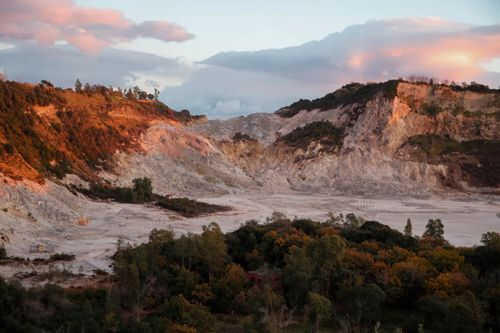

Can a volcano rise from the dead? Uturuncu, a lofty peak in the Central Andes mountain range, is what’s known as a “zombie volcano”.
Though it hasn’t erupted for over 250,000 years, it still exhibits activities often associated with active volcanoes, including gas plumes and seismic activities.
More than 20 years ago, satellite radar captured images of Uturuncu, the tallest peak in southwestern Bolivia, which revealed that internal forces of the volcano had caused an uplift and subsidence in an area around 150 kilometers wide near the summit, forming a shape reminiscent of a sombrero.
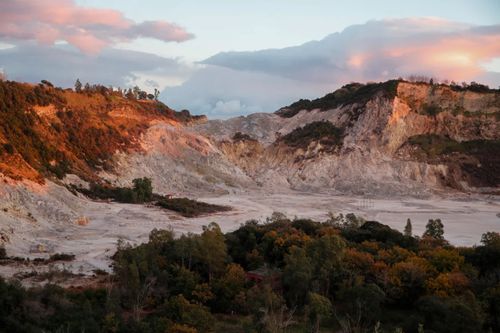
Scientists have recently examined Uturuncu more closely to determine if its continuous deformation and other signs indicate that the dormant volcano might be reawakening.
By combining satellite data with analysis of seismic activity and computer models of how rocks respond to different pressures, researchers pieced together a clearer picture of Uturuncu’s inner “anatomy” and uncovered the cause of its unrest.
They reported their findings April 28 in the journal Proceedings of the National Academy of Sciences.
Volcanic eruptions typically occur when magma below a volcano surges into subsurface pockets called magma chambers, then escapes to the surface through vents and fissures.
Eruptions are more explosive when magma is thicker, trapping gases so that pressure builds up and then suddenly releases, forcefully expelling magma as lava.
But that wasn’t the case under Uturuncu, according to the study.
Rather, magma, gases and briny fluids were interacting in a hydrothermal network â a system with activities that were not fully understood â to produce the volcano’s zombie rumblings.
Death toll in Iran rises to 70 as satellite images reveal devastation
Beneath Uturuncu at a depth of about 10 to 20 kilometres lies a vast reservoir of magma called the Altiplano-Puna Magma Body.
Spanning roughly 200 kilometres, it is the biggest known active magma body in the planet’s crust.
Prior studies hinted at an active hydrothermal system linking the magma reservoir and the mountain range above, but it was unknown how magma and fluids were interacting within this network.
Using signals from more than 1700 seismic events between 2009 and 2012, scientists produced high-resolution images of the shallow crust under Uturuncu.
They also recorded electrical and gravitational shifts underground, and changes in rock chemistry, revealing never-before-seen details of the channel system beneath and within the volcano as it circulated geothermally heated fluid.
The researchers found that as the magma body heated subterranean liquid and released gases, the gas and liquid migrated upward and collected in chambers below the volcanic crater.
Teenager makes staggering call after surviving airship disaster
Their movement through Uturuncu triggered quakes, released steam and deformed the volcano’s rock, causing surface rise of about one centimetre per year.
Uturuncu’s internal dynamics not only explain its activity but also suggest that this zombie won’t be reviving any time soon, said study coauthor Dr Mike Kendall, a professor and head of the department of earth sciences at the University of Oxford.
“We’re not seeing seismicity increasingly rising. A bad sign would be an increase in seismicity, and then seismicity that’s starting to migrate from great depth to much shallower depths â that’s usually an indication that magma is on the move,” Kendall told CNN.
“We’re not seeing anything like that,” he said.
“It looks like it’s just the volcano degassing, letting off steam and calming down, if anything.”
Using multiple techniques was a key part of bringing Uturuncu’s subsurface structure into focus, according to geologist Dr Benjamin Andrews, director of the Global Volcanism Program at the Smithsonian Institution’s National Museum of Natural History in Washington, DC.
In isolation, the methods investigating seismic activity, rock chemistry and physics “would give interesting but somewhat ambiguous results,” said Andrews, who was not involved in the study.
Together, these methods point to a hydrothermal system rather than surging magma as the cause of Uturuncu’s activity, and provide a snapshot of the interplay between magma, rock and fluid under volcanoes.
“This (research) has importance for understanding volcanoes, granitic rocks, ore bodies, and the formation of (the) continental crust,” Andrews said in an email.
It is also important to recognise that some volcanoes can be quite active “but not necessarily be primed for eruption”.
Over decades, the Global Volcanism Program has recorded about 50 zombie volcanoes older than about 12,000 years but younger than 2.6 million years.
Their signs of activity are “mostly geothermal features like hot springs and fumaroles (openings where hot gases escape),” said study coauthor Dr Matthew Pritchard, a professor of geophysics at Cornell University in New York.
As Uturuncu is one of many dozens of zombie volcanoes that scientists are tracking worldwide, the new findings could help identify which zombies are at risk of erupting. Some zombies show elevated surface temperatures and are already being explored as potential sources of geothermal energy, as well as for their mineral deposits, “but many are ripe for further investigations,” Pritchard told CNN in an email.
“Some might be in a long, slow decline, just cooling off from previous hotter times. Others might eventually have some increase in activity,” he said.
“But we don’t yet know how to tell them apart.”
Peering at a volcano’s internal plumbing could reveal possible targets for harnessing geothermal energy and accessing metals that are essential for technologies, such as copper, nickel and platinum, Kendall added.
And this combination of methods could be useful for analyzing any type of volcano â not just zombies.
“It’s a really good way of better understanding the anatomy of a volcano, at what stage of development it is in,” he said.
“That’s very important for risk and hazard assessment.”


