
Deep in the Guatemalan jungle lies the remains of an ancient city forgotten about for nearly 3,000 years, experts reveal.
Covering an area of six square miles (16 sq km), the city, dubbed ‘Los Abuelos’, may date as far back as 800 BC.
Experts at the Guatemalan Ministry of Culture say it was inhabited by the Maya, the ancient civilization of indigenous people in Central America.
The presence of pyramids and monuments suggest it was an important Mayan ceremonial site where brutal human sacrifices may have taken place.
The ministry noted that ‘the site showcases extraordinary architectural design,’ with pyramids and monuments ‘carved with distinctive regional iconography.’
Starting around 2600 BC, the Maya civilization thrived across Central and South America for approximately 3,000 years, peaking between AD 250 and 900.
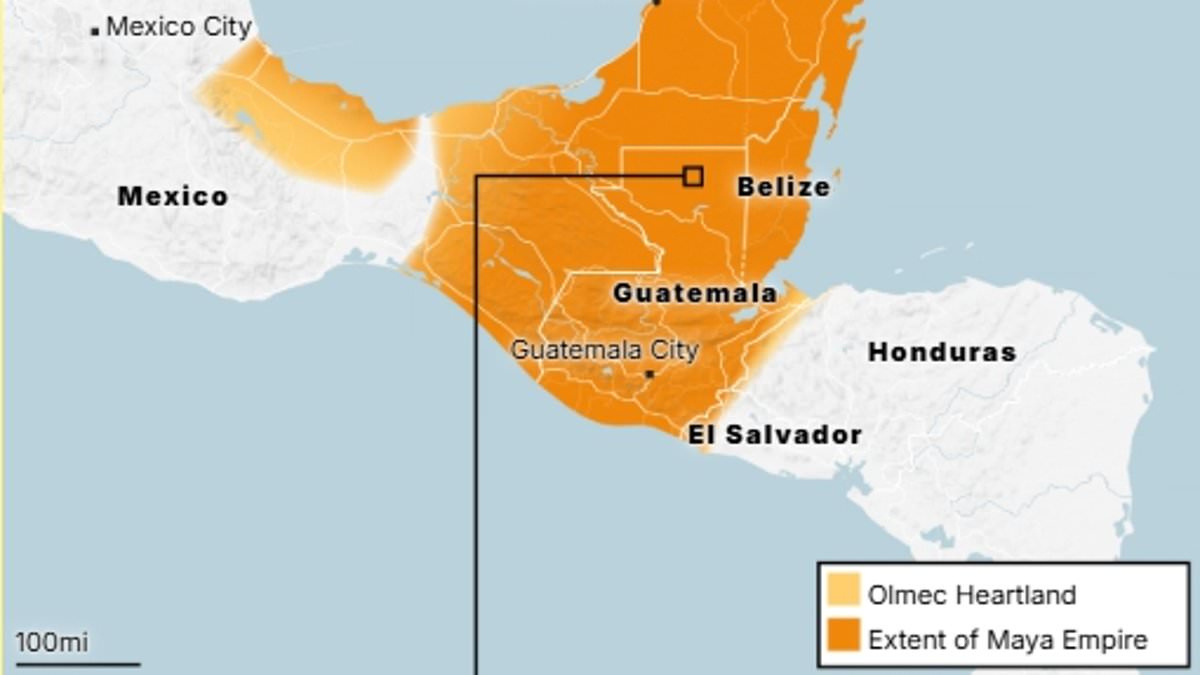
The civilization occupied present-day southern Mexico and Guatemala, as well as parts of Belize, El Salvador and Honduras.
But by 1000 AD, the civilization had mysteriously collapsed – possibly due to a devastating drought that created an agricultural crisis.

Two anthropomorphic sculptures of human form or appearance that ‘represent an ancestral couple’ discovered at the archeological site

An ancient Maya city over 2,800 years old, along with other pre-Columbian remnants, was unearthed within an archaeological park in northern Guatemala, close to the Mexican border.
This lost city of Los Abuelos is in the Maya Biosphere nature reserve (Reserva de Biosfera Maya), about 13 miles from Uaxactun, Guatemala.
It was found by Guatemalan and Slovak archaeologists in previously under-explored areas of the jungle habitat, home to a large number of animal and plant species.
Authorities have already dated it to an estimated period from about 800 to 500 BC – what is known as the ‘Middle Preclassic’ period in Maya history.
To put this into context, 800 BC was the time when people in Britain learned how to use iron for tools, several centuries before the Romans arrived.
Los Abuelos (Spanish for ‘The Grandparents’) takes its name from two mysterious human-like sculptures described as an ‘ancestral couple’ found at the site.
The figures, dated to between 500 and 300 BCE, ‘could be linked to ancient ritual practices of ancestor worship,’ said the ministry.
It’s well known the Maya would dance, sing and sometimes make offerings of blood to their several gods to demonstrate their respect and loyalty.
But it’s as yet unclear what these structures represented and how exactly they may have played a part in such events.

Pictured, the two anthropomorphic sculptures of human form or appearance that ‘represent an ancestral couple’ and may have been involved in rituals

A pot discovered at the site in the Maya Biosphere. Authorities have already dated it to an estimated period from about 800 to 500 BC
Maya people even engaged in the brutal act of human sacrifice because they though blood was a potent source of nourishment for their gods – and that they’d get rain and fertile fields in return.
Sadly, some of the humans caught up in such bizarre rituals were the very young, according to skeletal remains at a famous Maya pyramid.
The Guatemalan and Slovak archaeologists also managed to find a pyramid 108 feet (33 metres) high with murals from the Preclassic period and ‘a unique canal system’.
We already know the Mayans developed sophisticated techniques to harness natural water sources, adapting to seasonal rainfall patterns and creating complex irrigation systems.
Noted for the only fully developed written language of the pre-Columbian Americas, the Mayas also had advanced art and architecture as well as mathematical and astronomical systems.
Mysteriously in the 8th and 9th century AD, a large chunk of the Mayan civilization collapsed, leading to their eventual downfall around 1000 AD.
While the reason for this has been hotly debated, drought and climate change are among the most widely-spouted theories.
An increase in the elite Maya’s preference for corn may have made the population more vulnerable to drought, contributing to its societal collapse, one theory goes.

The ancient Maya created one of the world’s most brilliant and successful civilizations. Pictured, an early Maya mask

Mayan culture in Guatemala has a long history, stretching back more than 4,000 years in the Mesoamerican region. Pictured are ruins left by the ancient civilization in Tikal National Park

The Maya civilization occupied present-day southern Mexico and Guatemala, as well as parts of Belize, El Salvador and Honduras. Pictured, a Maya pyramid nestled in a clearing among dense rain forest in, Copan, Honduras
Experts at the Guatemalan Ministry of Culture say the new findings ‘allow us to rethink the understanding of the ceremonial and socio-political organization’ of the region in the pre-Hispanic period – the time prior to Spanish conquests in the 16th century.
It follows the discovery of a Mayan city in Mexico that once featured an urban landscape of more than 6,500 structures. Using a laser method, researchers from the US uncovered a 21-square-mile metropolis with iconic stone pyramids, houses and other infrastructure that have been concealed for more than 3,000 years.
Scientists also recently discovered a 1,000-year-old altar from Mexico’s ancient Teotihuacan culture at nearby Tikal, about 14 miles (23km) south of Uaxactun.
The find was interpreted as proof of ties between the two pre-Hispanic cultures, which lived about 800 miles (1,300 km) apart.
Tikal is the main archaeological site in Guatemala and one of its biggest tourist attractions.