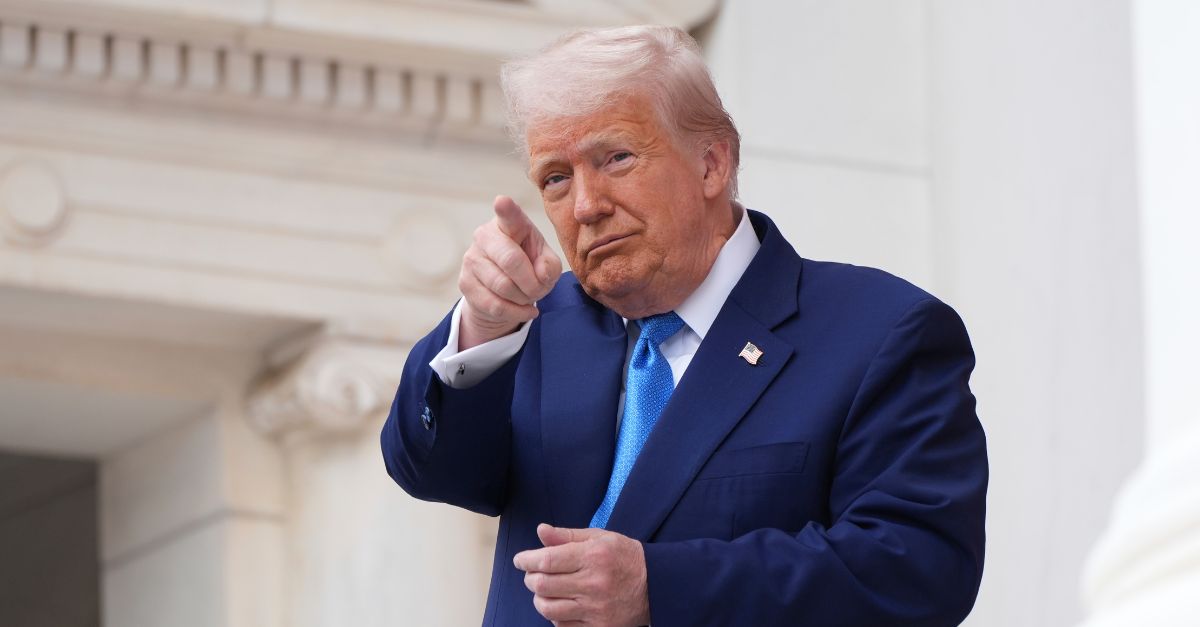

President Donald Trump is seen attending the 157th National Memorial Day Observance at Arlington National Cemetery on Monday, May 26, 2025, in Arlington, Virginia. (AP Photo/Jacquelyn Martin).
The Public Broadcasting Service (PBS) along with a Minnesota affiliate launched a lawsuit against President Donald Trump on Friday in a federal court in Washington, D.C., challenging his contentious plans to eliminate federal funding.
On May 1, the 45th and 47th president released Executive Order 14290 titled, “Ending Taxpayer Subsidization Of Biased Media.” According to the order, PBS and National Public Radio (NPR) fail to provide “a fair, accurate, or unbiased portrayal of current events to taxpaying citizens.” Consequently, Trump’s directive instructs the Corporation for Public Broadcasting Board of Directors (CPB Board) “and all executive departments and agencies” to discontinue funding NPR and PBS.
In a 35-page complaint, PBS and Lakeland PBS say the “unprecedented presidential directive” attacking them and other member stations “will upend public television,” and they dispute the “charged assertions” leveled in Trump’s order.
The lawsuit also says Trump’s effort to defund them lacks any legal basis.
Love true crime? Sign up for our newsletter, The Law&Crime Docket, to get the latest real-life crime stories delivered right to your inbox.
“[R]egardless of any policy disagreements over the role of public television, our Constitution and laws forbid the President from serving as the arbiter of the content of PBS’s programming, including by attempting to defund PBS,” the complaint reads.
The plaintiffs are asking the court to enjoin Trump’s funding rescission as in violation of the federal law establishing the public airwaves and unconstitutional under the First Amendment.
“[S]ince Congress laid the foundations for the growth of public television over 50 years ago, it has repeatedly protected the flow of federal funds from political interference by filtering them through a non-federal, non-profit, and nonpartisan entity,” the lawsuit reads.
The filing goes on to reference part of the originating legislation that established the CPB in 1967 – creating PBS in 1969 – and which was quickly amended to add NPR in 1970.
“Lest there be any doubt that the Executive Branch should have no power to influence CPB’s decision-making, Congress enacted a specific ‘[p]rohibition’: no ‘department, agency, officer, or employee of the United States’ may ‘exercise any direction, supervision, or control over public telecommunications, or over [CPB] or any of its grantees’—including with respect to ‘the content or distribution of public telecommunications programs and services,”” the lawsuit explains.
The plaintiffs, in no uncertain terms, accuse the Trump administration of unconstitutionally targeting them for disfavored speech.
From the complaint, at length:
The EO makes no attempt to hide the fact that it is cutting off the flow of funds to PBS because of the content of PBS programming and out of a desire to alter the content of speech. That is blatant viewpoint discrimination and an infringement of PBS and PBS Member Stations’ private editorial discretion. The EO also seeks to impose an unconstitutional condition on PBS Member Stations’ receipt of federal funds by prohibiting them from using federal funds to access PBS programming and services. And the EO smacks of retaliation for, among other things, perceived political slights in news coverage. That all transgresses the First Amendment’s protection of both speech and freedom of the press.
While five of the seven counts in the lawsuit allege First Amendment violations, the thrust of the complaint is that the president simply lacks the power to do what he wants his order to do. Moreover, the plaintiffs allege, Trump knows his efforts are unsupported.
“Notably, the President contemplated attempting a formal rescission of funds to PBS and PBS Member Stations under the [Impoundment Control Act],” the lawsuit goes on. “But rather than engaging in that process, which preserves the separation of powers with respect to congressional appropriations, the President acted unilaterally to purport to force CPB and other federal actors to alter the decades-long flow of funds to PBS and eliminate PBS Member Stations’ statutorily protected discretion as to how best to use federal funds to effectuate the goals of the Act.”
The lawsuit also offers another piece of evidence for the claim that Trump was intentionally trying to go beyond his available power.
“The first sentence of the EO makes plain that the President is attempting to circumvent Congress,” the lawsuit continues. “The EO begins by declaring that the reasons motivating Congress to enact the Act, ‘[u]nlike in 1967,’ do not apply today. But whether the Act remains good policy is for Congress—which has consistently appropriated funds pursuant to the Act—to decide.”
The staying power of public broadcasting, the plaintiffs insist, is a fait accompli – until Congress says otherwise. And the lawsuit argues the presence of PBS in American life is worth the money spent.
The lawsuit justifies PBS’ budget in various ways:
PBS and PBS Member Stations have fulfilled that mission by providing commercial-free, educational television programing and services that reflect the interests of the American people. Their informative, enriching content is free to the public and available to nearly 97% of the United States’ population, serving parts of the country not profitable for commercial media.
The demographic composition of PBS’s audience mirrors the overall U.S. population with respect to geography, income, education, race, and ethnicity. Sixty percent of PBS viewers live outside of urban areas. The breakdown of viewers is almost evenly split among Democrats, Republicans, and independents…
PBS reaches more children, and more parents of young children, than any other children’s television network. PBS KIDS is a dedicated children’s media service that delivers free educational content via television and digital platforms, including PBS Member Stations, the 24-hour PBS KIDS channel and live stream, pbskids.org, and the PBS KIDS Video and Games apps.
“If allowed to stand, the EO would override Congress’s decision to remove the administration of federal funding for public television from the government’s editorial purview,” the lawsuit argues. “And it would have profound impacts on the ability of PBS and PBS Member Stations to provide a rich tapestry of programming to all Americans. PBS and Lakeland PBS bring suit to preserve their ability to serve their viewers and communities without political interference, as both Congress and the First Amendment mandate.”


