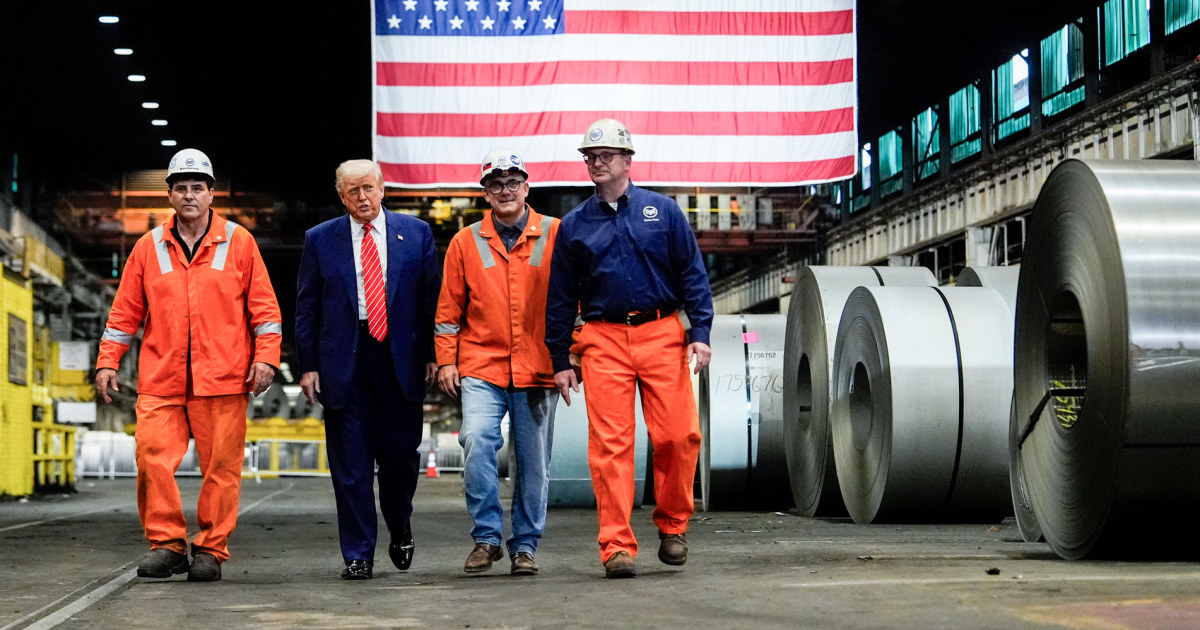

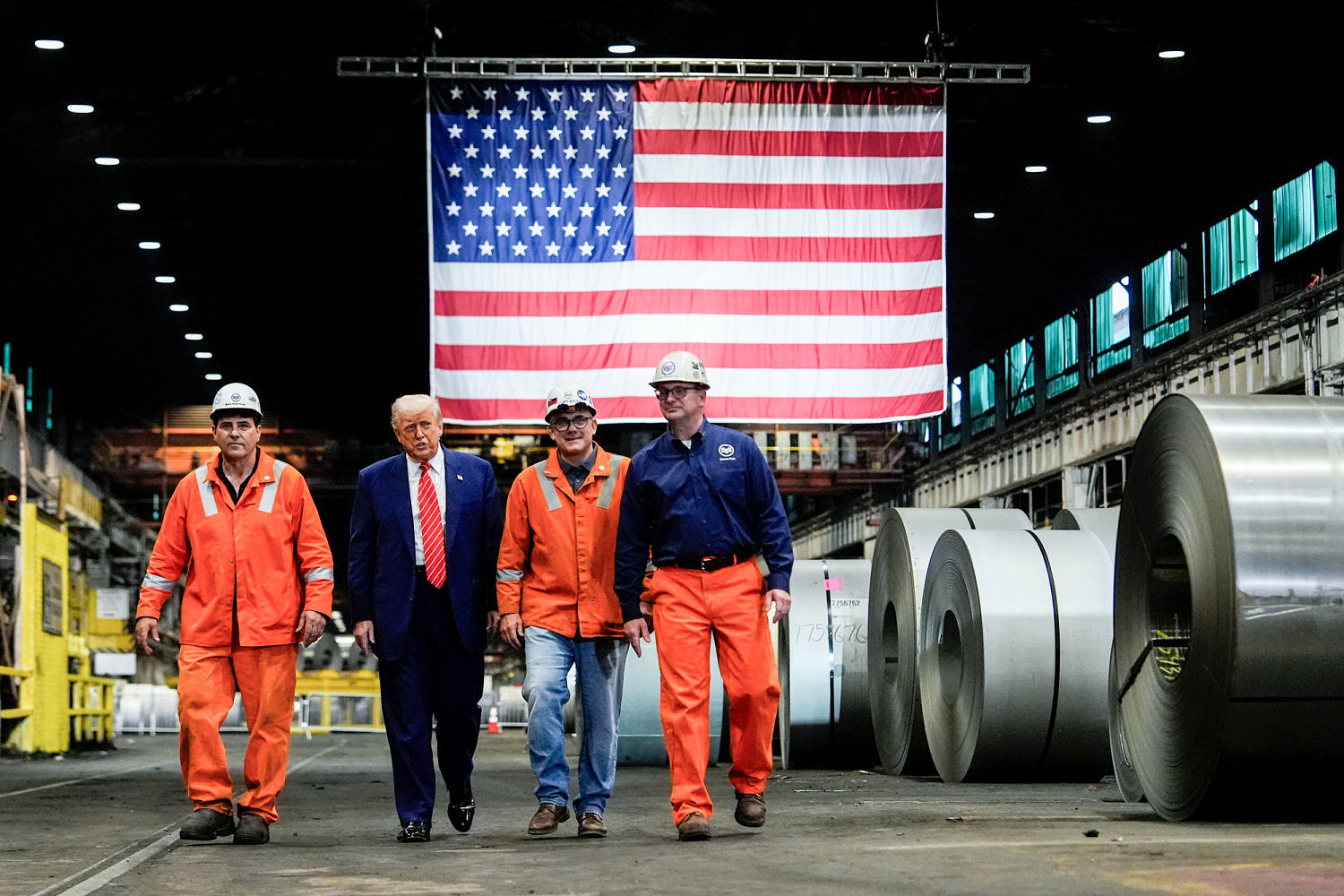
One of the most renowned industries in the United States is receiving a significant boost from President Donald Trump’s recent imposition of tariffs, though this could potentially have a negative impact on the wider U.S. economy.
Trump issued an executive order to increase the tariffs on steel imports from an already high 25% to 50%. The President had indicated the tariff hike was forthcoming, and it officially took effect at midnight on Wednesday.
“We’re increasing it from 25% to 50% — the tariffs on steel entering the United States,” Trump announced at a Pennsylvania rally, “which will further fortify the steel industry in the United States.”
The new 50% duties also affect aluminum products.
The tariffs on steel, along with those on imported automobiles and auto parts, have been imposed under authorities not affected by recent court decisions that cast doubt on the president’s powers to enact trade barriers.
U.S. steel firms have hailed Trump’s renewed push to raise the cost to American firms that rely on imports of steel. It’s a notably favorable reaction to tariffs amid what has broadly been a backlash against them.
“American-made steel is at the heart of President Trump’s plan to revitalize domestic manufacturing and return our country to an economic powerhouse,” the Steel Manufacturers Association said in a statement that applauded Trump’s remarks about the new 50% tariffs.
Investors have rewarded the steel firms accordingly, sending shares of U.S. steelmakers soaring across the board Monday as U.S. steel and aluminum prices jumped.
Today, the steel manufacturing industry directly employs 86,000 U.S. workers. It’s a fraction of the half million-strong workforce the industry counted in the decade after World War II, though employment levels have stabilized more recently.
While trade globalization bears substantial responsibility for steel’s decadeslong downturn, experts say advances in technology have played an equally significant role. Steel production increasingly revolves around so-called electric arc furnace technology, a more efficient means of production than the classic open blast furnace operations that prevailed for much of the 20th century.
The same levels of output from steel’s heydays can now be achieved with just a fraction of the workforce. As recently as the early 1980s, it took about 10 man-hours to produce a ton of steel. Today, the rate is as little as a single man-hour assuming multiple steel mills are working in tandem.
“The way we make steel in the U.S. has changed a lot,” said an expert on the local impact of industrial transitions, Ken Kolb, chair of the sociology department at Furman University in South Carolina.
“There is simply no way to bring that scale of employment back if a fraction of that workforce is needed to essentially reach the same production levels,” Kolb said.
He estimated that perhaps 15,000 new direct jobs could be added assuming capacity levels increase. But the broader cost to industries dependent on steel inputs, like autos, construction and solar panels — which relies on tariffed aluminum components — would be likely to negate those gains.
“Theoretically you’re going to be able to hire some people, but in reality, the tariffs just raise the average price of steel,” Kolb said. “And when the price of a commodity like that goes up, businesses just buy less and sideline investment.”
A study found that while Trump’s 2018 steel tariffs created 1,000 new direct jobs, it cost downstream industries that rely on steel to make their products as many as 75,000 jobs because they became less competitive thanks to higher costs.
While some limited capacity could come back online in the near term, the on-again, off-again nature of the tariffs limit any immediate job gains, said Josh Spoores, head of Steel Americas Analysis at the CRU Group consultancy.
If the higher tariffs remain, there could be new investments, Spoores said in an email — but building new steel mills can take at least two years.
Nor is it clear that American steelworkers themselves are entirely in favor of the tariffs. The United Steelworkers union signaled only tepid endorsement for the measure in a statement after its Canadian chapter rebuked Trump’s announcement.
“While tariffs, used strategically, serve as a valuable tool in balancing the scales, it’s essential that we also pursue wider reforms of our global trading system, working in collaboration with trusted allies like Canada to contain the bad actors and excess capacity that continue to undermine our industries,” the union said.
The union has also shown signs of a split when it comes to Trump’s proposed “partnership” between U.S. Steel and Japan’s Nippon Steel, whose takeover of the U.S. firm he previously opposed. Trump now sees the deal “creating” as many as 70,000 jobs.
“There’s a lot of money coming your way,” Trump told supporters at the Pennsylvania rally Friday.
The United Steelworkers signaled lingering doubts about the Nippon arrangement in a statement Friday.
“We have not participated in the discussions involving U.S. Steel, Nippon Steel, and the Trump administration, nor were we consulted, so we cannot speculate about the meaning of the ‘planned partnership’ between USS and Nippon,” it said, using an initialism to refer to the American firm.
It continued: “Whatever the deal structure, our primary concern remains with the impact that this merger of U.S. Steel into a foreign competitor will have on national security, our members and the communities where we live and work.”


