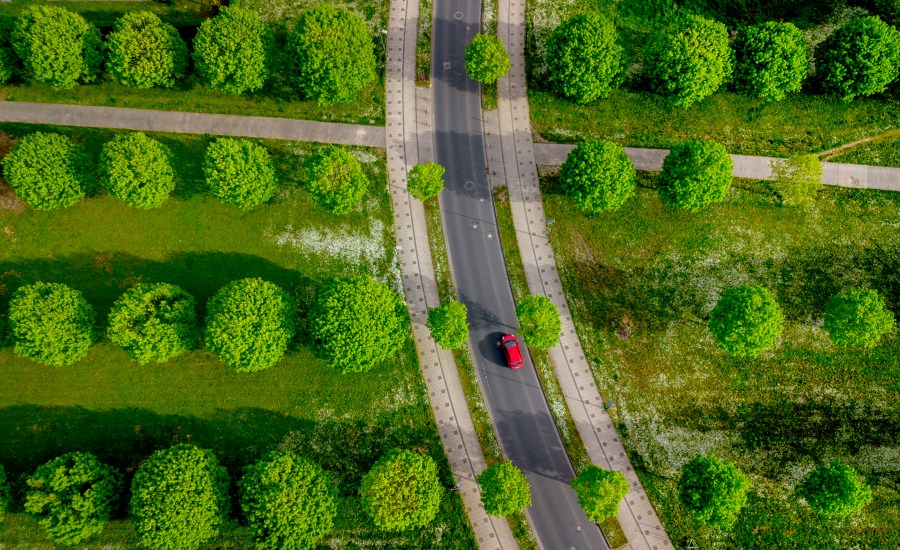


While planting trees offers numerous advantages, this well-known strategy for removing carbon cannot single-handedly offset the greenhouse gas emissions generated by the biggest fossil-fuel corporations globally. To achieve this offset, an area equivalent to the entire land of North and Central America would need to be covered with trees, according to a recent study.
Esteemed climate scientists and organizations emphasize the importance of not only reducing carbon emissions but also actively removing them to effectively address climate change. Trees naturally remove carbon by “breathing,” or through photosynthesis. However, after analyzing the data, researchers concluded that the carbon-absorbing capacity of trees cannot match the emissions potential from the reserves of the top 200 fossil-fuel companies, as there simply isn’t enough suitable land available worldwide to make this viable.
Moreover, if it were theoretically possible, these 200 companies would face a cost of $10.8 trillion for planting such a vast number of trees, surpassing their total market value of $7.01 trillion. Additionally, if these companies were held accountable for the social costs associated with the carbon in their reserves, the expenses would outweigh their financial worth, given that scientists estimate the social cost at about $185 per metric ton of carbon dioxide.
“The general public maybe understand offsetting to be a sort of magic eraser, and that’s just not where we’re at,” said Nina Friggens, a research fellow at the University of Exeter who co-authored the paper published in Communications Earth & Environment, a Nature Portfolio journal.
Carbon offsetting essentially means investing in tree planting or other environmental projects to attempt to compensate for carbon emissions. Trees are one of the cheapest ways to do this because they naturally suck up planet-warming carbon. Fossil fuel corporations, along with other companies and institutions, have promoted tree-planting as key part of carbon offset programs in recent years.
For example, TotalEnergies, a global energy company, said in a statement that it is “investing heavily in carbon capture and storage (CCS) and nature-based solutions (NBS) projects.”
To do their calculations, the researchers looked at the 200 largest holders of fossil fuel reserves — the fuel that companies promise shareholders they can extract in the future — and calculated how much carbon dioxide would be released if this fuel is burned. The researchers also focused solely on tree planting because the expense and technological development needed for other forms of carbon capture are still mostly cost-prohibitive.
Forestry expert Éliane Ubalijoro, who was not involved with the research, called the study “elegant.”
It “gives people a sense of proportion around carbon,” said Ubalijoro, CEO of CIFOR-ICRAF, an international forestry research center.
But she cautioned against oversimplifying the equation by looking only at carbon capture, noting that tree planting done right can foster food security and biodiversity and protect communities from natural disasters.
The paper effectively makes the point that it’s financially impossible to offset enough carbon to compensate for future fossil fuel burning, said Daphne Yin, director of land policy at Carbon180, where her team advocates for U.S. policy support for land-based carbon removal. And the idea that companies would ever be required to account for the downstream emissions from the fossil fuel they extract is a “fantasy,” she said.
The idea of planting trees is appealing to the public and to politicians because it’s tangible — people can literally see the carbon being incorporated into branches and leaves as a tree grows, Friggens said. But she says other methods shouldn’t be overlooked — microbes underground store carbon too, but they can’t be seen.
And it’s a physically and mathematically inescapable fact, illustrated in part by this study, that there’s no getting around it — we have to stop emitting carbon, said Jonathan Foley, the executive director of Project Drawdown, who also was not part of the study. Carbon emissions are like an overflowing bathtub, he says: Before you start cleaning up, you have to turn off the water.
“Trees are the sponges and the mops we use to clean up the mess,” he said. “But if the taps are still running and the water’s pouring out over the edges of your bathtub, destroying your bathroom and your home, maybe you’ve got to learn to turn off the taps too.”
___
Follow Melina Walling on X @MelinaWalling and Bluesky @melinawalling.bsky.social.
___
The Associated Press’ climate and environmental coverage receives financial support from multiple private foundations. AP is solely responsible for all content. Find AP’s standards for working with philanthropies, a list of supporters and funded coverage areas at AP.org.