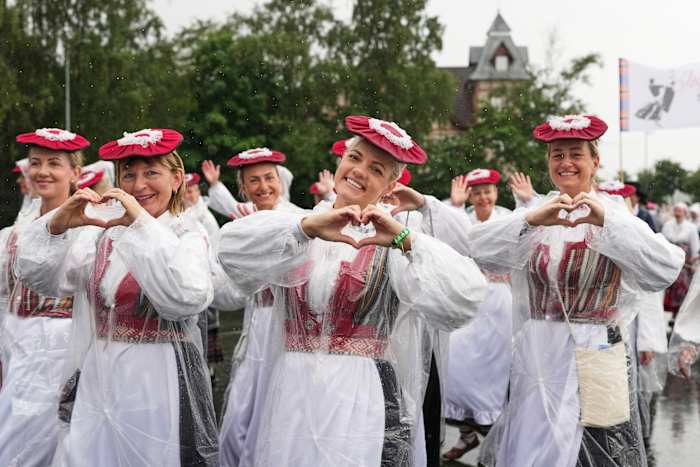


TALLINN – Over 21,000 choir singers filled the rainy air with their voices in Estonia, while a vast audience responded with applause, undeterred by the overcast skies.
The Song Festival Grounds, a sprawling outdoor space in Tallinn, Estonia’s capital, was crowded on Saturday evening despite wet conditions. The traditional Song and Dance Celebration, which ignited resistance against Soviet authority decades ago and later earned recognition from the U.N.’s cultural agency, drew in tens of thousands of both performers and onlookers, many dressed in traditional attire.
This four-day event of choir singing and dancing focuses on Estonian folk melodies and nationalistic anthems and takes place approximately once every five years. Its origins trace back to the 19th century. In the late 1980s, it fueled the inspiring Singing Revolution, aiding Estonia and other Baltic states in gaining independence from Soviet control.
To this day, it remains a major point of national pride for a country of about 1.3 million.
This year, tickets to the main event -– a seven-hour concert on Sunday featuring choirs of all ages -– sold out weeks in advance.
Rasmus Puur, a conductor at the song festival and assistant to the artistic director, ascribes the spike in popularity to Estonians longing for a sense of unity in the wake of the global turmoil, especially Russia’s war in Ukraine.
“We want to feel as one today more than six years ago (when the celebration was last held), and we want to feel that we are part of Estonia,” Puur told The Associated Press on Friday.
Soviet occupation
The tradition to hold massive first song-only, then song and dance festivals dates back to the time when Estonia was part of the Russian Empire.
The first song celebration was held in 1869 in the southern city of Tartu. It heralded a period of national awakening for Estonians, when Estonian-language press, theater and other things emerged, says Elo-Hanna Seljamaa, associate professor at the University of Tartu.
The festivals continued throughout a period of Estonia’s independence between the two world wars and then during the nearly 50 years of Soviet occupation.
The Soviet rulers were into “mass spectacles of all kinds, so in a way it was very logical for the Soviet regime to tap into this tradition and to try to co-opt it,” Seljamaa said in an interview.
Estonians had to sing Soviet propaganda songs in Russian during that time, but they were also able to sing their own songs in their own language, which was both an act of defiance and an act of therapy for them, she said.
At the same time, the complicated logistics of putting together a mass event like that taught Estonians to organize, Seljamaa said, so when the political climate changed in the 1980s, the protest against the Soviet rule naturally came in the form of coming together and singing.
The unity extended beyond Estonia’s borders. During the Singing Revolution, 2 million people in Estonia, Latvia and Lithuania joined hands to form a 600-kilometer (370-mile) human chain that protested Soviet occupation of the Baltics with a song.
In 2003, the United Nations’ cultural body, UNESCO, recognized Estonia’s folk song festival and similar events in Latvia and Lithuania for showcasing the “intangible cultural heritage of humanity.”
‘We sang ourselves free’
Marina Nurming recalls attending the Singing Revolution gatherings in the 1980s as a teenager. This year she travelled to Tallinn from Luxembourg, where she currently lives, to take part in the Song and Dance Celebration as a choir singer –- her longtime hobby.
The Singing Revolution is a time “when we sang ourselves free,” she told AP.
Seljamaa says the song and dance celebration may have suffered a drop in popularity in the 1990s, a somewhat difficult time for Estonia as it was emerging as an independent country after the Soviet Union collapsed, but has since bounced back.
There is a tremendous interest in it among young people, she says, and always more performers willing to take part than the venue can fit in, and there are people who had left Estonia to live abroad, but travel back to take part.
Nurming is one example. She is part of the European Choir of Estonians – a singing group that unites Estonians from more than a dozen countries.
Many opportunities to sing
This year’s four-day celebration, which started on Thursday, included several stadium dancing performances by over 10,000 dancers from all around the country and a folk music instrument concert.
It culminates over the weekend with the song festival featuring some 32,000 choir singers, preceded by a large procession, in which all participants -– singers, dancers, musicians, clad in traditional costumes and waving Estonian flags –- march from the city center to the Song Festival Grounds by the Baltic Sea.
Those taking part come from all corners of Estonia, and there are collectives from abroad, as well. It’s a mix of men, women and children, with participants aged from six to 93.
For most, singing and dancing is a hobby on top of their day jobs or studies. But to take part in the celebration, collectives had to go through a rigorous selection process, and months worth of rehearsals.
For Karl Kesküla, an electrical engineer from Estonia’s western island of Saaremaa, this is the first time taking part in the song celebration as a singer -– but he attended it before as a spectator.
“I got the feeling that what they did was really special and almost, like, every person you meet has gone to it or been a part of it at least once. So I just wanted that feeling too,” Kesküla, 30, told the AP at the procession on Saturday.
High emotional point
The theme of the song festival this year is dialects and regional languages, and the repertoire is a mix of folk songs, well-known patriotic anthems that are traditionally sung at these celebrations and new pieces written specifically for the occasion.
The festival’s artistic director, Heli Jürgenson, says that although the audience won’t know all the songs -– especially those sung in dialects -– there will be many opportunities to sing along.
The main concert on Sunday will end with a song called “My Fatherland is My Love” –- a patriotic song Estonians spontaneously sang at the 1960 festival in protest against the Soviet regime. Every song celebration since 1965 has concluded with this anthem in what both performers and spectators describe as the highest emotional point of the whole event.
An emotional Jürgenson, who this year will conduct a combined choir of about 19,000 people singing it, said: “This is a very special moment.”
She believes that what drove the tradition more than 150 years ago still drives it today.
“There have been different turning points, there have been a lot of historical twists, but the need for singing, songs and people have remained the same,” she said. “There are certain songs that we always sing, that we want to sing. This is what keeps this tradition going for over 150 years.”
‘We forget our troubles’
Participants described the celebrations as being an important part of their national identity.
“Estonians are always getting through the hard times through songs, through songs and dances. If it’s hard, we sing together and that brings everything back together and then we forget our troubles,” singer Piret Jakobson said.
“It’s really good with all Estonian people to do the same thing,” said engineer Taavi Pentma, who took part in the dance performances. “So we are, like, breathing in one and the heart is beating (as one).”
Some 100 members of the European Choir of Estonians came to the Song Celebration this year from various corners of Europe. Among them is Kaja Kriis, who traveled from Germany, where she’s been living for the last 25 years.
“Estonia is my home,” she said, adding that it’s important for her “to be together with my friends, to keep my Estonian language, to maintain the Estonian language and Estonian culture.”
Copyright 2025 The Associated Press. All rights reserved. This material may not be published, broadcast, rewritten or redistributed without permission.