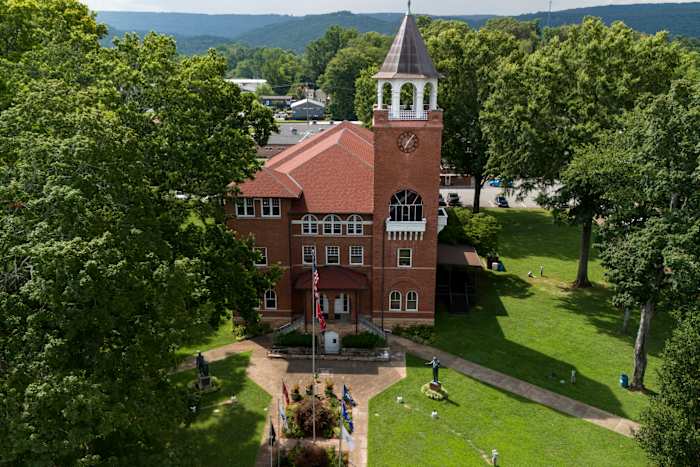


NASHVILLE, Tenn. – A century ago, a public high school educator faced trial in Dayton, Tennessee, for teaching the concept of human evolution. The effects of this event are still evident nationally today.
The court records identify the case as State of Tennessee v. John T. Scopes. It is famously referred to as the “Monkey Trial.” This proceeding escalated into a national spectacle, featuring a courtroom clash between a prominent, agnostic defense lawyer and a well-known fundamentalist Christian politician who supported the Bible on the stand.
In a sweltering, pre-air conditioning courtroom, the trial became a linchpin for a tense debate that wasn’t just a small-town aberration.
“This is a broad-based culture war of which the Scopes trial is just one place lightning struck,” states James Hudnut-Beumler, a professor specializing in American religious history at Vanderbilt University in Nashville, Tennessee.
Today, new state laws requiring the display of the Ten Commandments in public school classrooms are facing legal challenges. As the Supreme Court leans right, there is an ongoing conservative push to infuse more religion — often Christianity — into taxpayer-funded education. Advocates of religious diversity and church-state separation are countering it in capitols, courts and public squares.
“We are fighting on an almost daily basis,” says Robert Tuttle, a religion and law professor at George Washington University Law School in Washington, D.C.
That Tennessee jury found Scopes guilty of violating the state’s Butler Act — of teaching “any theory that denies the story of the Divine Creation of man as taught in the Bible.”
A century later, the role of religion in public schools — and whether to keep it out entirely — is still being fiercely debated.
Some perceive a threat to their spot in the culture
While attempts to interlace America and the divine are not new, from the last half of the 20th century to today they are driven by a perceived threat among white Christians who think their dominant spot in politics and culture is being eroded by secularism or multiculturalism, Tuttle says.
Other recent examples of the debate over religion in schools include adding chaplains and Bibles to classrooms, infusing designated prayer time into the school day and expanding voucher programs that can be used at religious schools. At the Supreme Court, the justices effectively stopped the first taxpayer-funded Catholic charter school and gave parents a religious exemption for LGBTQ+-related instruction.
Tuttle’s scholarship was used in the recent federal appeals court ruling that declared Louisiana’s Ten Commandments law unconstitutional, citing a similar Kentucky law the Supreme Court ruled against in 1980.
Tuttle and his co-author, Ira Lupu, assert that the principles underlying the Establishment Clause — the First Amendment’s ban on the government establishing a religion — remain alive despite arguments that cite a change made in a 2022 school prayer ruling by the Supreme Court.
“We have good reasons not to concede the battlefield to the forces aimed at eliminating the idea of a secular state,” their article states. “When they overclaim their victories, others should speak up.”
The day after the court ruling, Republican Gov. Greg Abbott signed the Texas Ten Commandments bill that had easily passed the GOP-controlled state legislature. Lawsuits have been filed to block it and the Arkansas law that was approved earlier this year.
Abbott has taken on a Ten Commandments issue before. He reiterated his support for the new law while celebrating the 20th anniversary of his 2005 Supreme Court victory that prevented efforts to tear down the Commandments monument on the grounds of the state Capitol.
“I will always defend the historical connection between the Ten Commandments and their influence on the history of Texas,” he says in a video posted on X.
Texas Values, a conservative Christian law and policy nonprofit, rallied support for the Texas bill. If other ideals are shared in the classroom, the Ten Commandments should be able to be shared as well, says Mary Elizabeth Castle, director of government relations for the organization.
A similar argument was made in 1922 by Scopes prosecutor William Jennings Bryan, a onetime populist firebrand who became the face of the anti-evolution movement.
“If the Bible cannot be taught, why should Christian taxpayers permit the teaching of guesses that make the Bible a lie?” Bryan wrote in The New York Times. “A teacher might just as well write over the door of his room, ‘Leave Christianity behind you, all ye who enter here.’”
The arc of the religion-in-schools debate is long
About 60 years earlier, advances in biblical criticism caused conservative Christians to double down on rejecting anything they believe conflicted with their interpretation of the Bible, human evolution included, says Hudnut-Beumler. He blames weaponized post-World War I rhetoric for spreading anti-evolution beliefs to legislation. He sees parallels to today.
“Whatever we’re going through now,” he says, “it’s the product of people manufacturing rhetoric in a way that stokes fear.”
Castle sees the 2022 school prayer decision as a step in the right direction. “There’s always just going to be that conflict where people are trying to trample on religious freedom,” she says, “and so that’s why we do the work that we do.”
The American Civil Liberties Union, joined by other legal groups, is representing the families in Louisiana, Arkansas and Texas that sued to block new Ten Commandments laws. A much younger ACLU, boosted by the star power of defense attorney Clarence Darrow, represented Scopes, who agreed to be a test case challenging the Butler Act and to bring attention to Dayton.
Daniel Mach, who directs the ACLU program on freedom of religion and belief, sees a through line between 1925 and what he describes as a present-day assault on the separation of church and state.
“There are those who want to use the machinery of the state — and in particular, our public schools — to impose their religious beliefs on everyone else,” Mach says. “The constitutional guarantee of church-state separation has served us as a nation quite well over the years in general. And there’s simply no reason to turn back the clock now.”
In 1925, the ACLU lost the Scopes case. It would be more than 40 years before the Supreme Court would overrule an anti-evolution teaching ban. But the trial, which took place from July 10-21, dealt a big hit to Bryan’s reputation. He died days after it ended.
Though a brief legal circus, the trial inflamed social divisions. Conservatives and fundamentalists in the Midwest and South felt mocked by those they considered liberal, East Coast elites. “They were humiliated,” Tuttle says. “That’s internalized, and it carries through.”
In the 1940s, tensions flared with a school funding case before the Supreme Court. They returned in the 1960s when the justices ruled against school-sponsored prayer and Bible readings. It was upsetting, Tuttle says, to conservative Christians who saw schools as a source of morality.
“The link you see with the Scopes case is a sense of alienation and devaluing of what civic experience means to them,” he says.
Suzanne Rosenblith, an expert on religion in public education at the University at Buffalo in New York, sees the wave of court cases as primarily First Amendment tensions.
“Your argument for removing something can be seen as ensuring that Congress makes no law respecting the establishment of religion. And my wanting something included, that’s my way of exercising my right to religious freedom,” she says. “And it could be on the same issue.”
A lesson to be learned from the last 100 years, Rosenblith says, is that America remains a pluralist democracy and needs to be approached as such.
“All sides are going to win some and lose some,” she says. “But how can we treat each other, especially those with whom we disagree on these significant issues, how do we treat each other more seriously?”
___
Holly Meyer is global religion news editor for The Associated Press. AP’s religion coverage receives support through the AP’s collaboration with The Conversation US, with funding from Lilly Endowment Inc. The AP is solely responsible for this content.
Copyright 2025 The Associated Press. All rights reserved. This material may not be published, broadcast, rewritten or redistributed without permission.