Share this @internewscast.com
The United States reached a trade framework agreement with the European Union on Monday AEST, setting a 15 percent import tariff on most EU goods. This agreement prevents an escalating trade conflict between two major allies, which together represent nearly a third of global trade.
The news was announced following talks between European Commission President Ursula von der Leyen and US President Donald Trump at his golf course in western Scotland, with von der Leyen advocating for a decisive agreement.
“I think this is the biggest deal ever made,” Trump remarked to the press after a meeting lasting an hour with von der Leyen, who noted that the 15 percent tariff was implemented “across the board”.
“With a trade agreement between the world’s two largest economies, it signifies a substantial development. It promises stability and predictability,” she commented.

This agreement, which also involves US$600 billion ($915 billion) of EU investments in the U.S. and US$750 billion ($1.14 trillion) worth of EU purchases of U.S. energy during Trump’s second term, indeed offers clarity for European companies.

Even so, the baseline 15 per cent tariff will be viewed by many in Europe as a poor outcome compared with the initial European ambition of a zero-for-zero tariff deal, although it is better than the threatened 30 per cent rate.
German Chancellor Friedrich Merz welcomed the deal, saying in a statement that a trade conflict had been averted that would have hit Germany’s export-driven economy and its large auto sector hard.
But Bernd Lange, the German Social Democrat who chairs the trade committee of the European Parliament, said he was “quite critical” because the tariffs were imbalanced and the pledged $600 billion of investment would likely come at the expense of EU industry.
The euro rose around 0.2 per cent against the US dollar, UK pound sterling and Japanese yen within an hour of the deal.

The deal mirrors key parts of the framework agreement the US clinched with Japan last week.
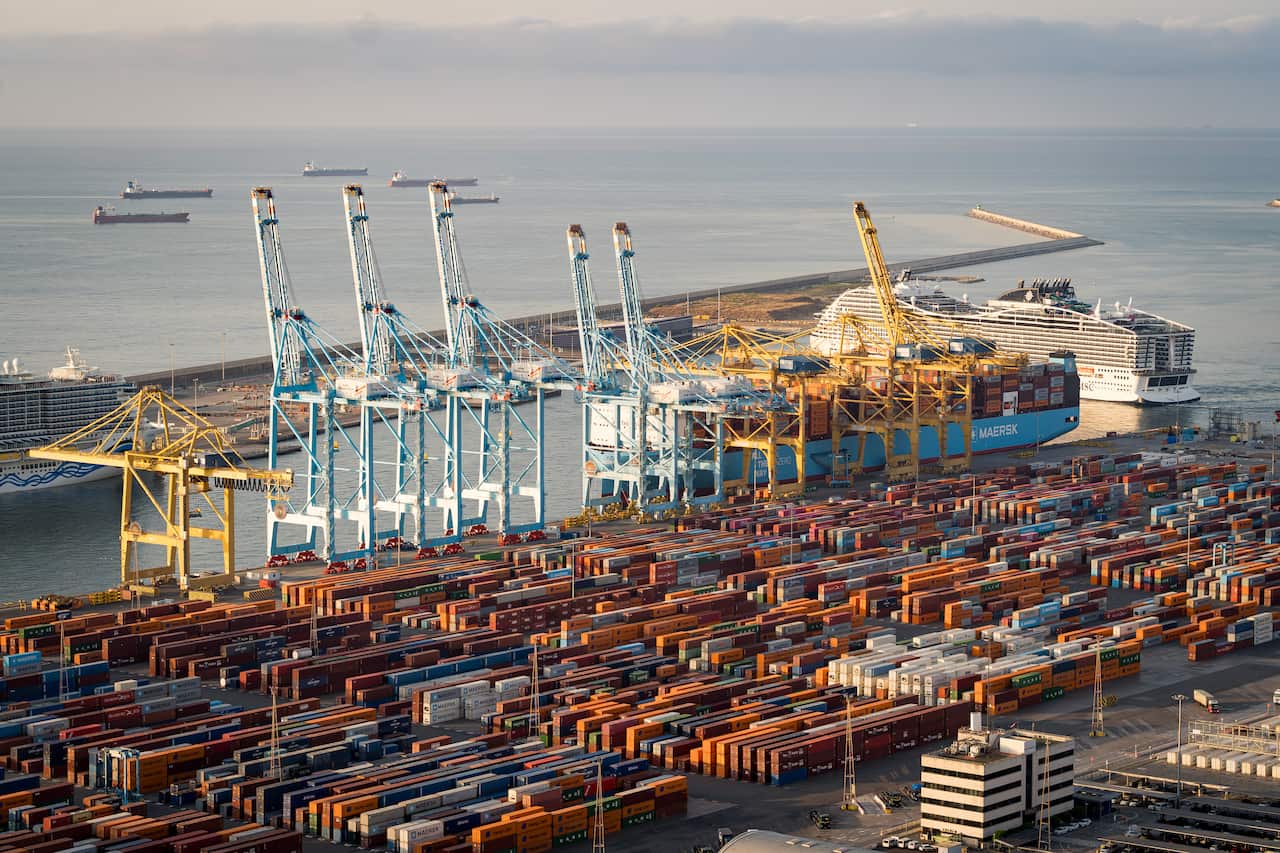
Rows of shipping containers line the port as cargo ships rest at the docks.

The agreement will mean EU goods exported to the US will be liable for a 15 per cent tariff. Source: AAP / Davide Bonaldo / SOPA Images

“We are agreeing that the tariff … for automobiles and everything else will be a straight-across tariff of 15 per cent,” Trump said.

That rate, however, will not apply to steel and aluminium, for which a 50 per cent tariff will remain in place, although von der Leyen said it would be cut and replaced with a quota system.
Von der Leyen said the rate also applied to semiconductors and pharmaceuticals, and there would be no tariffs from either side on aircraft and aircraft parts, certain chemicals, certain generic drugs, semiconductor equipment, some agricultural products, natural resources and critical raw materials.
“We will keep working to add more products to this list,” she said, adding that the situation on spirits was still to be established.
Eric Winograd, chief economist at investment firm AllianceBernstein in New York, noted the similarity with Japan’s US deal.

“While it’s important to monitor how long both sides adhere to the agreement, from a market perspective, having such an agreement provides more reassurance than not having one,” he noted.

Trump, who is seeking to reorder the global economy and reduce decades-old US trade deficits, has so far reeled in agreements with the United Kingdom, Japan, Indonesia and Vietnam, although his administration has failed to deliver on a promise of “90 deals in 90 days”.
He has periodically railed against the European Union, saying it was “formed to screw the United States” on trade.
Arriving in Scotland, Trump said the EU wanted “to make a deal very badly” and said, as he met von der Leyen, that Europe had been “very unfair to the United States”.
His main concern is the US merchandise trade deficit with the EU, which in 2024 reached US$235 billion ($357 billion), according to data from the US Census Bureau.

The EU highlights the U.S. surplus in services, which they believe partially balances the equation. Trump also mentioned the “hundreds of billions of dollars” in revenue that tariffs were bringing in.


On 12 July, Trump threatened to apply a 30 per cent tariff on imports from the EU starting on 1 August, after weeks of negotiations with the major US trading partners failed to reach a comprehensive trade deal.
The EU had prepared counter tariffs on €93 billion ($166 billion) of US goods in the event there was no deal, and Trump had pressed ahead with 30 per cent tariffs.
Some member states had also pushed for the bloc to use its most powerful trade weapon, the anti-coercion instrument, to target US services in the event of a no-deal.

Share this @internewscast.com
You May Also Like
MANCHESTER, UNITED KINGDOM - AUG 07, 2015: Qatar Airways Airbus A330 tail livery at Manchester Airport Aug 07 2015.

Unveiling the Secrets: How Planes Safely Navigate the Skies Over the Middle East

With hubs such as Doha, Abu Dhabi and Dubai being used by…

Severe Storm Unleashes Golf Ball-Sized Hail on Sydney Regions

In an unexpected twist of weather, hailstones the size of golf balls…

Industry Group Warns of Construction Delays Without Fuel Exemption Amid COVID Resurgence Concerns

Key Points The war in the Middle East is causing concern about…
Petrol selling for 299.9 cents a litre on March 6, 2026.

Australia Encourages Remote Work as Petrol Prices Soar to Record Highs

The International Energy Agency (IEA) has sounded an alarm as diesel prices…

Khamenei Stands Firm Amid US Troop Surge: A Tense Middle East Showdown

The United States is ramping up its military presence in the Middle…

Iranian Australians Face Hidden Struggles Amidst Nowruz Celebrations: Unveiling the ‘Devastating’ Truth

The aroma of fragrant rice fills the air, its saffron-infused steam weaving…
Iran nuclear facility 'attacked' after Iran fired missiles at UK-US base

Suspected Attack on Iran Nuclear Site Follows Missile Strikes on UK-US Base

Israel‘s defence minister threatened a surge in attacks against Iran on Saturday…
Teenager arrested over fire bitten by police dog in Melbourne

Teenager Facing Charges Following Fire Incident Apprehended by Police K-9

A teenage boy required hospital treatment after being bitten by a police…
Tropical Cyclone Narelle Aurukun

Aftermath of Cyclone Narelle: Recovery Efforts Ramp Up in Far North Queensland

A cleanup is under way in Far North Queensland after Tropical CycloneNarelle…
Indonesian police have issued a reminder to all tourists in Bali after the arrest of travellerKarl Adolf Amrhein was detained by local authorities at 7.15am yesterday morning while walking with luggage through the Gianyar Regency during Bali's annual day of silence.

Tourist Apprehended for Violating Bali’s Stringent Regulations

Bali authorities have issued a reminder to tourists about the importance of…

South Australian Election: Party Leaders Cast Votes Amid National Spotlight

Political leaders have cast their ballots in South Australia’s election, a significant…
Kelsey Waghorn was a 25-year-old tour guide and one of 47 people on New Zealand's White Island when it erupted on December 9, 2019. She has written a book about that day and its aftermath. She is pictured IN April 2020 showing some of her injuries

Surviving the Inferno: Kelsey Waghorn’s Harrowing Tale from White Island’s Deadly Eruption

Nestled in the heart of the island are a pair of streams…