
Four-day weeks are becoming ‘very common’ among Dutch workers, says an economist.
Eurostat reports that individuals aged 20 to 64 in the Netherlands are working an average of just 32.1 hours per week at their main job, making it the shortest workweek across the EU.
Across the Organisation for Economic Co-operation and Development (OECD), no country has a higher rate of part-time workers.
And many full-time staff are now squeezing their hours into just four days, leaving Fridays free.
‘The four-day work week has become very, very common,’ explained Bert Colijn, an economist at Dutch bank ING.
‘I do work five days, and sometimes I get scrutinised for working five days!’
This wasn’t always the norm. For years, the Netherlands followed the traditional male breadwinner approach until the 1980s and 1990s, when more women began taking part-time roles in the workforce.
This shift led to the emergence of the ‘one-and-a-half earner model’—one parent working full-time and the other part-time—supported by tax incentives and benefits.

Four-day workweeks are becoming increasingly common among Dutch employees, as noted by an economist. Pictured: Historic Dutch houses and their reflection in a canal on a sunny day in Amsterdam, Netherlands

Eurostat indicates that people aged 20 to 64 in the Netherlands average just 32.1 hours per week in their main job, which is the shortest in the EU (stock image)
Currently, this model is widely adopted. More fathers are taking a ‘papa day’ to care for their children, as men are embracing shorter workweeks alongside their partners.
Critics of shorter hours often predict economic collapse – but the Dutch experience suggests otherwise.
Despite fewer hours on the clock, the Netherlands remains one of Europe’s richest countries, thanks to high productivity per hour and a staggering 82 per cent of working-age people in jobs.
That’s higher than the UK at 75 per cent, the US at 72 per cent, and France at 69 per cent.
But the system is not perfect. The OECD has flagged that it is holding women back, with only 27 per cent of managers female – one of the lowest figures in the developed world.
Labour shortages are also biting hard in areas like teaching, leaving schools understaffed and families struggling to juggle work and childcare.
As Colijn said, the country may be ‘holding itself back by working fewer hours’.

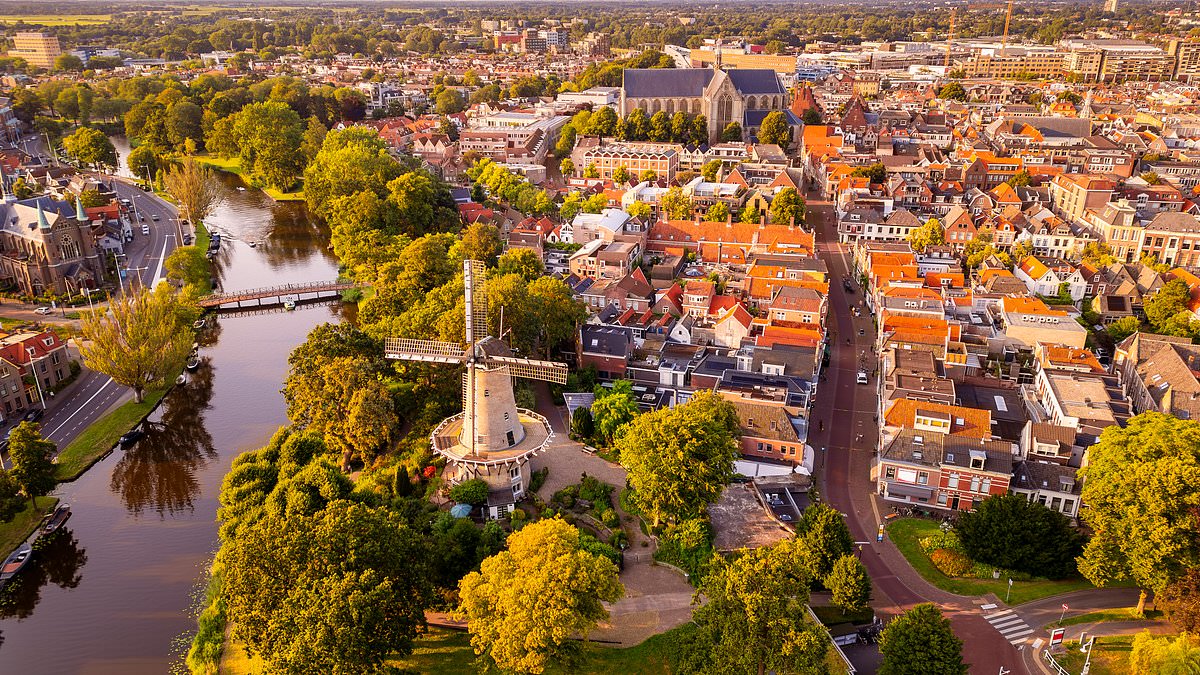
For decades, the Netherlands stuck to the traditional male breadwinner model, until women began entering the workforce in part-time roles during the 1980s and 1990s. Pictured: High angle Drone Point of View on Old Windmill in City Center of Alkmaar, North Holland
On the other hand, he warned: ‘also wouldn’t want to propose any dystopian society where everyone is working more than Korean hours, just because it increases GDP’.
It comes after Belgium became the first country in Europe to legislate a four-day week.
In February 2022, Belgian employees won the right to perform a full workweek in four days instead of the usual five without loss of salary.
The new law came into force on November 21, 2023, allowing employees to decide whether to work four or five days a week.
Belgian prime minister Alexander de Croo said he hoped that the change will help to make Belgium’s notoriously rigid labour market more flexible and will make it easier for people to combine their family lives with their careers.
Iceland has long been a champion of the four-day workweek, conducting one of the world’s largest and most influential trials between 2015 and 2019.
The pilot – which included 2,500 public sector workers, over 1 per cent of the country’s entire workforce – reduced weekly working hours from 40 to 35 without reducing pay, with results showing improvements across productivity, job satisfaction, and wellbeing.
Following the trial, several of the country’s biggest unions renegotiated contracts, and now around 86 per cent of Iceland’s workforce have either adopted shorter hours or gained the right to request them.
As a result, Iceland is widely regarded as a model for sustainable workweek reform.
Since 2022, Lithuania has also offered a shorter workweek to a specific segment of its public sector workforce.
Employees with children under the age of three are entitled to a 32-hour workweek without any reduction in salary, with the policy aiming to support working parents, reduce stress and help balance family responsibilities.
Germany began a six-month trial of the four-day workweek in February 2024, involving 45 companies in partnership with 4 Day Week Global.
Spain introduced a four-day workweek pilot program in late 2022, initially targeting small and medium-sized enterprises.
The government provided subsidies to participating companies to reduce the financial risks of shifting to a shorter week, with a focus on improving work-life balance without sacrificing productivity.
Japan’s government began pushing for optional four-day workweeks in 2021 as part of a broader plan to address issues such as overwork, mental health, and declining birth rates.
As a result, Tokyo introduced a four-day schedule for public sector employees in 2025.


