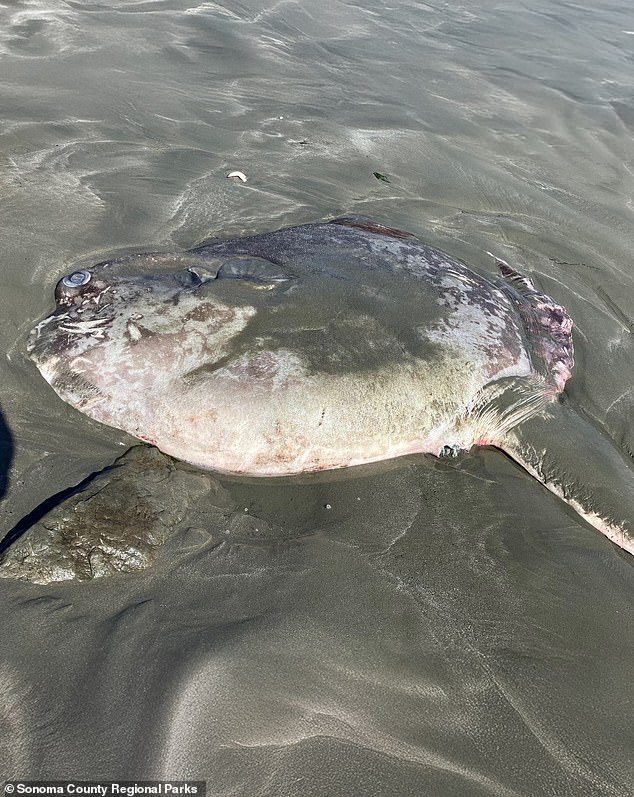

A massive and exceptionally rare sunfish washed up on a beach in California, astonishing early morning visitors who encountered the unusual six-foot-long marine animal.
The hoodwinker sunfish, also known as Mola tecta, was found at Doran Regional Park in Bodega Bay, located approximately 60 miles north of San Francisco, a location renowned as the backdrop of Alfred Hitchcock’s 1963 film, The Birds. This sunfish spanned about six feet in length and three feet in width, its size far exceeding the usual items found on a beach.
With its tiny mouth and lack of a visible tail, the strange-looking fish is so unusual that scientists only recognized the species in 2017.
Marine biologist Marianne Nyegaard from New Zealand, who initially identified the species, verified to the East Bay Times that the beached fish was indeed a hoodwinker.
She said it could be distinguished from the more common ocean sunfish because ‘the clavus is quite narrow and there is no head bump or chin bump.’
Nyegaard expressed surprise at its presence in Northern California, explaining to the East Bay Times, ‘We know Mola tecta occurs in the Humboldt Current off South America, as far north as Peru.’
‘But we did not expect them to cross the warm equatorial belt—at least not frequently. Nonetheless, they undoubtedly do cross—likely by diving deep and swimming below the warmer equatorial surface waters.’
The unusual sighting was first reported by Stefan Kiesbye, a novelist and English professor at Sonoma State University.

The enormous hoodwinker sunfish discovered on Doran Beach in Bodega Bay – the strange species has only been recognized by scientists since 2017

Beachgoer Stefan Kiesbye, a professor at Sonoma State (not pictured), remarked that he was ‘still in awe’ after discovering the six-foot-long creature while collecting trash.
He had been out picking up trash early Sunday morning when he noticed the massive creature near the western tip of the beach.
‘It’s sad that it’s been washed to shore,’ he said. ‘But it was so enormous and so weird and gorgeous. It’s like suddenly you’re on another planet.’
Kiesbye said he was ‘still in awe’ hours after finding the fish, which he initially mistook for a dead sea lion.
Later, he Googled ‘big weird fish around here’ and found news coverage of another hoodwinker that had washed ashore in Santa Barbara in 2019 – the first time the species had ever been spotted north of the equator.
Since then, at least half a dozen hoodwinkers have washed up from Southern California to Oregon, and as far north as Alaska, leaving scientists scrambling to understand their range.
According to Sonoma County Regional Parks spokesperson Meda Freeman, several sunfish were seen offshore before the latest hoodwinker became stranded.
One ranger said it was only the second dead sunfish he had come across in six years of coastal patrols.
Despite their alien appearance, Nyegaard said such strandings are not necessarily alarming.

At roughly six feet in length, the massive hoodwinker was larger than most grown men and unlike anything locals had seen before

The hoodwinker, whose Latin name tecta means ‘hidden,’ has increasingly been found along the West Coast despite once being thought confined to the Southern Hemisphere

The discovery was made on the shores of Bodega Bay, a windswept inlet along Sonoma County’s coast that attracts campers, surfers and birdwatchers
‘All over the world’ sunfish can ‘strand’ – meaning they beach themselves and are unable to return to the water, she explained. ‘As far as I can tell it is not necessarily a sign of human influence.’
The hoodwinker, whose Latin name tecta means ‘hidden,’ was given its name because scientists struggled for years to realize it was a distinct species.
For beachgoers in Bodega Bay, the encounter was both eerie and unforgettable – an unexpected glimpse of one of the ocean’s strangest giants.