
During her three years as the 24th poet laureate, Ada Limón said her travels around the United States taught her just how many poets the country has.
Limón mentioned that during her public appearances, people would often tell her they regularly jotted down poems in journals, during full moons, or with their children.
“They might not be publishing poems, they might not even be sharing poems, but there are many people that are secret poets,” Limón said.
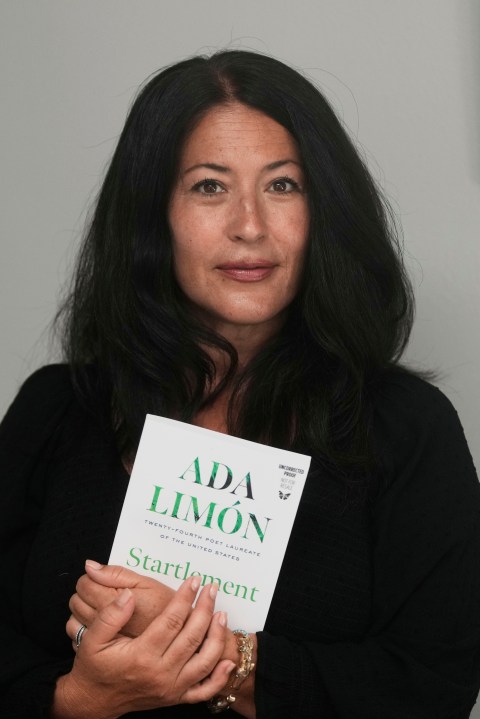
Throughout her tenure, which concluded in April, Limón achieved milestones such as writing a poem for a spacecraft journeying to Jupiter’s moon Europa and launching a program that placed poems in seven national parks. Her upcoming book, “Startlement: New and Selected Poems,” will be released on Sept. 30.
She explained that choosing which works to feature in her compilation was challenging, as she usually considers her books to be one cohesive poem. She needed to think about how to create a fresh poem from these assembled works.
“It was tougher than anticipated,” Limón admitted. “But once I committed to it, listened to the poems, and identified which ones were ready for a new beginning, it transformed.”
In a discussion with The Associated Press, Limón reflected on her poet laureate experience, talked about her new book, and expressed her worries about how the current political landscape might affect the arts. This conversation has been condensed for clarity and brevity.
AP: In your poetry, you seem to find wonder both in nature and seemingly trivial exchanges. I imagine that has to require a lot of focus. How do you cultivate that and how you maintain that with so much distraction right now?
LIMÓN: I appreciate you mentioning this because just today, I encountered a challenging moment with my phone. I wanted to share something about a recent reading I did in Yosemite, but that led me to be tethered to my phone. … It felt like a tangled interaction with what should be merely a tool, yet it became more like a taskmaster.
So I think that my job as a poet is to not lose the amazement, not lose the wonderment at the world. So I find myself often having to put devices away, having to be delighted when I am out of range, if you will, and really start noticing the strangeness of the world. But it’s not just in nature. Human beings are bizarre. Our existence is bizarre. How we relate to one another provides an endless amount of terror and amusement. … And if I’m doing my job, being in a body noticing, there is no end to poems that can be written about that.
AP: Before and after Donald Trump returned to the White House, did that have any kind of effect on your job as poet laureate, or any kind of pressures in terms of what you were able or not able to do?
LIMÓN: I think that, like everyone I know, this new administration has shifted our moral center in a way that feels drastic and evident. The biggest thing for me personally was that the Trump administration let go of Dr. Carla Hayden unceremoniously. She was serving her 10-year term as the Librarian of Congress, doing a remarkable job opening the Library of Congress up to the people in a way that had never been open before. She named it “the people’s library” and her firing, I think, was really emblematic of the trouble that is here and the trouble that’s coming.
AP: Were you ever told to lay off certain topics or certain things that you speak about publicly?
LIMÓN: The poet laureate is technically an employee of the library. We’re not funded by the U.S. government directly. It’s through the library and it’s through a donation. So because of that, we’re asked not to speak about policy, just like anyone who worked for the federal government, whether you were a park ranger or you were a librarian. That being said, there was nothing that happened directly to me as a result of the new administration, aside from the firing of Dr. Carla Hayden.
The other thing that I will say was momentous was that my project, “You are Here: Poetry in the Parks and Poetry in the Natural World,” was meant to go into every single national park. And we began with seven, we unveiled these beautiful poems, and it was such an incredible experience. And it was meant to continue. And because of funding issues and because of the new administration’s sort of attack on national parks, that program is now on pause.
AP: We’ve seen Smithsonian museums go through a review of language in their exhibits, National Park signs have been changed or reported for possible changes and fights over literature in libraries and public schools. What kind of impact does this have on the humanities for the long term?
LIMÓN: I think these are dangerous times. I think that as artists we really have to hold true to what we believe in. We have to maintain our moral center even as funding resources dry up and even as we are asked to toe the line, if you will, so I think it’s really important to remember who we are and however it is that we move in the world — whether it’s the activist poets that are doing remarkable work or whether it’s someone who’s quietly writing in order to save themselves … and I’m seeing that even in my own work, how I protect myself, how I find my courage, how I find my strength, how we rely on one another.
I think it’s really important to gather right now. I think it’s really important to remember where our power comes from and however we use our art. However we use our voices or our ears or our paintings, our bodies, whatever it is that we do to make this work, the art, the work of life, I think we need to keep doing it and we need to make sure that we aren’t losing sight of the soul.
AP: There’s a lot of attention on people using artificial intelligence and ChatGPT for writing — not just students but also adults. As someone who has dedicated her life to writing and teaching about writing, what concerns does that raise?
LIMÓN: I am morally opposed to the use of AI, particularly for the creation of art. I think that if we are to use artificial intelligence for anything, it should be used to address the climate crisis. I think it should be used for medicine, I think it should be used to help save the planet and I don’t think it should be used for art or for essays or for cognitive thinking.
I think we are in grave danger of losing critical thought and I know I’ve said “danger” a few times in this interview. But I feel it. And I think we should be really open to the possibility that AI has been a mistake. I also think we should be open to the fact that what is it in us that creates something and asks it to make art? I feel it’s because we’re asking it if it has a soul. I think every time we see something that is made, we know it doesn’t.
AP: What’s your next project?
LIMÓN: I am writing prose about my life. I just moved back to my hometown, and I actually bought my childhood home. So it is really bringing up a lot of ideas about time, ideas about identity, how we find where we belong. I’m writing about that and seeing where that takes me.