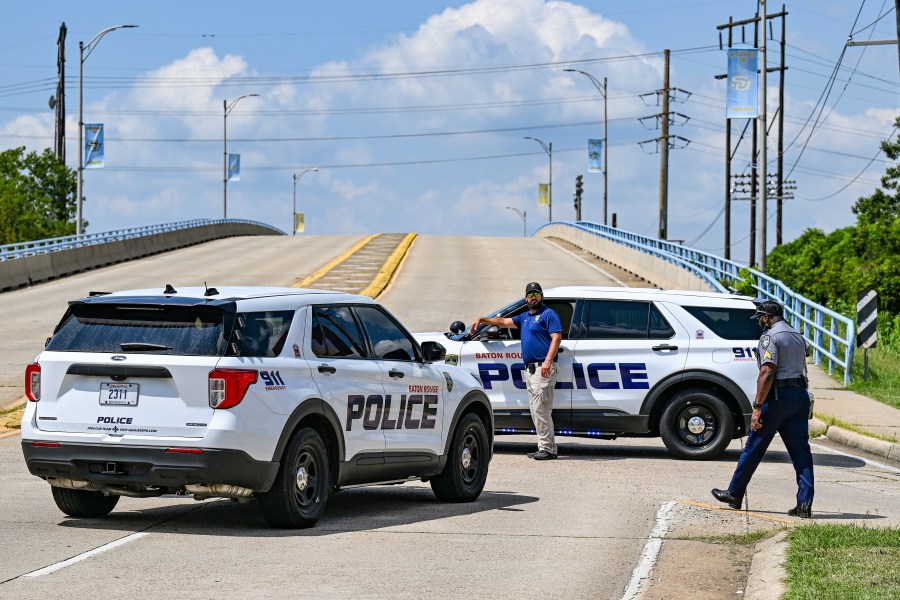


MISSION, Kan. (AP) — Recently, about 50 college campuses nationwide have been overwhelmed by hoax calls regarding armed assailants and other violent threats, highlighting the difficulty of swiftly identifying fake alerts to avoid widespread fear.
Students at several institutions spent hours hiding under their desks, only to find out later that it was a mere prank. On Thursday, several historically Black colleges either went into lockdown or canceled classes after receiving threats, especially since the fatal shooting of conservative activist Charlie Kirk at a Utah college had already heightened tensions on campuses.
In other cases, schools figured out early that something was amiss, but even then it took time and resources.
The FBI is investigating, but so far there have been no arrests.
Emergency dispatch centers often serve as the last line of defense against swatting incidents, which remains a significant challenge in an era marked by frequent mass shootings, including a recent one this week at a high school in suburban Denver and another two weeks earlier at a Catholic church in Minneapolis that resulted in the deaths of two children and injuries to 21 people.
“There are so many mass shootings in this country and far too many young lives are lost,” stated Wendy Via, co-founder and CEO of the Global Project Against Hate and Extremism. “You cannot simply dismiss these because several have been hoaxes.”
Swatting calls are on the rise
Swatting aims to provoke law enforcement, particularly SWAT teams, into responding to a location and has origins in fake bomb threats that have existed for decades.
Initially, many swatting incidents arose from disputes in online gaming. Over time, they became tied to nihilistic groups, which frequently execute these calls in massive batches, exchanging strategies in online forums to elude capture.
The FBI said swatting is on the rise. Since a center was created in 2023 to gather details on swatting incidents, hundreds of law enforcement agencies have voluntarily submitted thousands of incidents, the FBI said.
Swatting has become so prevalent that the U.S. Department of Education offered guidance on how to spot hoax calls. Clues include if the caller can’t answer follow-up questions about their phone number or current location, or mispronounces names.
Some swats linked to the group Purgatory
Purgatory, a group affiliated with The Com, which is a loose network of online threat actors, has been linked to some of the recent swats, according to reports from the Global Project Against Hate and Extremism, an Alabama-based nonprofit that tracks extremist groups online, and the nonprofit Center for Internet Security and Institute for Strategic Dialogue. The FBI declined to comment on the reports.
On more than two hours of livestreams captured by the nonprofits and provided to The Associated Press, the caller’s friends can be heard in the background laughing, belching and taking breaks to rap.
Keven Hendricks, a cyber crime expert who teaches law enforcement about investigating swatting, said the calls “shake your faith”
“We want there to be a reason they were doing it,” he said. “And they were doing it for the LOLs.”
Spotting a swat
One swatting attempt last month at Kansas State University serves as a case study of sorts on spotting a swat.
There were clues from the start that something was amiss. The first red flag was that it wasn’t a 911 call, said Major Daryl Ascher, of the Riley County Police Department. Police declined to provide their own recording of the call, but Ascher confirmed many of the details.
Emergency calls are geolocated, meaning someone calling 911 outside the targeted area won’t get through because it will be directed to the dispatch center closest to their location. Swatters instead resort to calling non-emergency police numbers.
“That should be a dead giveaway,” said Don Beeler, chief executive officer of TDR Technology Solutions, which tracks swatting calls and offers technology to prevent them. “You’re not going to look it up if you are in an emergency. That’s just not how the human brain works.”
He said that if its system detects a suspicious call like that, it is transferred to an automated recording that tells the caller to hang up and dial 911.
On the technical side, halting calls made using voice over internet protocol technology, or VoIP, from being made from behind virtual private networks would stop most swats, said Hendricks, who has been swatted himself.
Dispatchers look for clues
The next clue was that the swatter got the Manhattan, Kansas, school’s name slightly wrong, calling it Kansas City State University, referencing a city around 120 miles (193 kilometers) away.
“Obviously, if you were from Manhattan or attending a university, you would know the name of the university,” Ascher said.
As a giggling throng listened on messaging platform Telegram, the swatter then described a man armed with an AR-15 prowling the university’s library, a description that was nearly identical to the calls flooding other university towns. The gunfire that peppered the call also was a tip-off because it “sounded like it was from a TV,” Ascher said.
On the livestream, the clearly skeptical dispatcher asked why the caller couldn’t see the purported gunman when the shots sounded so close to him and why other 911 calls weren’t flooding in.
“I’m not sure ma’am. I’m not sure if they have a phone or not,” the caller answered.
Officers still were dispatched to the library. Ascher provided no details on how many or their tactics, but said dispatchers kept them informed of the potential it was a hoax.
“I often wonder if people don’t have something better to do,” Ascher said, pausing. “It is just very taxing on law enforcement.”
It’s also been taxing on students.
The worry is that hoaxes will create complacency at campuses where active shooter alerts and drills have become a regular part of life.
“I hope we’re not desensitized enough to this enough to the point where we don’t take these alerts seriously anymore,” said Miceala Morano, a 21-year-old senior journalism major, who took cover after a recent threat at the University of Arkansas. “Unfortunately, it still is a very real possibility.”
___
DeMillo reported from Little Rock, Arkansas