Share this @internewscast.com
Key Points
  • Labor has introduced its 2035 climate goal following cabinet endorsement in Sydney.
  • The government revealed new investments to aid industry decarbonisation and reduce electricity costs.
  • Environmental advocates urged a minimum target of 80 per cent.
The federal government has pledged a new climate goal to reduce emissions by 62 to 70 per cent by 2035, compared to 2005 levels.
Prime Minister Anthony Albanese announced the target range on Thursday alongside Treasurer Jim Chalmers, Climate Change Minister Chris Bowen, and Climate Change Authority chair Matt Kean, following its cabinet endorsement.
Albanese stated that the government accepted the Climate Change Authority’s independent advice, describing it as a “responsible” measure grounded in science and a “practical plan to achieve it”.
“It is the appropriate target to safeguard our environment, advance our economy and jobs, and ensure we act in our national interest and for future generations,” he told reporters in Sydney.

Along with the 2035 goal, the government also launched a $5 billion Net Zero Fund within the National Reconstruction Fund to assist industries in decarbonisation, and $2 billion for the Clean Energy Finance Corporation to lower electricity costs.

“This will help to accelerate long-term renewable projects right across our nation,” Albanese said.
When asked exactly how much power bills will come down, Albanese did not provide a figure.
“What we know is if we do not act, [there] will be a cost of the economy … [That] will be lower wages, lower growth, less jobs,” he said.
Bowen said the global shift to clean energy presents the “biggest economic transformation” since the Industrial Revolution, and that the government had decided to “seize that opportunity”.
“It presents Australia with our best ever economic opportunity if we get this right, if we make the right investments at the right time, we can grow our economy, create good jobs for Australians,” he said.

Bowen said the target range comes with a “robust” plan to get there.

The target range builds on Australia’s existing target of a 43 per cent reduction in emissions below 2005 levels by 2030, on the path to net zero by 2050.
The Paris Agreement, which Australia and 194 other parties adopted in 2015, aims to limit global average temperature increase “well below 2C” and pursue efforts to limit it to 1.5C compared to pre-industrial levels.

According to the agreement, members must increase their emissions targets every five years and are prohibited from reducing them. Signing nations must present their new targets by the end of this month.

‘Ambitious but feasible’

The Climate Change Authority had previously suggested a 2035 target range of between 65 and 75 per cent would be achievable.
Its final advice, published on Thursday, recommended a range between 62 and 70 per cent, which the government accepted.
Kean said the target requires Australia to cut its emissions by half over the next decade.
“It is ambitious, but it is absolutely feasible,” he said.
He said the authority considered over 500 submissions from stakeholders, the “best available science” and economic modelling to build a “bottom-up analysis” and arrive at its advice.

“We focused on setting a target that will secure industry, secure the economy, and secure our lifestyle while protecting the planet,” he said.

Environmental groups had called on the government to set a target of no less than 80 per cent below 2005 levels, while business groups had warned that a target higher than 70 per cent would risk more than $150 billion in exports and send companies offshore.
Bowen said the announced target was the “maximum level of achievement possible”.
“You [have] heard me say many times that the target must be two things: ambitious and achievable. A target over 70 is not achievable — that advice is clear. We have gone for the maximum level of ambition that is achievable,” he said.
Modelling undertaken by Treasury, also released on Thursday, showed that under a 65 per cent target, the economy would be $2.2 trillion bigger by 2050, and create 5.1 million jobs.
Chalmers said a “disorderly transition” to net zero would leave the economy $1.2 trillion smaller.
“The only scenario which would be worse than a disorderly transition would be to abandon net zero completely. That would be a disaster for our economy,” he said.

‘Weak, dangerous and drastically short’, Greenpeace says

The Australian Conservation Foundation (ACF) said the government’s “timid target range” suggests Albanese “is more committed to the future of the coal and gas industries than he is to the safety of Australian communities and nature”.
The range “falls significantly short on all measures of what’s needed”, ACF’s climate and energy program manager Gavan McFadzean said, suggesting the government’s plans prepare Australia “only to meet the bottom end of the range”.
Environmental organisation Greenpeace Australia Pacific branded the range as “weak, dangerous and drastically short of what’s needed to meet the urgency of the climate risk”.
Shiva Gounden, Greenpeace’s head of Pacific, said: “The Albanese government’s new climate plan is an affront to communities across the Pacific and Australia facing the escalating impacts of dangerous climate change.”
The Business Council of Australia (BCA) said the target range is “ambitious” and will require significant investment and major reform.

BCA chief executive Bran Black remarked: “We strongly support net zero by 2050, and achieving this is about balancing future generations’ needs while allowing Australian industry to remain competitive in the global market today.”

What have the Opposition and the Greens said?

Greens leader Larissa Waters labelled the government’s target range a “shameless capitulation” to coal and gas corporations.
“Labor’s utter failure of a climate target is a betrayal of people and the planet and a win for coal and gas corporations,” she said.
Speaking later on Thursday, Opposition leader Sussan Ley said the government’s target range fails on both “cost and credibility”.
“There is nothing in this announcement that demonstrates to Australians how much it will cost. And that’s not reasonable for households, for businesses, for the hard-working manufacturers in this country who want answers and are seeing their electricity bills skyrocket,” she said.

“If the government wants a candid discussion with Australians, they must be transparent about critical energy sector announcements. Energy drives the economy. They must be honest about the real costs involved.”

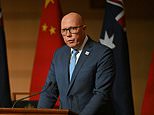
Ley said on Thursday that the Coalition is unified in its plans to oppose the government’s target, saying: “I can assure you there was absolutely no division in opposing Labor’s latest piece of train wreck energy.”
She said the party’s own energy policy is going through a “detailed policy development process”.
— With additional reporting by the Australian Associated Press

Share this @internewscast.com
You May Also Like

Unveiling Australia’s Rarest Parenting Experience: A Behind-the-Scenes Look at the ‘Military Operation’ Approach

Raising triplets is no small feat, and parents facing this unique challenge…
A plus-size model has left her fans divided after she unveiled the white gown she wore for her wedding welcome party

Controversial Welcome Party Wedding Dress by Australian Plus-Size Model Sparks Fan Debate

A plus-size model has sparked a mix of reactions among her followers…
How nuclear power plant neighbours could be in for a cash windfall: Peter Dutton reveals specific details of his energy plan - as the seven Aussie sites are named

Peter Dutton Unveils Energy Plan: Find Out Which Aussie Towns Near Nuclear Sites Could Benefit Financially

Dutton’s pitch to the public: ‘A long term energy plan’ Peter Dutton…
Man sentenced to 11 years in prison over unprovoked stabbing spree

Justice Served: Man Receives 11-Year Sentence for Shocking Unprovoked Stabbing Rampage

A man who carried out a series of unprovoked stabbing attacks on…
Monster illicit tobacco haul uncovered in suitcase

Massive Illicit Tobacco Bust: Suitcase Yields Shocking Discovery

A record number of illegal vapes and tobacco products have been intercepted…

Trump Extends Ceasefire Agreement with Iran: What It Means for Global Diplomacy

Transportation ministers from the European Union’s 27 member countries convened in Brussels…

Wong’s Diplomatic Blitz: Albanese Cautions Australians on Prolonged War Impact

IN BRIEF Penny Wong has held urgent talks with global counterparts as…

Protesters Launch Legal Battle Against Controversial Anti-Hate Speech Laws

in brief Pro-Palestinian protesters are challenging Queensland’s hate speech laws after arrests…
Mr Mohamed was in Hawaii  for the Festival of Pacific A

Anthony Albanese’s Early Confidence in the Voice: Creating an Ambassadorial Role for Global Advocacy Before Australia’s Rejection

Anthony Albanese was so sure of the Indigenous Voice to Parliament’s success…

Unraveling the Peter Mandelson Controversy: What It Means for Keir Starmer’s Leadership

Since the revelation in September last year, United Kingdom Prime Minister Keir…
Health Minister Mark Butler announced the changes at the National Press Club today.

Understanding the Impact of the NDIS Overhaul on Your Benefits

The government is poised to significantly reduce the expenses associated with the…

Australia’s Gas Tax Under Fire: Calls Intensify for a Major Overhaul

In brief A Senate inquiry has heard from think tanks, economists and…