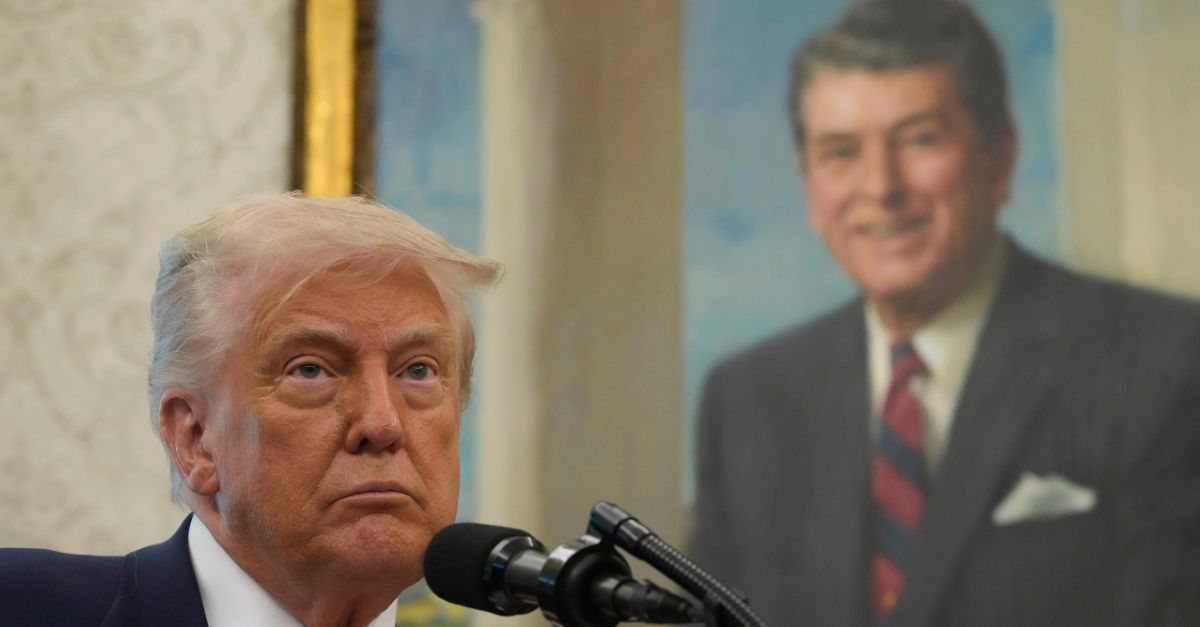

President Donald Trump addressed an audience in the Oval Office on Tuesday, May 6, 2025, during a ceremony where Steve Witkoff was sworn in as a special envoy. The event, held in Washington, featured a portrait of former President Ronald Reagan in the background. (AP Photo/Mark Schiefelbein).
On Friday, a federal judge prohibited the Trump administration from applying an anti-transgender executive order to organizations receiving funds through the National Endowment for the Arts (NEA).
The executive order, titled “Defending Women From Gender Ideology Extremism and Restoring Biological Truth to the Federal Government,” was issued in January by the 45th and 47th president. This order instructed agencies to discontinue federal funding and to make sure that grant money does not support gender ideology.
U.S. District Judge William E. Smith, appointed by George W. Bush, harshly criticized the NEA’s actions to implement and uphold the executive order in a comprehensive 45-page memorandum opinion.
The opinion stated, “The public interest is not aligned with the government when a program meant to encourage free expression is instead used to suppress it.”
Following the issuance of the contentious decree by Trump, the NEA introduced a policy mandating all applicants for grants to affirm that no federal funds would be utilized to endorse gender ideology.
The four Rhode Island-based plaintiffs – Rhode Island Latino Arts, National Queer Theater, The Theater Offensive, and Theatre Communications Group – sued alleging a raft of constitutional and statutory violations. The heart of their 32-page complaint alleges the NEA’s implementation of Trump’s order violates the First Amendment as well as the Administrative Procedure Act, the federal law governing agency behavior and lawsuits challenging such behavior.
Earlier in the litigation, the judge said he believed the plaintiffs were likely to succeed on their free speech claim – but denied preliminary relief in order to allow an administrative review process to play out.
While that process was seen through to its statutory end, motions practice continued on the docket for several months.
Now, the court has found that sufficient time has passed to put a kibosh on the Trump administration’s actions under the First Amendment.
“With the Final Notice in effect, projects deemed to promote gender ideology are less likely to be approved for NEA funding,” the opinion reads. “The Final Notice is thus a restriction on artists’ speech, and one that is viewpoint based, because it assigns negative weight to the expression of certain ideas on the issue of gender identity. The Final Notice is thus presumptively unconstitutional.”
The court elaborates, at length:
Defendants concede that if the [NEA] Chairperson “concludes that a proposed project ‘promotes gender ideology,’ that factor could weigh against the project’s final approval.” To be sure, the Chairperson “will not disqualify a project from consideration solely on [the Chairperson’s] conclusion that a proposed project ‘promotes gender ideology.'” But in no circumstance could that conclusion “weigh in favor of the project’s final approval.”
From the Court’s perspective, these concessions demonstrate that projects deemed to “promote gender ideology” are less likely to receive NEA funding. In other words, the NEA intends to disfavor applications that promote gender ideology precisely because they promote gender ideology. The Final Notice therefore promises to penalize artists based on their speech. If the NEA restricted all applications that touched on the subject of “gender ideology,” or on the relationship between sex and gender more broadly, that would amount to a content-based restriction on artists’ speech. Because the Final Notice targets the promotion of specific ideas about these topics, however, the NEA is engaged in viewpoint discrimination, which is “an egregious form of content discrimination.”
By terming such forms of discrimination constitutionally “egregious,” Smith is essentially employing a term of art used to activate the appropriate form of judicial scrutiny required for the final part of his analysis.
Under long-standing ideas of constitutional analysis, the way a court approaches an inquiry into government behavior is often determinative, if not dispositive. In the parlance of the U.S. Supreme Court, there are three major frameworks: rational basis review, intermediate scrutiny, and strict scrutiny. In general terms, rational basis review often yields a win for the government; strict scrutiny often yields a loss; while intermediate scrutiny is anyone’s guess.
Here, Smith applied strict scrutiny – but the inquiry is terse and cursory because the government made “no effort to argue the Final Notice satisfies any type of judicial scrutiny, let alone strict scrutiny.”
As for the APA claim leveled by the plaintiffs, the court determined the NEA’s attempt to block such funds was arbitrary and capricious.
The APA’s “arbitrary and capricious” standard is a term of art – and a phrase which has leapt from the statute into popular culture writ large. In context, the term describes government actions that go too far while simultaneously eschewing formal, mandatory, processes.
Here, the court was withering.
“There is no examination of relevant data, there are no findings of fact, and there is zero explanation of what it means for a project to ‘promote gender ideology,’ let alone how that concept relates to artistic merit, artistic excellence, general standards of decency, or respect for the diverse beliefs and values of the American public,” Smith goes on. “In short, the NEA has made no effort to justify its policy on any grounds aside from complying with the [executive order].”
In a combined APA and First Amendment discussion, the court quickly sums up the case: “the Final Notice is unlawful under the APA because it violates Plaintiffs’ constitutional rights to free speech.”


