
Key Points
  • Goodall revolutionized wildlife research, sparking public interest in her cherished chimpanzees.
  • Motivated by extensive habitat destruction, she spearheaded a worldwide movement for wildlife and environmental advocacy.
  • Her institute confirmed she passed away due to natural causes while in California for a speaking engagement.
Jane Goodall, a scientist and influential activist who transformed her passion for primates into a lifelong mission to safeguard the environment, has passed away at 91.
According to a post by the Jane Goodall Institute, she died from natural causes in California during a speaking tour on Thursday morning AEST.
“Dr. Goodall’s breakthroughs in ethology changed the scientific landscape, and her devotion to the protection and recovery of nature was unwavering,” stated the Institute on Instagram.

The renowned primatologist’s journey led her from a small English seaside town to Africa and eventually around the world, with the aim of deepening understanding of chimpanzees and encouraging human responsibility in protecting their habitats and the broader ecosystem.

Goodall was a pioneer in her field, both as a female scientist in the 1960s and for her work studying the behaviour of primates.
She upended scientific norms of the time, giving chimpanzees names instead of numbers, observing their distinct personalities, and incorporating their family relationships and emotions into her work. She also found that, like humans, they use tools.
As her career evolved, she shifted her focus from primatology to climate advocacy after witnessing widespread habitat devastation, urging the world to take quick and urgent action on climate change.

“We’re forgetting that we’re part of the natural world,” she told CNN in 2020. “There’s still a window of time.”
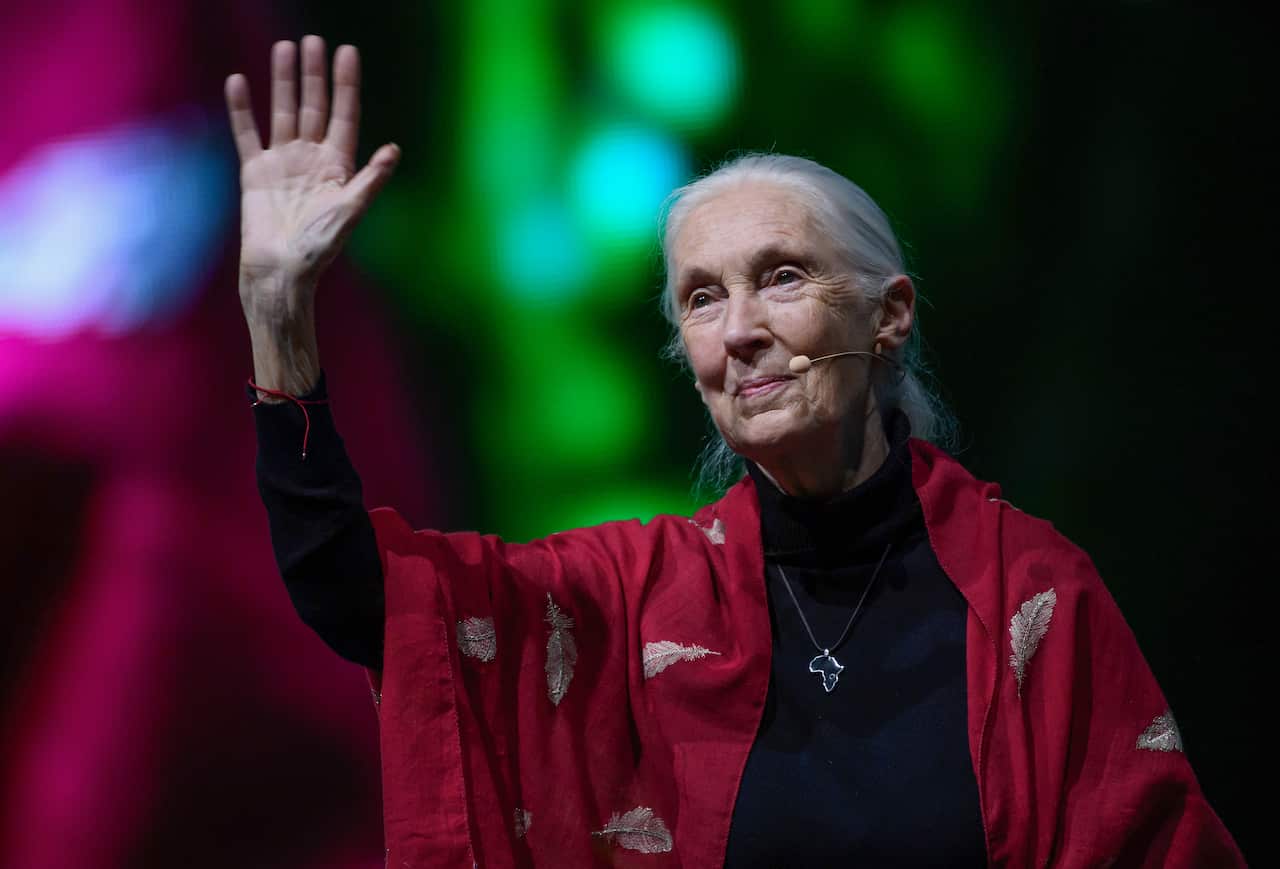
A woman wearing a black top and red shawl waving her hand.

Jane Goodall authored over 30 books on primatology, including her acclaimed 1999 work, Reason For Hope: A Spiritual Journey, in addition to numerous children’s books. Source: Getty / Sven Hoppe

Born in London in 1934 and then growing up in Bournemouth on England’s south coast, Goodall had long dreamed of living among wild animals. She said her passion for animals, stoked by the gift of a stuffed toy gorilla from her father, grew as she immersed herself in books such as Tarzan and Dr Dolittle.

She set her dreams aside after leaving school, unable to afford university. She worked as a secretary and then for a film company until a friend’s invitation to visit Kenya put the jungle — and its inhabitants— within reach.
After saving up money for the journey, by boat, Goodall arrived in the East African nation in 1957. There, an encounter with famed anthropologist and paleontologist Louis Leakey and his wife, archaeologist Mary Leakey, set her on course to work with primates.

Under the guidance of Leakey, Goodall established the Gombe Stream Chimpanzee Reserve, now known as the Gombe Stream Research Centre, near Lake Tanganyika in modern-day Tanzania. Her discoveries there revealed that chimpanzees consume meat, engage in territorial conflicts, and notably, create tools to extract termites.

Although she eventually paused her research to earn a PhD at Cambridge University, Goodall remained in the jungle for years.
She also drew the public into the wild, partnering with the National Geographic Society to bring her beloved chimps into their lives through film, TV and magazines.
Nearly thirty years after first arriving in Africa, however, Goodall said she realised she could not support or protect the chimpanzees without addressing the dire disappearance of their habitat.
In 1977, she set up the Jane Goodall Institute, a nonprofit organisation aimed at supporting the research in Gombe as well as conservation and development efforts across Africa. Its work has since expanded worldwide and includes efforts to tackle environmental education, health and advocacy.
She later expanded the institute to include Roots & Shoots, a conservation program aimed at children.
A prolific author, she published more than 30 books with her observations, including her 1999 bestseller Reason For Hope: A Spiritual Journey, as well as a dozen aimed at children.
Goodall said she never doubted the planet’s resilience or human ability to overcome environmental challenges.
“Yes, there is hope … It’s in our hands, it’s in your hands and my hands and those of our children. It’s really up to us,” she said in 2002, urging people to “leave the lightest possible ecological footprints”.

You May Also Like
NRL star Jai Arrow has retired aged just 30, with his devastating motor neurone disease diagnosis leaving rugby league fans shattered

Experts Weigh In: Are Football Legends Jai Arrow and Neale Daniher at Higher Risk for Motor Neurone Disease?

The recent passing of Neale Daniher and the shocking diagnosis of Jai…
In a special episode of the Daily Mail's Palace Confidential, royal editor Rebecca English tours an exhibition which charts Queen Elizabeth's historic reign through clothes, guided by its curator, Caroline de Guitaut. To mark what would have been the monarch's centenary, Queen Elizabeth II : Her Life in Style puts many of her most iconic outfits and accessories on public display for the first time at The King's Gallery, Buckingham Palace. Among the pieces visitors can study up close is the historic gown from the Queen's 1953 coronation, created by royal couturier and longtime collaborator Sir Norman Hartnell. Hartnell was given around eight months to realise his vision for the outfit, eventually presenting the monarch with eight separate designs to choose from.

Queen Elizabeth’s Unique Coronation Dress Request Revealed

In a unique episode of the Daily Mail’s Palace Confidential, royal editor…

Discover How Major Global Cities Have Tackled Heatwaves Amidst the UK’s Rising Temperatures

In brief As the UK swelters, its residents have turned to tried…
US launches new strikes on Iran

US Conducts Strategic Strikes on Iran: Key Developments and Global Implications

In a bid to bolster Ukraine’s defense capabilities against escalating Russian missile…
Iran reveals 'draft deal' that would unlock world's oil crisis

Iran’s Proposed Draft Deal Aims to Alleviate Global Oil Shortage

Iran‘s state TV says it has obtained a draft of an initial,…
Missing four-year-old Gus

Police Disheartened After Exhaustive Three-Day Search for Gus Yields No New Leads

South Australian police have announced that their latest search efforts around the…
Lauren Huxley is a name most Australians will always remember.

Shocking Parole Denial: Lauren Huxley’s Attacker Remains Behind Bars

Robert Black Farmer, infamous for a brutal and nearly deadly assault on…
Father of Nesrine Zahab, Zakariah Zahab.

Father Defends ‘ISIS Bride,’ Argues Against Legal Charges for Past Mistake

The father of a woman labeled as an “ISIS bride” recently returned…

Aussies Turn to Extreme Measures: Bin Diving and Thinning Meals to Survive Economic Strain

In Brief More Australians are taking ‘desperate’ measures as they battle food…
'I'm still shaking': Villagers found alive after week trapped in cave

Survivors Rescued After Week-Long Ordeal Trapped in Cave

Five villagers stuck in a flooded cave in central Laos for more…
The four spent two hours wrangling the massive fish.

Epic $70,000 Catch: Why This Aussie Trio Missed Out on a Fortune

Three brothers have hooked a monster tuna weighing 107.5 kilograms off the…

Australia’s Next Move: Will It Adopt US and Canada’s Ebola Travel Restrictions?

in brief Countries including the United States and Canada have started placing…