
Share this @internewscast.com
Advocates for people with disabilities are pushing for the government to clarify the recent changes announced regarding how individuals over 16 using the National Disability Insurance Scheme (NDIS) will have their support needs evaluated.
Previously, NDIS participants have depended on reports from healthcare professionals to request various funding levels.
However, starting in mid-2026, these reports will largely be replaced by interviews ranging from one to three hours, as stated by NDIS Minister Jenny McAllister in late September.
McAllister mentioned that this new approach “will be fairer, more consistent, and simpler for participants to navigate”.

“We want to allow providers and therapists to focus on delivering services to participants instead of spending time writing reports,” she told SBS News.

The new assessment process will also use a digital tool — the I-CAN — a customised version of which has already been used for almost five years in the Disability Support for Older Australians program, McAllister said.
The tool will be applied alongside questionnaires assessing each individual’s personal and environmental circumstances, with further targeted assessments for those with more complex disability support needs.

Nonetheless, disability advocates argue that McAllister should offer more information, expressing concern that if participants’ voices aren’t considered, the new system could potentially be “traumatizing”.

Trauma is ‘real and it’s large’

NDIS participant and advocate Jarrod Sandell-Hay is alarmed by the prospect of NDIS assessors coming into people’s homes, something he said would be necessary if they wanted to truly understand people’s needs.
“To do a thorough assessment of somebody’s needs, you really do have to go into all aspects of their life,” said Sandell-Hey, who has cerebral palsy and uses an electric wheelchair.

“Imagine being a woman with a disability, who statistically has a 70% chance of surviving sexual violence, and is asked personal questions about her showering habits by a stranger, someone who might not make her feel secure. This situation could be quite distressing.”

A middle-aged man with a full dark beard and glasses smiles at the camera, wearing a light-coloured collared shirt and a muted olive-green fedora. The outdoor photo is taken on a sunny day with a bright blue sky and blurred greenery, including a large tree, in the background.

Jarrod Sandell-Hay cautioned that simplifying the NDIS assessment process might make it so ineffective that it’s “not worth it” for some participants. Source: Supplied

“And in the back of your mind, you understand that these three hours can make or break your next five years of funding — that’s extremely traumatising.

“The trauma involved is real and it’s large.”
Another NDIS participant and advocate, Stevie Lang Howson, described the possibility of in-home visits from assessors as “degrading”.
“Disabled people — and most Australians — aren’t keen on the idea of a nice person from the government coming over to your house to look around and watch you make a cup of tea or get on or off the toilet,” Lang Howson said.

“It’s crucial for participants to continue having assessments done by trusted and qualified practitioners with whom they have a rapport.”
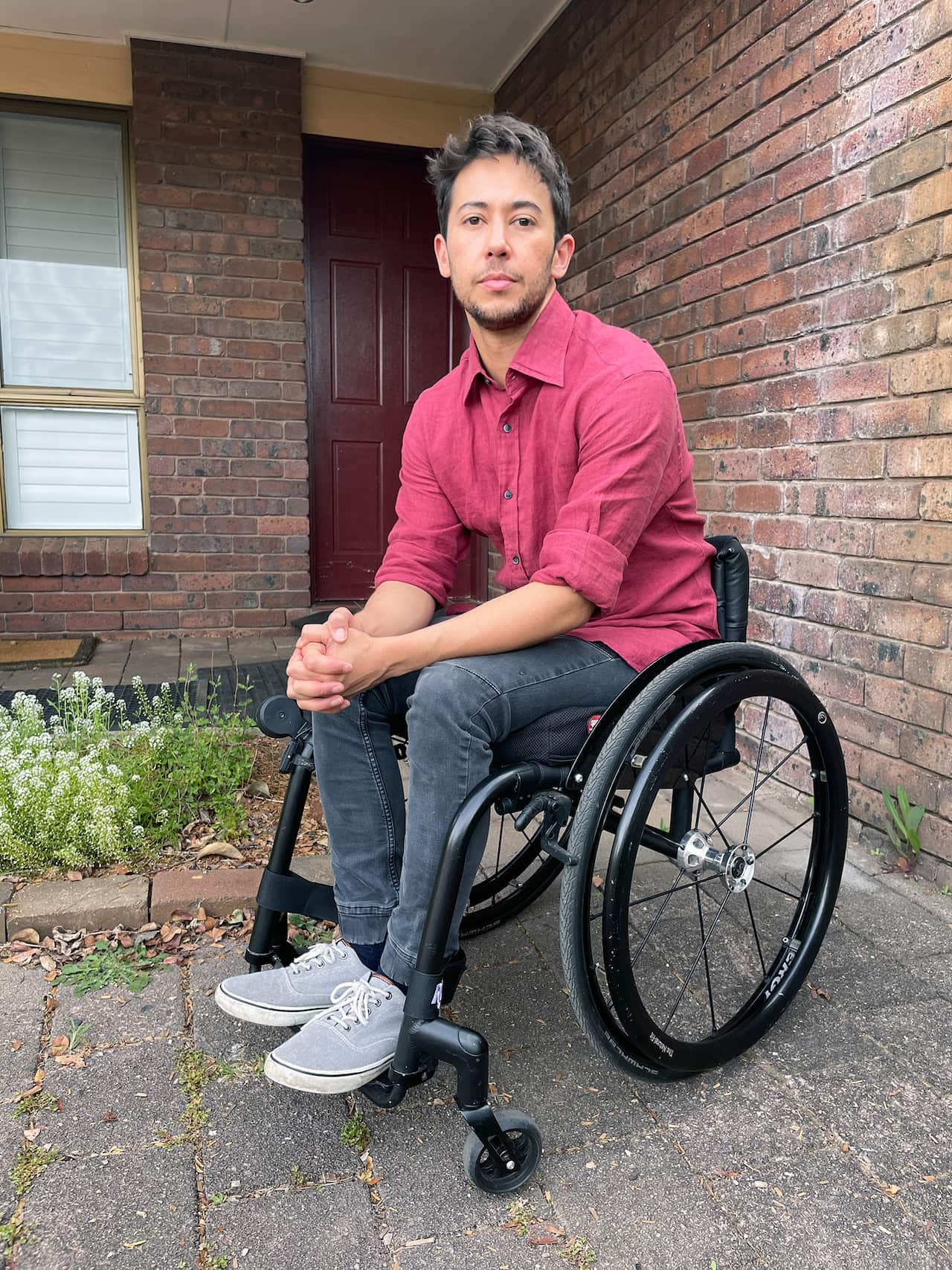
A man with short brown hair sits in a sleek black manual wheelchair, looking directly at the camera with a neutral expression. He is wearing a long-sleeved dark red button-up shirt and dark grey jeans, positioned on a paved walkway in front of a brick house.

Stevie Lang Howson shared with SBS News: “Currently, when I need an NDIS assessment, my occupational therapist who is familiar with me ensures it’s conducted in a way that’s attuned to my personal needs.” Source: Supplied

McAllister did not provide a specific answer to an SBS News question about whether the new system would involve in-person visits.

However, she said the government was “committed to continuing consultation” on the implementation of the plan, which was being rolled out in stages to allow participants to provide real-time feedback.

“The NDIA [National Disability Insurance Agency, which administers the NDIS] will continue to engage with participants, families, carers and the broader disability community to make sure that when support needs assessments are introduced from mid-2026, they work for everyone.”

‘Doesn’t make a lot of sense’

The government has promoted the changes by pointing out that preparing professional reports from GPs or allied health practitioners is cost-prohibitive for some participants.
“It will mean the level of supports a person receives won’t depend on whether they can afford to have a report prepared,” McAllister told SBS News.
However, the changes are also partly motivated by the capacity of the NDIA, disability advocates say.
“They’ve already told the public that they don’t have time to read our gigantic reports that are very detailed,” Sandell-Hay said.
Former NDIA chief executive Rebecca Falkingham told Senate estimates in February that her staff “can’t read the 280-page reports that they get”.
Sandell-Hay said: “They’re not that big, and if they’re big, the reason why they’re big is because the agency don’t take our needs and our assessments seriously.”

“A lot of us said: ‘Yeah, okay, if you want to do these assessments, no worries, but you need to allow us to also give you reports and other evidence, and that evidence needs to be equally considered.'”

He also said the system moving away from professional reports towards self-reporting “doesn’t make a lot of sense in my mind”.
“If you have a look at recent decisions by the NDIS in legal procedures, they talk about how they don’t really value self-assessment from participants.
“So it’s a bit confusing: why they would choose a tool (I-CAN) that relies on — the majority of the tool relies on — the participant giving a self-assessment,” he said.
Lang Howson agreed, saying: “We know the NDIA doesn’t trust us to say what our support needs are without good evidence.”
“If they trusted disabled people to just have a conversation about what we need, we wouldn’t be seeing a 76 per cent increase in the numbers of participants in the tribunal right now.

“Some people have disabilities that make it harder to self-report. And we know the NDIA already assumes that people are exaggerating their needs.”

However, it remains unclear whether assessors will have any obligation to consider professional reports submitted under the new system.
“Participants will be able to submit their own reports to help the support needs assessor understand their situation,” McAllister said, while not directly answering questions about whether they would be obliged to read these reports.
“We are developing a comprehensive needs assessment which reduces the need for individuals to supply additional information or supporting evidence.”
Lang Howson said McAllister “must come clean about how our NDIS budgets will be calculated and what evidence will be used and explain the full extent of any automation, templating or algorithmic inputs”.
“I don’t believe for a moment that they will decide if we get zero dollars or $200,000 in our NDIS budget based on a ‘conversation’,” he said.
SBS News asked the minister whether the way budgets are calculated under the new system would be transparent but did not receive a direct response.

Share this @internewscast.com
You May Also Like

Understanding Australia’s Fuel Excise: How It Stacks Up Against Global Counterparts

In brief: The Australian government imposes a tax on petrol, called the…

Navigating the Squeeze: Surging Rental Prices and Limited Availability Challenge Renters in 2023

In brief While rental property vacancy rates have slowly improved since post-COVID…
Pay rise looming for millions of Aussies as fuel crisis hits

Impending Salary Increases for Millions of Australians Amid Fuel Crisis Impact

For weeks, Donald Trump and Benjamin Netanyahu have appeared united since the…
Cyclone Narelle is getting stronger and set to hit large parts of Western Australia.

Cyclone Forecast to Bring Torrential Rain and Flash Flooding to Perth

Tropical Cyclone Narelle has reformed off the north-west of Western Australia and…

Government Under Increasing Pressure to Implement Emergency Fuel Measures

Key Points The Liquid Fuels Emergency Act, if invoked, would give the…
US President Donald Trump

Trump Urges Iran to ‘Get Serious’ as Tehran Dismisses Ceasefire Proposal

President Donald Trump has issued a stern warning to Iran, urging its…

Australia Faces Rising Food Costs as Fuel Shortages Hit Hard

In Brief Diesel shortages are disrupting transport and supply chains across Australia.…
Pensioner Larry Allison says he will likely have to work until he is 80 to afford the cost of living.

Discover Why Many Australians Are Redefining Retirement and Continuing to Work Beyond 65

Larry Allison, at the age of 74, still hears his alarm buzzing…
Gold Coast man Richard Croydon is four weeks into a nine month road trip.

Rising Fuel Costs Halt Easter Road Trips, Prompt Cafes to Consider Surcharges

Cafes and businesses are being urged to pass on a surcharge and…
Meta struck down in child negligence decision

Meta Faces Legal Setback in Landmark Child Negligence Case

A groundbreaking court ruling has held Meta and YouTube accountable for causing…
What nation's youngest murderer asked a stranger

Unveiling the Shocking Case: Nation’s Youngest Convicted Murderer Seeks Help from Stranger

An infamous Australian criminal, who was convicted of murdering a preschool-aged child…
Savannah Guthrie

Savannah Guthrie Speaks Out in Emotional First Interview After Mother’s Mysterious Disappearance

NBC offered viewers a sneak peek of an upcoming interview on Wednesday…