

In today’s fast-paced world, it’s not unusual to forget to send an email or struggle to focus, and many of us may even feel anxious about attending social gatherings. While these are typical indicators of stress, experts caution that such issues might also be early warning signs of dementia.
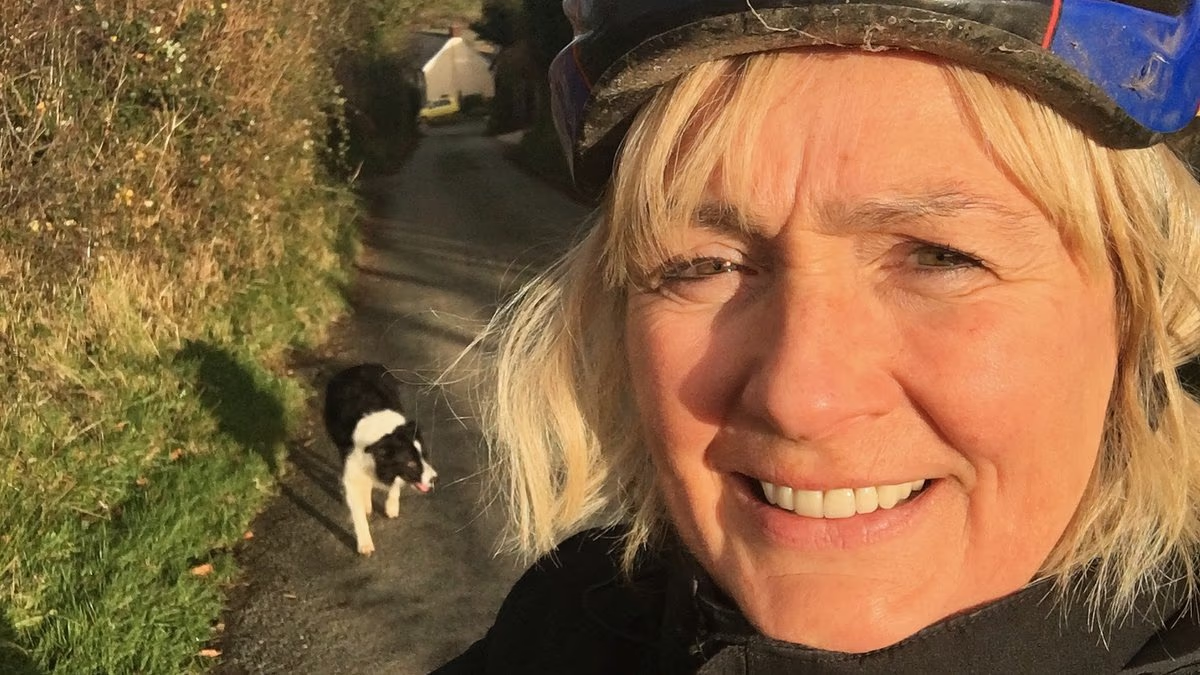
Professor June Andrews, a dementia care expert and nurse at the University of Stirling, explains, “Almost everyone encounters moments of forgetfulness, confusion, or lack of focus during stressful or hectic times.”
She adds, “Typically, these symptoms fade away after some rest and recovery. However, they can also be early indications of dementia, which people often overlook.”
The crucial factor, according to Professor Andrews, is observing whether these symptoms persist and intensify over the course of months or even years.
So, what should you be on the lookout for in the early stages of dementia?
Forgetting appointments
One of the most prevalent early signs of dementia is memory loss.
But as forgetfulness is something many of us will experience from time to time, experts warn that patients often do not acknowledge it as a symptom and instead put it down to stress.
‘The key here is whether memory lapses increase in frequency and minor lapses become more serious,’ says Professor Paresh Malhotra, a dementia expert at Imperial College London.
With stress-related forgetfulness, people often suddenly remember what they forgot. But with dementia, it’s more likely a person has no recollection of the thing they missed.
‘Often, loved ones are the first to notice this,’ adds Prof Malhotra.
Technophobia
Experts warn that if someone has trouble problem-solving and deeply resents change, which is often put down to being under stress, it may also be a sign of dementia.
Professor Malhotra says: ‘What people do not realise is that we need memory to learn new skills, so what patients often report or confuse for pressure is an inability to get to grips with new information, such as computer software.’
Memory challenges also present in other common symptoms such as difficulty planning, problem-solving or confusion over being in a new place.
‘Patients often complain that cooking a complex meal – perhaps Christmas dinner – or finding their way around a new place, become more challenging,’ he adds.
Tired eyes? A subtle sign
After a hard week at work, people often feel fatigued, and lapses in concentration are common.
However, an early warning sign of dementia is struggling to process visual information.
‘This may mean that patients put a T-shirt on the wrong way or grab the mug rather than the handle of a hot cup of coffee,’ says Dr Calum Hamilton, a fellow at Alzheimer’s Research UK.
‘Their first port of call is to think it is a problem with their eyesight and check their glasses prescription. But it could be an early sign of dementia.’
Frequently lost for words
Not being able to find the right word for an object is a common sign of stress, but it may be a sign of dementia.
‘We often see patients in the early stages of dementia who fail to recall names or objects that they would normally be able to – these are things like kitchen utensils or animals,’ says Dr Hamilton.
A person with dementia may find it hard to engage in conversations. They might forget what they are saying or what somebody else has said, and it may be hard to enter a conversation.
People may also find their spelling, punctuation, grammar and handwriting get worse.
Changes in mood
While stress-related changes usually ease when pressures reduce or we have a rest, dementia-related changes tend to be more persistent and progressive.
For example, they may become irritable, depressed, fearful or anxious. They may also become more disinhibited or act inappropriately and lose spatial awareness.
Avoiding social gatherings
We often put down our lack of social ‘battery’ to fatigue or stress.
But Professor Malhotra says: ‘One of these behavioural changes is withdrawing from social situations.
‘And it can often be explained by other symptoms, such as feeling less confident in their speech, so not wanting to be in a social setting, or a change in personality.’