
Share this @internewscast.com
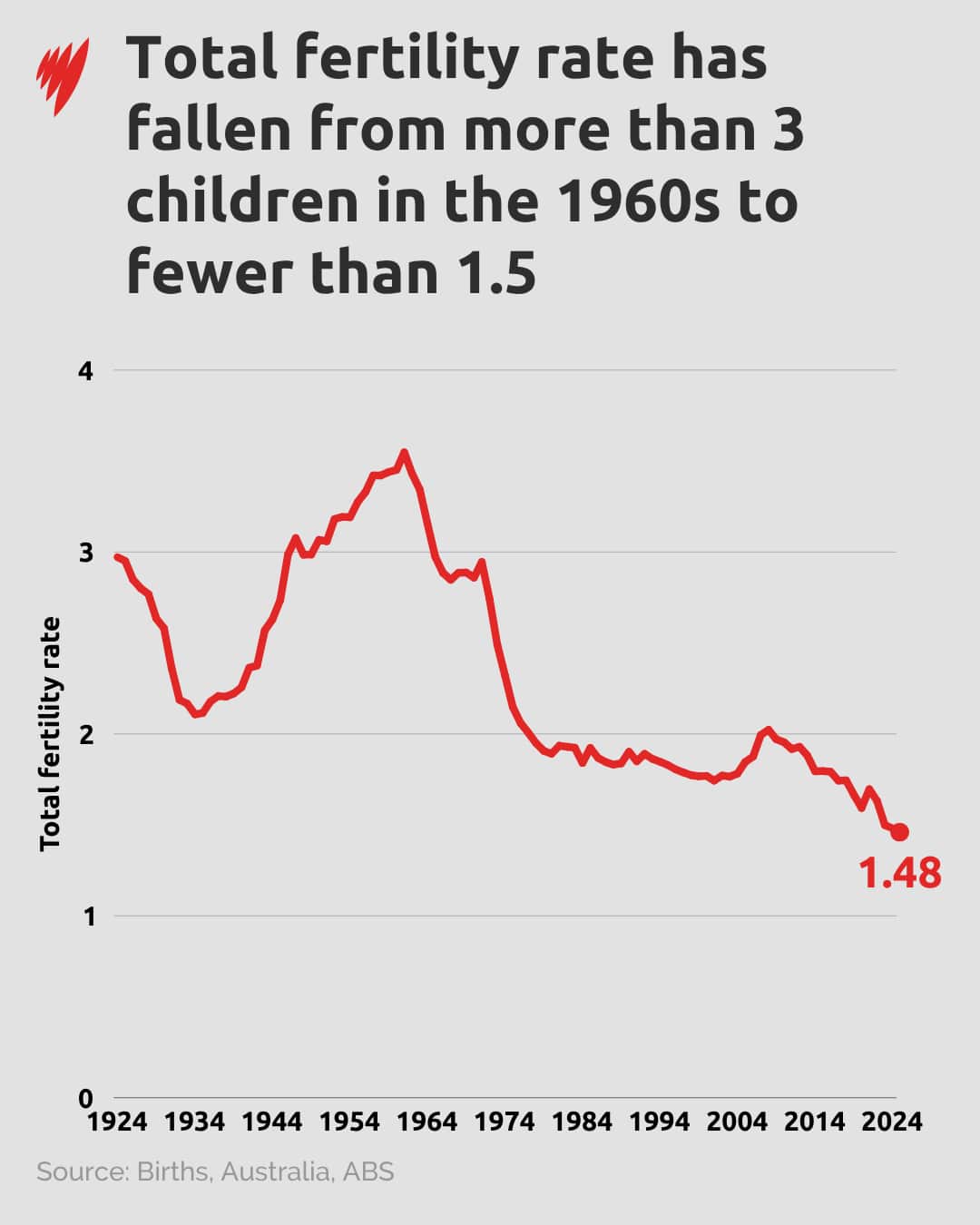
Australians are having fewer children than ever. At 1.5 babies per woman, the fertility rate is at a record low. Many attribute this to the cost of having and raising children.
If this is true, it raises questions of intergenerational fairness and future planning for governments. What do we do about the young would-be parents who are opting out because it’s simply too expensive?
The problem with this assumption is that while it may feel true that childbearing must have become more expensive over the decades, it’s not that simple.

As the cost of raising children continues to be a topic of concern for many families, it is worth exploring the methods used to measure these expenses and whether the financial burden has truly increased over time. Additionally, we must examine how these costs are influencing Australia’s declining fertility rates.

When it comes to assessing the cost of raising children, one common method is the “budget standards” approach. This involves calculating the monetary value of a set of goods and services for families both with and without children, and identifying the difference as the cost of raising children.
Calculating the cost of raising kids is a complicated beast that raises many questions for academics to consider. Is a second child less expensive than a first child? Are older children more expensive than younger children? Do higher income families spend more on children than lower income families, and what share of that spending is necessary compared to discretionary?
These are debates in the literature for which there aren’t necessarily clear answers, in spite of much research.
Researchers also contest whether we should talk about just the direct cost, or if we should also consider the indirect costs, such as the impact on hours in paid work or the loss of leisure time for busy parents. We focus here and in our paper for the Economic Inclusion Advisory Committee on the direct costs.
A line chart showing the fall of Australian birth rates over time after a peak in the 60s.

However, an alternative method, which serves as the focal point of our discussion, is based on survey data. Known technically as the “iso-welfare” approach, this method compares the living standards of households with and without children. The aim is to determine how much additional income or spending is necessary for a family with children to maintain the same living standard as a childless family.

Given that the most recent comprehensive survey on household expenditure in Australia dates back a decade, our latest research has adopted a novel approach by using financial stress as an indicator of living standards. This innovative method provides fresh insights into the economic challenges faced by families with children.

Living standards are measured by what share of total household income or expenditure is spent on basic items, such as food or utilities.
The logic here is that a family that spends a lower share (on average) on basic goods has a higher standard of living than a family that spends a higher share on basic goods.

Understanding these methodologies is crucial, as they offer a window into the real financial implications of raising children today. The insights gained from such studies not only help families plan better but also guide policymakers in crafting supportive measures to address the economic pressures influencing Australia’s birth rates.

Using Housing Income and Labour Dynamics in Australia (HILDA) data, we model financial stress against income and a range of other household variables and estimate how much extra disposable income a family with children needs to maintain the same living standard as a couple without children. That extra income is considered the cost of children.

While there are many advantages to using this method, a major drawback is that it doesn’t give you an estimate for how much a family needs to spend, rather how much they do spend. Families may well spend more than what they strictly need to.

So, how much do families spend on children?

We estimate families spend about 13 per cent of their disposable income on the first child and a further ten percentage points for each child after that.
For a working-age couple earning the typical after-tax income (around $130,000 per year), that equates to about $17,000 per year for the first child and around $13,000 per year for each subsequent child.
That means to raise the eldest child to adulthood, the couple would spend about $300,000 over 18 years in today’s dollars. Subsequent children would be about $230,000 each.

Lower income families spend a higher share of their income on children, at around 17 per cent for the first child and 13 per cent for subsequent children. But these households spend a lower absolute amount on children.

Does age of the child change the cost? There is uncertainty around this, but our latest research indicates younger children and older children are moderately more expensive than middle aged (six to 12) children.
This finding contrasts with previous research and conventional wisdom that older children are the most expensive.

These estimates are not set in stone. There are different ways to estimate such numbers and they can differ depending on what definitions you adopt and methods you use to analyse the data.

Ok, do kids cost more now?

The HILDA dataset has been gathered over many years, so we can compare the cost of children through time, albeit not perfectly.
Single year samples are relatively small and subject to error, but that analysis suggests not a lot has changed with the cost of children since 2001.

Our research doesn’t provide clues as to why fertility rates in Australia have dropped (as they have in most developed nations). Other data such as Australian Bureau of Statistics income survey and financial stress data suggest real incomes for couples with children have increased over the longer term (although not by much, if at all, in recent years).

The lack of evidence here likely points to other factors driving lower fertility rates. Families may be delaying having children to focus on other pursuits, such as employment or education. It’s also more acceptable for couples, and women in particular, to choose to not have children.
Another possible reason is people could be being deterred by the perception of higher costs, instead of the actual cost. Or perhaps people simply want to spend their money elsewhere.
Calculating the cost of children is complex and imprecise, but it’s fair to say the evidence doesn’t show that the direct cost of kids is getting more expensive over time. Younger generations not having kids, or fewer kids, is likely related to many factors, but we can’t draw affordability down generational lines.
Ben Phillips is an associate professor at POLIS@ANU Centre for social policy research at Australian National University. Phillips through his role at the ANU provides consulting services on a range of areas in economic and social policy and has recently published work on a consulting basis for the Economic Inclusion Advisory Committee on the cost of children.
The Conversation

Share this @internewscast.com
You May Also Like
Therese Frangie graduated high school with no university offers; now she's the chief executive of restaurant giant Oporto.

Unlock Career Success: CEO Reveals Three Powerful Words to Boost Your Job Prospects

Exclusive Feature: In a special series by nine.com.au, we delve into the…

Shocking Courtroom Moment: Nick Reiner’s Brief Remark on Murder Charges

The younger son of Hollywood filmmaker and political activist Rob Reiner has…
2013 Academy Award nominees announced: Surprises and shock snubs galore!

The Oscars Transition from ABC to Embrace Digital Streaming Platforms

In a seismic shift for one of television’s marquee events, the Academy…

Shocking Mid-Air Incident: Sydney Man Faces Charges for Antisemitic Threats on Bali Flight

Police have arrested and charged a man after he allegedly made antisemitic…
Queensland Police released a photo of Kai Fursey, who they want to speak to about the deadly Wacol Uber crash.

Shockwaves as Driver Receives 11-Year Sentence for Fatal Hit-and-Run

A car thief is set to serve a minimum of seven years…
Schools told to keep children inside as polluted fog envelops Bosnian capital

Bosnian Capital Shrouded in Toxic Fog: Schools Urged to Shelter Students Indoors for Safety

On Thursday, Sarajevo was shrouded in a dense fog that led to…

Review Reveals Optus Overlooked Early Alerts in Emergency Call Outage

The 14-hour outage during a network upgrade in September hit South Australia,…
A 14-year-old girl bravely took a bullet to her thigh as she shielded two toddlers from the gunfire that rained down on crowds at Bondi Beach. 

Heroic Teenager Protects Toddlers During Bondi Shooting Incident

A courageous 14-year-old girl was wounded in the thigh while heroically protecting…
Man charged over alleged antisemitic threats on flight from Bali to Sydney

Man Faces Charges for Alleged Antisemitic Threats on Bali-Sydney Flight: A Disturbing Mid-Air Incident

A 19-year-old man from Condell Park, Sydney, finds himself facing serious charges…
'I accept my responsibility': Albanese makes raw admission on Bondi attack

Albanese’s Candid Confession: Owning Up to the Bondi Attack Responsibility

Prime Minister Anthony Albanese has accepted responsibility and admitted more could have…
Australians who lost their retirement fund to be paid back $100m

Aussies Set to Recover $100 Million in Lost Retirement Savings

Netwealth has reached an agreement with the Australian Securities and Investments Commission…
Noam Chomsky, Jeffrey Epstein

New Epstein Estate Photos Unveil High-Profile Connections: A Closer Look

On Thursday, Democrats serving on the House Oversight Committee unveiled a series…