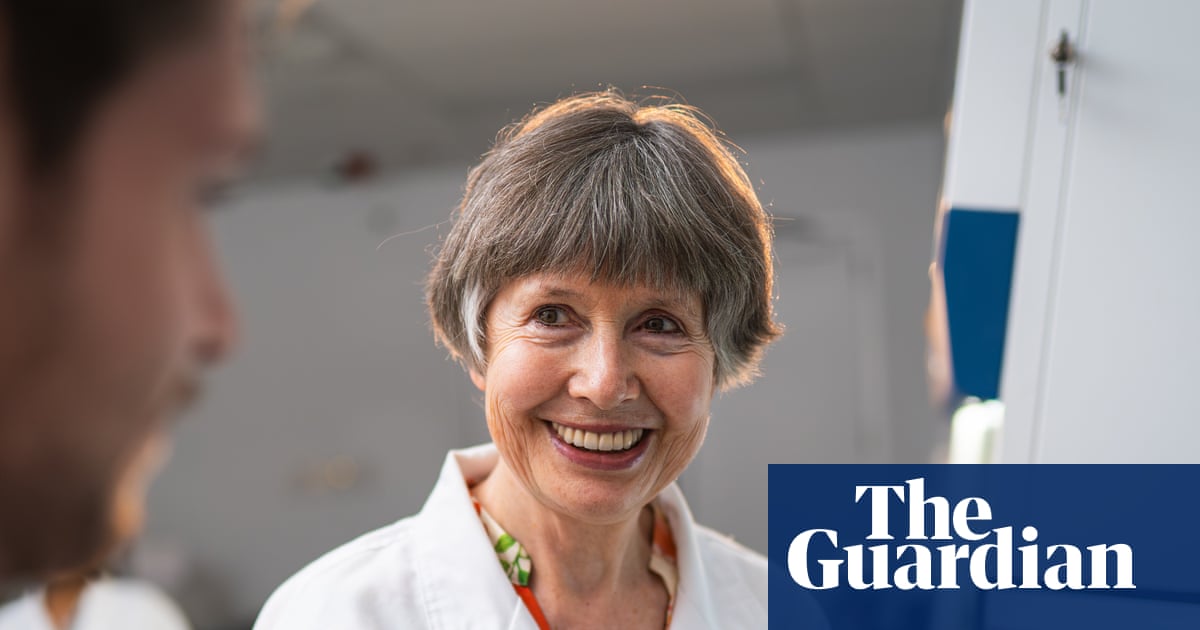

When the World Health Organization mistakenly announced in March 2020 that Covid-19 was not airborne, Professor Lidia Morawska felt compelled to act.
Morawska, a leading authority on air quality and health at Queensland University of Technology, reached out to her international peers. She successfully rallied 239 scientists from around the world to underscore the airborne transmission threat of Sars-CoV-2.
Their collective effort eventually pressured the WHO and other health bodies to revise their guidelines to reflect the true nature of the virus’s spread.
In recognition of her significant contributions during the pandemic, Morawska was honored as one of Time magazine’s most influential people in 2021.
Adding to her accolades, Morawska received the highest honor at the Prime Minister’s Prizes for Science on Monday evening for her “groundbreaking research on the air we breathe.”
She expressed immense joy upon receiving the $250,000 Prime Minister’s Prize, emphasizing that the award would shine a spotlight on her vital area of research.
Her current work focuses on ultrafine particles – tiny pollutants tens to hundreds of times smaller than PM2.5 and believed to have more significant health impacts, but which are not yet widely regulated.
“Because they are so small, they can get deep into the human respiratory tract,” Morawska said.
Sign up: AU Breaking News email
Morawska’s recognition comes at a fraught time – an “age of anti-science”, as she has called it.
“In the United States, it’s a particularly difficult situation,” she said. “Science and scientists are nowhere near as listened to as … in the past, and decisions are not based on science.” It is a problem she hopes to tackle by bringing scientists together as she did during the early years of the pandemic.
“If we operate individually, it’s very easy to reject us … but eventually, the voice of a large scientific body, which can be respected, hopefully will make a difference.”
The prime minister’s science prizes, now in their 26th year, are Australia’s most prestigious awards for achievements in scientific research, innovation and teaching.
Anthony Albanese said in a statement: “I congratulate and thank Prof Morawska for her incredible work over many years which influenced how Australia and the world mitigated risks associated with Covid-19.
“I extend that congratulations and thanks to all recipients.”
In a category awarded for the first time this year, Prof Michael Wear received the prime minister’s prize for Aboriginal and Torres Strait Islander knowledge systems.
after newsletter promotion
Wear, a Malgana traditional custodian of Gutharraguda (Shark Bay) in Western Australia, received the $250,000 prize in recognition of his marine conservation work. He is the founder of Tidal Moon, Australia’s first Indigenous-owned and led sea cucumber fishery and marine restoration enterprise.
Wear founded the enterprise several years after a marine heatwave in 2010-11 resulted in the loss of 22% of seagrass beds in Shark Bay.
“When the seagrass died, we noticed that the sea cucumbers increased in size,” he said. “We built a free market enterprise … around sea cucumbers as a commodity to export.”
Proceeds from the sale of those sea cucumbers, primarily in cosmetic products, funds the organisation’s seagrass restoration efforts, with 12 Indigenous divers trained to date.
The firm plans to restore 20 hectares of seagrass beds next year.
The minister for science, Tim Ayres, said he was proud the prizes “are now acknowledging and elevating the extraordinary contributions Aboriginal and Torres Strait Islander peoples have made and continue to make to science and our nation”.
“Prof Michael Wear’s work exemplifies the ongoing importance of Aboriginal and Torres Strait Islander knowledge systems to peoples, communities and place,” Ayres said in a statement.
“I’m happy to be the first [recipient],” Wear said, “but I don’t want to be the last.”
Other prize recipients include Prof Yao Zheng of the University of Adelaide, recognised for his work in producing clean hydrogen directly from seawater; and Dr Vikram Sharma, founder of QuintessenceLabs, who was recognised for translating quantum science research into cybersecurity protections.