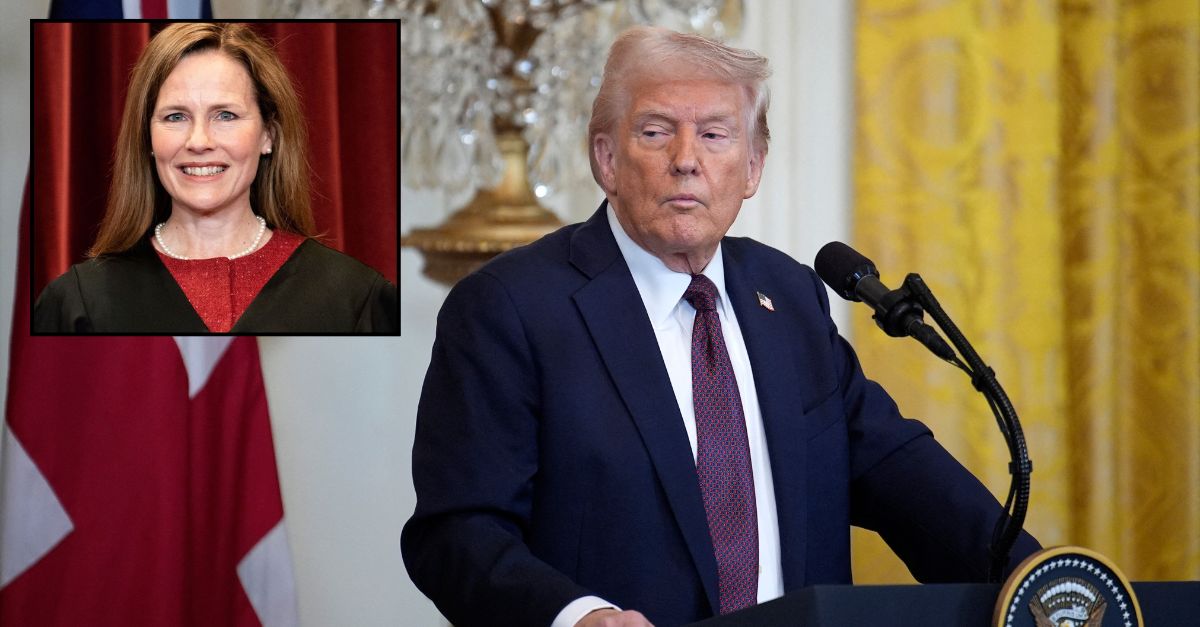

President Donald Trump at a press conference at the White House in Washington on February 27, 2025 (Yuri Gripas/Abaca/Sipa USA; AP Images). Inset: Associate Justice Amy Coney Barrett in Washington, DC on April 23, 2021 (ERIN SCHAFF/POOL/AFP via Getty Images).
President Donald Trump toyed with the idea of attending Supreme Court sessions concerning his emergency tariffs, but ultimately opted out. The justices, including one of his own conservative nominees, expressed skepticism over Trump’s claims regarding the breadth of his executive authority in implementing unilateral economic measures on the grounds of national security and foreign policy.
The debate centers around the International Emergency Economic Powers Act (IEEPA), which appellate judges noted does not mention tariffs and has never been applied for such purposes in its 50-year history.
The Supreme Court is reviewing two cases, initiated by wine and spirits importer V.O.S. Selections, Inc. and educational product company Learning Resources, Inc. In September, the Court accepted Learning Resources’ petition for certiorari before judgment, bypassing the appellate court to merge it with V.O.S. Selections’ case. This followed a U.S. Court of Appeals for the Federal Circuit decision in August declaring Trump’s trade tariffs unconstitutional.
D. John Sauer, the U.S. solicitor general and a former attorney for Trump, began his defense by emphasizing the president’s right to address “exploding trade deficits” that put the country on the edge of an “economic and national security catastrophe,” arguing that the major questions doctrine was irrelevant.
According to a congressional research paper, the Supreme Court employs the major questions doctrine to dismiss agency claims of regulatory power when the issue is of “vast economic and political significance” and there is no explicit congressional authorization.
Justice Clarence Thomas promptly questioned why this doctrine did not apply. Sauer responded by citing “common sense,” suggesting Congress would naturally bestow “major powers” on the president to tackle emergencies, facilitated by the broad authority granted under IEEPA.
It would not be the last time the justices asked about the major questions doctrine.
After Justice Elena Kagan stated that the power to tax belongs to Congress, Sauer replied that Trump is not asserting a “power to tax,” but a “power to regulate foreign commerce,” which the solicitor general maintained is what is meant by the words “regulate importation” in IEEPA.
It was at this point that Justice Sonia Sotomayor said, “Counsel, I just don’t understand this argument.”
“It’s a congressional power, not a presidential power, to tax. And you want to say tariffs are not taxes, but that’s exactly what they are,” the justice said, wondering why under this theory of law that former President Joe Biden couldn’t have simply declared “a global warming national emergency” and then rammed his student loan forgiveness program through without implicating the major questions doctrine.
A short time later, Justice Amy Coney Barrett asked Sauer questions that led to a barrage of even more skepticism, including a statement from Chief Justice John Roberts that it seemed the major questions doctrine might be “directly applicable” here.
“Can I just ask you a question?” Barrett began. “Can you point to any other place in the code or any other time in history where that phrase together ‘regulate importation’ has been used to confer tariff imposing authority?”
“Well, as to relegate importation, that was held in TWEA,” referring to the Trading with the Enemy Act of 1917, which the Trump administration has claimed used the “exact same language” Trump is now using — “regulate importation” language that stood up to judicial scrutiny in the 1975 President Richard Nixon-related case of United States v. Yoshida International, Inc.
In the Yoshida case, the Federal Circuit decided that Congress, “in enacting [TWEA], authorized the President, during an emergency, to exercise the delegated substantive power, i.e., to ‘regulate importation,’ by imposing an import duty surcharge or by other means appropriately and reasonably related … to the particular nature of the emergency declared.”
But the Yoshida court also opined that a president cannot merely utter “national emergency” to “rewrite the tariff schedule,” and IEEPA reforms of TWEA were enacted by Congress two years later.
“Okay, okay, and so an intermediate appellate court held it in TWEA, but you just told Justice Kavanaugh that wasn’t your lead argument, that your lead argument was this long history of the phrase ‘regulate importation’ being understood to include tariff authority,” Barrett interrupted Sauer, saying the cases he cited fell short of a power he claimed exists. “So my question is has there ever been another instance in which a statute has used that language to confer the power?”
“Can you identify any statute that used that phrase to confer tariffs?” Barrett asked again.
“The only two statutes I can identify now are TWEA as interpreted in Yoshida, and then closely related, not regulate importation, but ‘adjust imports’ in Section 232,” Sauer said before Barrett cut him off.
“Well, I think ‘adjust imports’ is different[],” the justice said. “So the answer is the contested application in TWEA and now in IEEPA.”
From here, Kagan jumped in to follow up with the very same skeptical question.
“I’ll broaden out justice Barrett’s question, is there any place that you can find in the entire code where ‘regulate’ used just as ‘regulate’ includes taxing power?” she asked.
“We don’t assert that,” Sauer answered, “we say it includes tariffing power when it’s combined with importation.”
“But when the code uses ‘regulate,’ we don’t typically understand it to refer to duties or taxes or tariffs or anything of the kind. And then if you look at the flip side of this, and you look at all the tariff statutes that Congress has passed, I mean, they use language about revenue, raising tariffs and duties and taxes, all the language that does not appear in the statute,” Kagan fired back.
Sotomayor, seeing an opening, followed suit, asking: “Why is it that Congress has always used ‘regulate’ and ‘tax’ together in the code? Are you telling us that with respect to its use of ‘regulate’ in other statutes, the taxing reference is superfluous? They didn’t need to do that?”
“Uh,” Sauer paused for a couple of seconds before answering, “I’m not sure what other statutes use ‘regulate’ and ‘tax’ together, but this statute has a specific historical pedigree, going back to its enactment during world war one in 1917 where the phrase ‘regulate importation’ is evoking an inherent power to tariff that would became established in the 19th century[.]”
Chief Justice Roberts, hearing all of this, then brought the conversation back to the major questions doctrine.
“Counsel, some time ago, you dismissed the applicability of the major questions doctrine. And I want you to explain that a little bit more. I mean, it seems that it might be directly applicable,” Roberts said. “You have a claimed source in IEEPA that had never been used before to justify tariffs. No one has argued that it does until this particular case.”
“That seems like — I’m not suggesting it’s not there — but it does seem like that’s major authority, and the basis for the claim seems to be a misfit. So why doesn’t it apply again?” the chief asked.
Sauer replied that the point of IEEPA is to “address major questions” of an “emergency” nature, so it would be odd to say there is no major power for Trump to act as he has.
“Well, but the exercise of the power is to impose tariffs, right? And the statute doesn’t use the word tariffs,” Roberts pointed out.
“But it uses the word regulate importation,” Sauer answered.
On the eve of oral argument, Trump repeated in a social media post that if that justices don’t rule in his favor it’s “literally, LIFE OR DEATH for our Country.”
This struck the same tone as prior dark warnings of another Great Depression and literal destruction of America.
Based on the major implications of Trump’s claimed power, the justices have an opportunity to affirm that the president does not — through an emergency statute that makes no mention of tariffs — have an “unlimited power to set tariffs on all goods imported from all our trading partners,” preventing future commanders-in-chief from claiming a power reserved to Congress.
That was the overarching argument from Neal Katyal on behalf of V.O.S. Selections — that Trump cannot have a virtually unlimited and “unilateral” authority to set aside “all” of America’s trade treaties in a sweeping and unreviewable way.
“May it please the court: Tariffs are taxes,” he said.
“They’re citing one statute,” Katyal added, referring to IEEPA, “and we submit to you that it doesn’t come close” to making the case for trumping Congress’ tariff authority.
“With all due respect,” the attorney continued, the petitioners don’t think IEEPA allows Trump’s “junking of the worldwide tariff architecture” or wholesale “rewriting of the tariff code.”