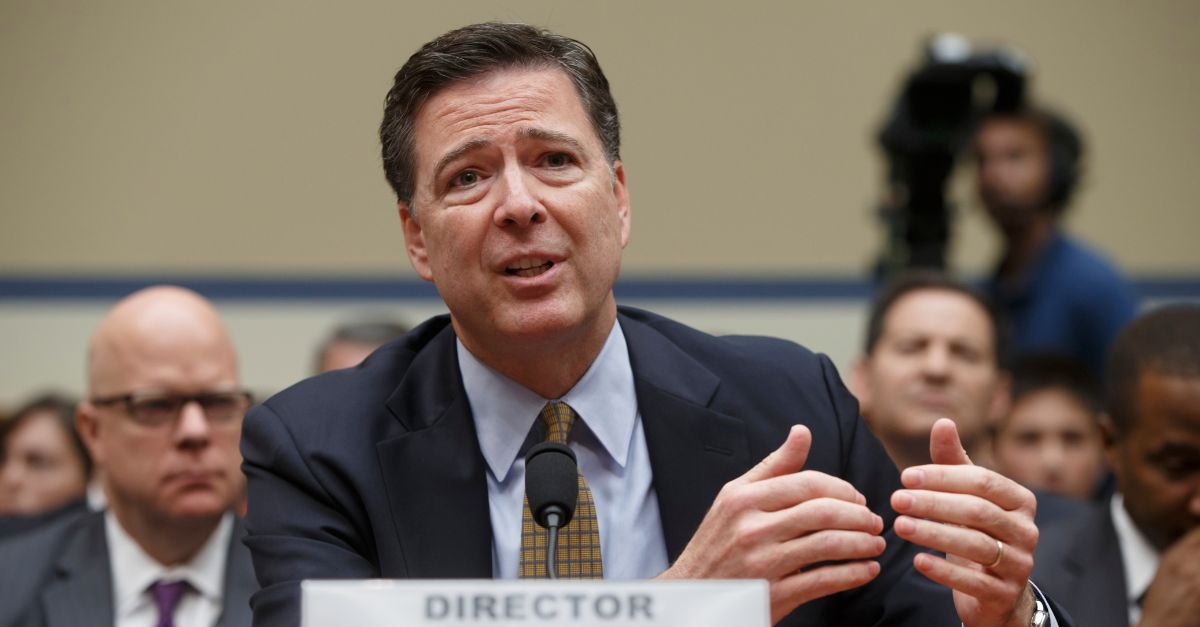
FILE – FBI Director James Comey testifies on Capitol Hill in Washington before the House Oversight Committee to explain his agency’s recommendation to not prosecute Hillary Clinton on July 7, 2016. (AP Photo/J. Scott Applewhite, File)
As a federal judge prepares to determine whether a magistrate’s directive requiring the Department of Justice (DOJ) to provide James Comey’s defense team with all grand jury materials was justified, former FBI Director James Comey has pointed to the Trump administration’s recent court maneuvers as significant. He argues that their reluctance to address a critical issue serves as “confirmation” that interim U.S. Attorney Lindsey Halligan pursued charges against him despite knowing that career prosecutors doubted their strength, essentially misleading the grand jury to retaliate against a perceived adversary of the president.
In their legal filing, Comey’s attorneys underscored what they described as a “deeply concerning” incident during a Wednesday hearing with U.S. District Judge Michael Nachmanoff. During this session, the DOJ conspicuously avoided confirming the existence of a “declination memo,” which would outline why previous prosecutors in Virginia’s Eastern District felt the evidence against Comey for false statements and obstruction was insufficient.
As reported by Politico, when asked about the memo, prosecutor Tyler Lemons disclosed that Deputy Attorney General Todd Blanche’s office had instructed him not to comment on whether such a document existed, despite indications of at least three such memos being in circulation.
During the questioning, Lemons acknowledged being aware of written discussions regarding whether charges should be filed. However, he refrained from elaborating, citing the memo as privileged DOJ “work product” that Comey is not entitled to access.
Conversely, Comey’s legal team argues that the declination memo constitutes exculpatory evidence beneficial to their case, potentially highlighting U.S. Magistrate Judge William Fitzpatrick’s earlier order for the DOJ to disclose grand jury materials. This would allow the defense to scrutinize Halligan’s statements to the jury.
In a pointed footnote, Comey’s defense criticized the prosecution’s evasive stance on the memo issue, suggesting that their reticence amounts to unjustifiable stonewalling.
“The government’s refusal to answer basic questions about the existence of this declination memorandum and decision to hide behind a flimsy claim of privilege to stonewall the Court’s inquiries, should be taken as confirmation that such a memorandum exists,” the footnote said.
According to the defense, if there is proof that Halligan was “advised by career prosecutors in that declination memorandum that ‘seeking the charges would violate DOJ policy, raise serious ethics issues, and risk being rejected by the grand jury,’” then this opens the door to dismissal on its own.
“Mr. Comey is entitled to learn what Ms. Halligan said in order to try to convince a grand jury that Mr. Comey remembered a communication for which there is no evidence he received,” the filing continued, alluding to a counterintelligence operational lead (CIOL) from 2016 warning the “Clinton campaign was going to create a scandal regarding Trump and Russia[,]” according to Sen. Lindsey Graham’s phrasing during 2020 questioning of Comey.
The grand jury, the defense noted, ultimately rejected a criminal charge related to Comey’s answer that the CIOL didn’t “ring any bells,” so if Halligan “presented misleading evidence on a charge—and/or omitted material exculpatory facts on the same point—after being clearly told that there was insufficient evidence on that point, that would be quintessential proof of misconduct before the grand jury justifying dismissal[.]”
The defense added that there is no evidence Comey ever saw the CIOL the DOJ tried to indict him for lying about:
There is no electronic trail showing that Mr. Comey received the CIOL at issue. There is no paper trail showing that he received it. And there is no witness who says that Mr. Comey either received it or discussed it with him. Full stop.
This total lack of evidence is extremely troubling in light of credible press reporting that not only does a declination memorandum exist in this case, but it made clear that with respect to the CIOL in particular, a prior investigation found that Mr. Comey’s statement could not support a false-statement charge because there was insufficient evidence Mr. Comey had ever seen the CIOL.
What’s more, Comey’s lawyers asked Nachmanoff to review the materials himself, just like the magistrate did, and draw conclusions about whether some combination of a potentially “tainted” FBI agent witness “exposed” to attorney-client privileged information and Halligan “misstatements of law” before the grand jury could doom the case.
“The Court here should similarly review the materials as part of the government’s appeal and dismiss the government’s deflection,” the filing said, before briefly summarizing what discovery has indicated so far. “[T]here appears to be numerous pieces of highly exculpatory evidence that—given its tendency to undermine the existence of probable cause—Ms. Halligan likely did not present to the grand jury, and without which the grand jury would have been left with a deeply misleading picture of the case.”
In a response Wednesday, the DOJ resisted disclosure by saying that even if Halligan made “misstatements of law” to the grand jury, that should not override grand jury secrecy and should not lead to the dismissal of the case.
“The magistrate judge also found that two alleged misstatements of the law by the U.S. Attorney to the grand jury provided another basis for ordering disclosure of the grand jury material,” the DOJ said. “That, too, was contrary to law, since those alleged misstatements — even if they were incorrect statements of the law — are no basis to dismiss the indictment.”
Asserting that Comey did not carry his “burden,” the DOJ argued that Fitzpatrick misread the grand jury transcript and drew “incorrect legal conclusions” based on “factual assumptions” about Halligan’s activities.
“The U.S. Attorney did not misstate the law, the grand jury was not misled, and the transcript shows a routine, regular presentation of the indictment,” the government insisted.
The Comey reply also comes not long after Halligan created a new firestorm of her own, by misleadingly slamming the judge in comments to the New York Post.