
President Donald J. Trump is not one to give up easily.
The Nobel Committee’s decision to grant this year’s Peace Prize to Venezuela’s opposition leader Maria Corina Machado, who has bravely opposed the authoritarian Nicolas Maduro, won’t deter the 47th president in the slightest.
Trump remains determined to win the Nobel Peace Prize, even if it means waiting until next year.
He questions why he shouldn’t be considered, especially since former President Barack Obama received the prize in 2009 after only eight months in office. Trump has been praised for his efforts in bringing Israel and Hamas back to the negotiating table and notably for securing the release of hostages held underground for an extended period.

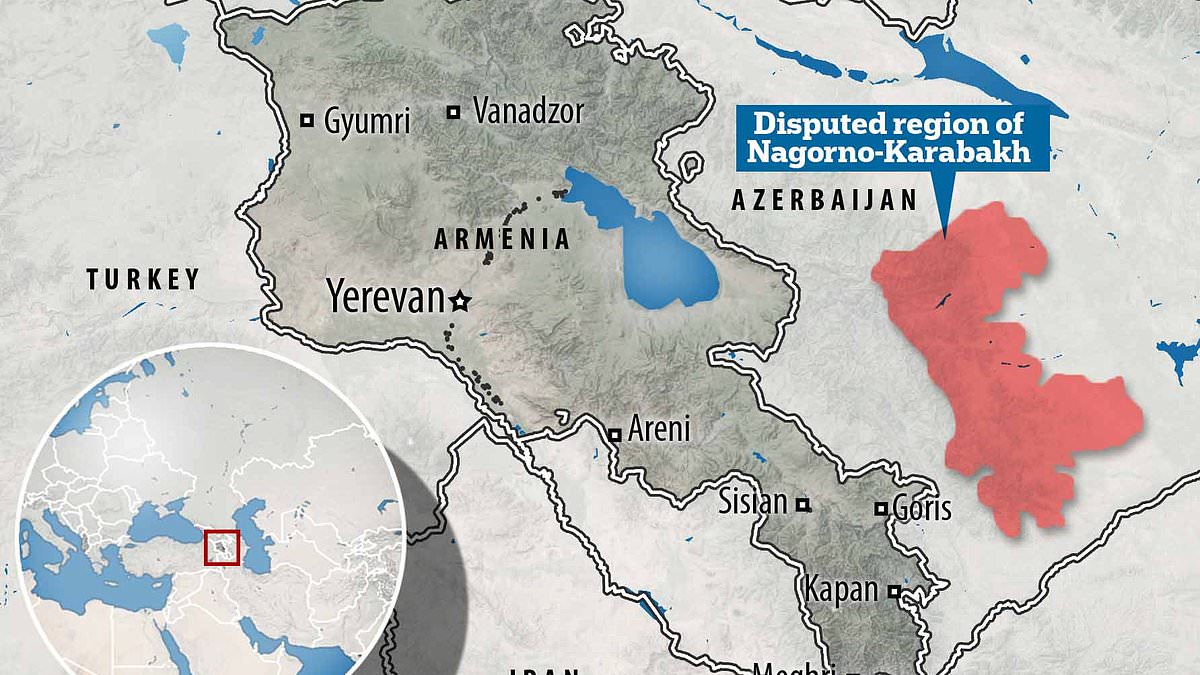
In 1991, Armenia, with the backing of the United States and its European allies, took control of the disputed enclave of Nagorno-Karabakh, a small island of Armenians in the middle of Azerbaijan
A ceasefire in the Middle East isn’t Trump’s sole accomplishment, even though he hasn’t yet succeeded in halting the Russian invasion of Ukraine.
When the president claims he has contributed to peace and stability in Central Asia, he is indeed correct, though perhaps not in the way most might expect.
Recent hostilities between Christian Armenia and Muslim Azerbaijan to the east stretch back to the collapse of the Soviet empire at the close of 1991. The two Caucasus nations had once been constituent parts of the former Soviet Union.
That’s when Armenia, with the backing of the United States and its European allies, moved to take control of the disputed Nagorno-Karabakh enclave, a small island of Armenians in the middle of Azerbaijani territory.
They succeeded, held on to the territory, and for years, there was a fractious peace, supported by both the West and Russia, which stationed troops and weaponry in Armenia.
However much Turkey might have liked to intervene on the part of its Turkic neighbour Azerbaijan – the nations share both the Muslim faith and ethnic roots – the balance of power lay with America and the West.
The dispute between the neighbours, Armenia and Azerbaijan, flared up again in 2016 but with little change to the front lines.
But then, in 2020, heavy fighting resumed, this time with Azerbaijan regaining much of the territory it had lost three decades earlier and the Armenian population of Nagorno Karabakh fleeing.
What changed to give the Azeri’s such a decisive advantage? The answer is that everything changed.

It was reported that, by 2023, more than 70 per cent of Nagorno-Karabakh’s Armenian population had fled. Pictured: refugees heading from the enclave to Armenia

Donald Trump is more concerned with the art of the possible than being the world’s policeman
Russia, already making plans to regain Ukraine – which it invaded in 2022 – had been paying less attention to the Caucasus region than in the past.
More significantly, the old-world order –imposed and enforced by European capitals and Washington – was, and is, unravelling.
For three decades years, the Western powers had given Armenia the advantage over its Muslim neighbour.
But America is no longer the world’s policeman in quite the same way as in the post-war decades.
While Trump has set out this new position with emphasis, the US has in fact been withdrawing from the farther reaches of world affairs for some time.
As for Europe and the West, they have enough problems of their own without taking part in central Asian adventures.
This is in sharp contrast with Turkey which under President Recep Tayyip Erdogan has been very much on the rise both economically and politically in the past decade.

Special Presidential Envoy Steve Witkoff arrives before a trilateral signing ceremony with Azerbaijan’s President Ilham Aliyev and Armenia’s Prime Minister Nikol Pashinyan at the White House in August
The booming Turkish defence industry, with the blessing of Ankara, was more than appy to arm the Azeris, who struck against Armenia in the disputed enclave and pressed their advantage home.
And there the conflict might have lain, ready to erupt once again but for this curious twist.
Because, not only has Azerbaijan regained the territory of Nagorno Karabakh, it appears to have secured a further vital concession from the Armenians: a trade corridor through the south of their country.
Azerbaijan and Turkey have the most to gain from this, particularly the former, which – through the corridor – now has a link both to its own disputed enclave of Azeris in Armenia, the so-called Nakhchivan Autonomous Republic, and also to the wider world.
Indeed, opening the Zengezur Corridor will ensure that goods and people can travel overland between Beijing and London in a mere 15 days.
Everybody on that vast trade route – from the Central Asian Republics to the wealthy capitals of Europe – should be in a position to benefit, particularly Turkey and China.
Not everyone is happy, with Armenia fearing the Zenzegur Corridor is a security risk. Iran meanwhile, sees its imposition as an unwelcome extension of Turkish power in the region.
They will have to get over it. Money talks. It is no exaggeration to say that this new trade route will be a critical piece of geography bridging Asia and Europe and will unquestionably change relations between the nations of the region for the better.
Even landlocked Armenia will benefit from the expanded opportunities and should avoid being at the mercy of the Russian Federation, Iran, and Georgia, through whose territory its goods have previously been obliged travel.
And this is where Trump has played his part.
Turning down the chance to be offended by the treatment of Armenia, a former ally in the region, Trump and his special envoy for both the Middle East and for Peace Missions, Steve Witkoff, have given their approval to the new status quo – and the Zengezur Corridor.
Witkoff, even went so far as to pose for a photo-op with Armenian and Azerbaijani leaders in Washington DC, in fact, as the US signed a concordat with the two nations. In other words, the new status quo has the backing of the White House as well as Erdogan in Turkey.

A refugee from Nagorno-Karabakh arrives in the town of Goris, Armenia
The Americans want to be seen endorsing not only peace and stability, but also the best solution possible – the realpolitik solution.
The Russian Federation, Iran, and Georgia must simply have to adapt to the new circumstances.
America may no longer be the world’s policeman but, simply put, Trump’s nod creates consensus in an increasingly chaotic system of international relations
He is endorsing the best approach to geopolitics available – and the result in the region is likely to be some measure of lasting peace.
Certainly, stability in the Caucasus means one fewer quarrel between the rival regional powers of Turkey, Russia and Iran, which can only be a good thing.
Perhaps the Nobel committee should cast its gaze to the Caucasus mountains – and give credit where it’s due.