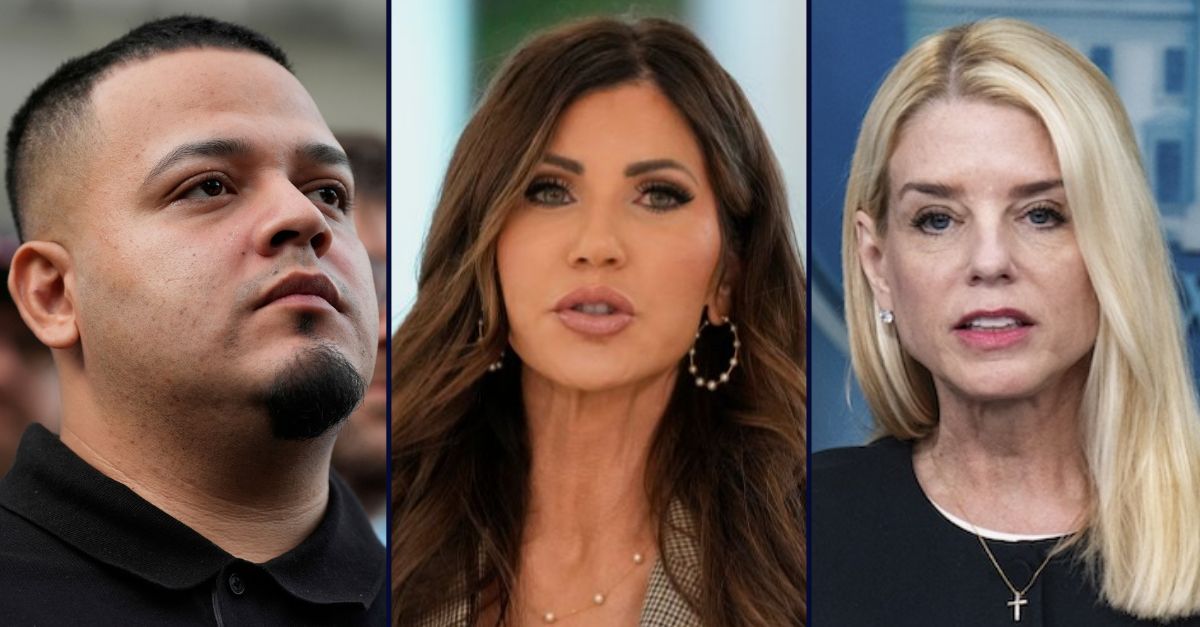

Left to right: Kilmar Abrego Garcia attends a protest rally at the Immigration and Customs Enforcement field office in Baltimore, Monday, Aug. 25, 2025, to support Abrego Garcia (AP Photo/Stephanie Scarbrough), Secretary of Homeland Security Kristi Noem speaks during a news conference at the Nashville International Airport, Thursday, July 17, 2025, in Nashville, Tennessee (AP Photo/George Walker IV), and U.S. Attorney General Pam Bondi speaks at a press briefing with U.S. President Donald Trump in the James S. Brady Press Briefing Room in the White House in Washington, DC on Friday, June 27, 2025 (Annabelle Gordon/Sipa USA)(Sipa via AP Images).
Attorneys representing Kilmar Abrego Garcia have formally accused the Department of Justice (DOJ) of attempting to unfairly influence the jury by introducing distracting and prejudicial evidence against the Salvadoran national. They argue that these allegations are intended to bolster Homeland Security Secretary Kristi Noem’s public remarks labeling Abrego Garcia as a “horrible” person.
In a detailed 14-page document submitted to the U.S. District Court for the Middle District of Tennessee, the defense team opposed the DOJ’s plan to present evidence of alleged “pornographic messages” exchanged between Abrego Garcia and a minor. The minor, who was reportedly 15 years old in 2020 when the messages were sent, is described as a known informant who has been compensated for providing information to law enforcement.
Abrego Garcia’s legal team has proposed to acknowledge his use of two specific phone numbers to prevent the introduction of allegations regarding domestic violence against his wife as evidence of his phone usage. They also argue against using the alleged messages exchanged between a Snapchat account, named “soytugaa,” and the informant as evidence in the case.
On November 13, the Trump administration filed a notice of intent, indicating that Witness-1, referred to as N.V., was not involved in the alien smuggling conspiracy outlined in the indictment. However, the witness is expected to testify that Abrego Garcia attempted to recruit her to participate in the smuggling operations during the conspiracy’s timeframe.
The DOJ claims that Witness-1 will testify that Abrego Garcia invited her to join smuggling trips and that they exchanged pornographic messages and videos through a messaging app while he was 25 and she was 15. Although prosecutors have stated that they do not plan to introduce these messages during the direct testimony of Witness-1, they reserve the right to use them during re-direct examination if the defense challenges the witness’s personal knowledge of Abrego Garcia during cross-examination.
Claiming prosecutors did “not intend to offer these messages as evidence during Witness-1’s direct testimony,” the DOJ said it could still “foresee […] multiple lines of cross examination that would open the door to these messages being admitted on re-direct examination” — in the event Abrego Garcia “attack[ed] Witness-1’s personal knowledge of the defendant[.]”
The government said that would transform what appears to be inadmissible character evidence into admissible evidence that would tend to help the DOJ prove the witness’s “close relationship” with Abrego Garcia.
Abrego Garcia’s lawyers have now countered that “evidence of alleged pornographic messages exchanged” with the witness should be excluded, and for multiple reasons.
For one, the DOJ hasn’t proved that Abrego Garcia was using the “soytugaa” Snapchat account at the time the messages were sent, the filing said.
Second, the defense claims the DOJ has been cagey about screenshot evidence of the November and December 2020 messages, which allegedly show “adult pornography […] involving third-party adults, not Witness-1 or the user ‘soytugaa.’”
“Even though the screenshots do not depict any sexually explicit content involving minors, the government has not provided these unblurred screenshots to the defense and has instead informed the defense that they can be reviewed in person at the United States Attorney’s Office,” the filing stated. “The government also revealed that it does not have any other records of purported communications between Witness-1 and the account ‘soytugaa.’”
“At most, the screenshots show that one of the chat participants saved what appears to be an image depicting nude bodies to the chat; it is not clear from the screenshot which of the users sent that image,” the defense claimed.
Taken together, the defense asserted that allowing this “unfair” prejudicial evidence would do little to prove the alleged smuggling offenses or a “close relationship” with the witness. Rather, the “lurid and extraordinarily inflammatory” evidence would serve to “distract the jury” and shore up in the jury’s mind that Abrego Garcia is a “horrible individual,” as Noem once put it.
“The government seeks to use Witness-1’s testimony to prove that Mr. Abrego is a ‘child predator’ who ‘will never be loose on American streets,’ not for any permissible purpose under the Federal Rules of Evidence,” the filing concluded.
In recent days, Abrego Garcia’s legal team also accused the Trump administration of “misleading” a Maryland federal judge in his civil case about Costa Rica’s willingness to accept him upon removal from the U.S., reiterating claims that government “vindictiveness” is running rampant.
U.S. District Judge Waverly Crenshaw, a Barack Obama appointee, two months ago ordered an evidentiary hearing, finding that the “totality of events” surrounding Abrego Garcia’s wrongful deportation and ensuing prosecution “creates a sufficient evidentiary basis to conclude that there is a ‘realistic likelihood of vindictiveness’ that entitles Abrego to discovery” before his motion to dismiss the criminal case is decided.
Abrego Garcia has attempted to compel Deputy Attorney General Todd Blanche to testify, but the DOJ has vehemently resisted.
Crenshaw separately slammed U.S. Attorney General Pam Bondi and Noem for “troubling” out-of-court statements about the defendant.
In August, Noem branded the defendant an “MS-13 gang member, human trafficker, serial domestic abuser, and child predator,” a statement that was again “contrary” to local rules guarding against extrajudicial statements, Crenshaw noted.
Initially scheduled for early November, the judge called off the evidentiary hearing and rescheduled it for Dec. 8 and 9. But on Thursday, Crenshaw canceled the hearing again — this time not setting new dates.