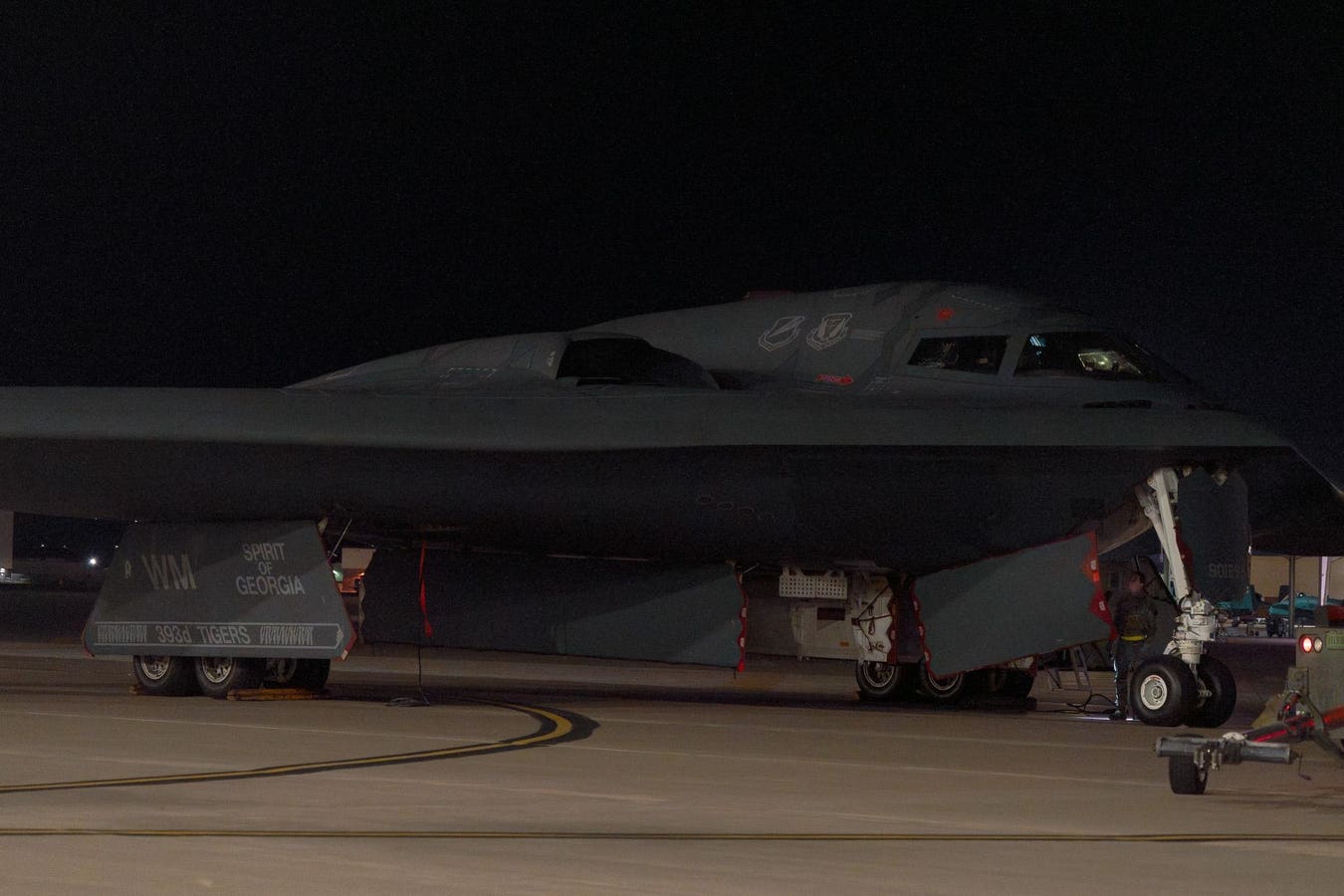


Modern military aircraft come with hefty price tags, a fact highlighted by the United States Air Force’s expenditure of about $23.7 million over four years to repair a Northrop B-2 Spirit bomber. This aircraft was damaged during a landing incident on September 14, 2021.
Known as the “Spirit of Georgia,” the bomber experienced a hydraulic system failure, resulting in a collapse of the landing gear. This caused the wing to graze the runway at Whiteman Air Force Base in Missouri, leading to damage of the aircraft’s composite structure.
The restoration process was an extensive, multi-phase endeavor, requiring significant resources and expertise to bring the aircraft back to operational status.
All efforts bore fruit when, on November 6, 2025, the Spirit of Georgia took to the skies once again.
The substantial investment was justified because the United States Air Force maintains a fleet of fewer than 20 of these unique flying-wing long-range strategic stealth bombers. The B-2 is expected to remain in service for at least another ten years, awaiting the arrival of its successor, the advanced Northrop Grumman B-21 Raider.
Currently, the B-2 Spirits hold the title of the “newest bombers” in the Air Force’s arsenal, with production spanning from 1988 to 2000. The last of the 21 B-2 Spirits rolled off the production line in 2000.
Just 19 B-2s In The Fleet
Currently, the B-2s are also the “newest bombers” in the Air Force’s fleet, with the program running from 1988 to 2000. The 21st and final B-2 Spirit was completed in 2000.
However, due to two other mishaps, just 19 remain.
The “Spirit of Kansas” crashed at Andersen Air Force Base, Guam, in 2008 and was a total write-off for the Air Force. Given the estimated $1.4 billion cost of the aircraft, it is considered the most expensive aircraft crash in history.
Three years ago, on December 10, 2022, the “Spirit of Hawaii” suffered a landing mishap during a routine support flight. The aircraft subsequently caught fire after its landing gear collapsed, destroying the airframe and grounding the B-2 fleet for months. It also resulted in the closure of Whiteman AFB’s only runway.
Although the retirement of the B-2 is likely just a decade away, the capabilities of the Spirit were apparent in June’s Operation Midnight Hammer, where the bombers flew for 36 hours round trip to strike Iran’s nuclear program. That mission also served as a reminder that the U.S. Air Force may need every bomber it has in wartime.
It Took Team Spirit
Returning the Spirit of Georgia to service was no small task. It also began nearly as soon as the bomber came to a halt following its 2021 mishap. Repair efforts were underway even before the aircraft was moved to a hangar.
“The immediate response by the 509th Maintenance and B-2 System Program Office Engineering team was critical,” explained Col. Jason Shirley, senior materiel leader at the Air Force Life Cycle Management Center’s B-2 System Program Office, in a statement.
“They quickly recovered the aircraft, using airbags to lift it enough to manually lock the main gear and tow it into the hangar,” added Shirley. “Damage assessments and Non-Destructive Inspections followed, revealing damage primarily concentrated around the left main landing gear bay and lower wing area.”
AFLCM led the overall effort to repair the aircraft, a long and complex journey that included four key phases. However, even before that point, there was an issue of where the work would be completed.
The entire B-2 Spirit fleet is based at Whiteman AFB. Still, the repairs needed to be handled at Northrop Grumman’s facility at Air Force Plant 42 in Palmdale, California, where the stealth aircraft first rolled off the assembly line. With a wingspan of 172 feet, the Spirit of Georgia couldn’t be transported to California except by making the flight across the country.
That required temporary repairs to the wings in Missouri, which were completed in just over a year. That allowed the damaged B-2 to make a ferry flight to Palmdale, but it also impacted its stealth capabilities, a key attribute of the Spirit.
“Air Force Global Strike provided critical response and concurrence on temporary repairs to facilitate the initial ferry flight and programmed and approved an unfunded request for in-depth scarf repairs during depot maintenance,” said Cindy Conner, deputy branch chief for Air Vehicle and Systems Management Branch in the B-2 System Program Office.
Once back at Northrop Grumman’s Plant 42, more significant repairs began in earnest, including:
Phase 1: Design the repair and order long-lead materials.
Phase 2: Conduct test panels to prove the repair concept.
Phase 3: Repair the aircraft.
Phase 4: Develop airworthiness artifacts to certify the repairs.
One challenge is that the B-2 hasn’t been produced in more than two decades at the time of the accident, and while there are spares, components like wing panels aren’t being made any longer. To save time and costs, the repair efforts included using an existing eight-by-four-foot composite skin section from a test aircraft as a donor part. That was used to restore the lower wing skin that carries wing loads, airstream, and internal fuel tank pressures. Further repairs included the replacement of a left-hand wingtip and the outboard wing major mate skin panel, as well as the landing gear hinges. The structural work was completed on May 12, 2025.
Composite Challenges
The repairs to Spirit of Georgia faced other challenges, including controlling the heat distribution to the composite materials.
“The distribution of localized heat to the areas needing cure, while maintaining localized control as repair areas were in enclosed, confined spaces and directly adjacent to critical joints and structure was a huge challenge,” said Matt Powers, structure engineer with the B-2 System Program Office. “This was overcome by utilizing advanced custom-built heating equipment, performing thermal surveys, and adjusting insulation and cooling air throughout the final cure.”
The team further employed a new resin system that could cure outside an oven. It was the first time the resin, which had previously been used on extensive composite repairs outside an autoclave, was used on the B-2. It saved months of work and lowered repair costs. It further utilized techniques and processes from other Northrop Grumman programs.
The combination of new materials, equipment, and processes should also help improve the sustainment and modernization of the B-2 Spirit fleet and enable faster, more cost-effective repairs of all aircraft composite structures. According to the Air Force, this will further reduce downtime and extend the lifespan of the fleet.
The result speaks for itself: another Spirit is back in the sky.


