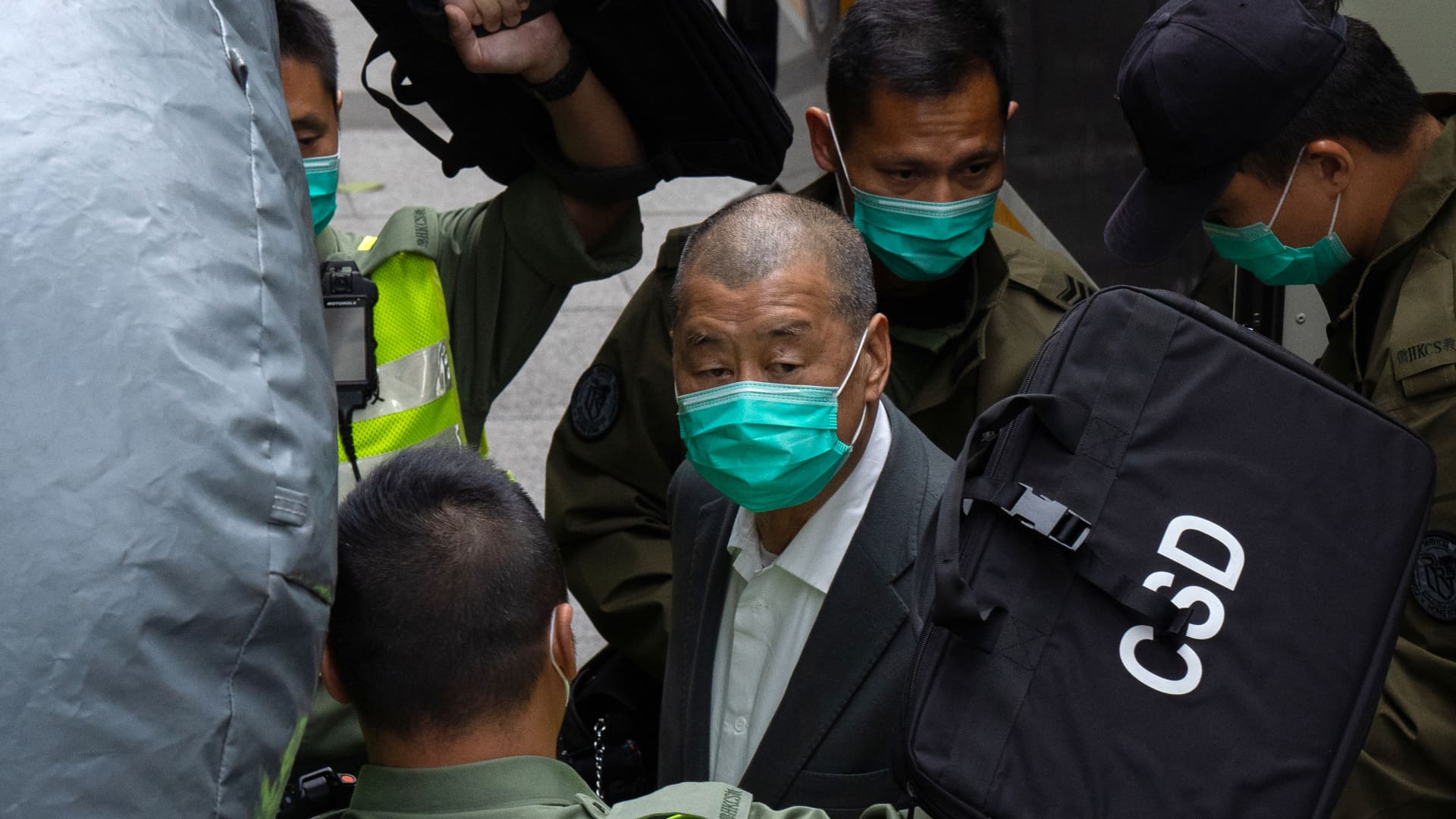
In a significant ruling on Monday, a Hong Kong court convicted pro-democracy advocate and media tycoon Jimmy Lai of sedition and colluding with foreign nations. The judgment adds a new chapter to the ongoing saga of political dissent in the region.
Lai, aged 78, faced charges under Hong Kong’s contentious national security law, which was imposed by Beijing in 2020 following widespread pro-democracy protests in 2019. This law has been a focal point of criticism for its role in curbing freedoms in the territory.
The court found Lai guilty of “conspiracy to commit collusion with a foreign country or with external elements to endanger national security.” This crucial verdict underscores the intense scrutiny on Lai and his media endeavors.
Additionally, the court accused Lai and his publication, Apple Daily, of soliciting foreign entities to “impose sanctions or blockade, or engage in other hostile activities” against Hong Kong or the Chinese mainland. This claim reflects the broader tensions between local activism and national policy.
In its exhaustive 850-page judgment, the court detailed that Lai had long harbored deep-seated resentment and animosity towards the People’s Republic of China. This personal animus was cited as a motivating factor in his actions.
Despite the accusations, Lai, a prominent critic of the Chinese Communist Party, maintained his innocence. He pleaded not guilty to the charges of colluding with foreign forces under the national security law, as well as to a charge of conspiracy to publish seditious materials. His defense highlights the ongoing struggle between local democratic aspirations and broader geopolitical pressures.
He has been under arrest since 2020, with his trial starting in December 2023. Lai’s sentencing is expected to be on Jan. 12.
Speaking just after the judgment, Andrew Collier, senior fellow at the Harvard Kennedy School, said the verdict was “not very good” from a foreign investor perspective, adding “people want an independent court system that’s going to protect the rights of citizens and the financial community.”
He said the verdict on Lai was expected, but the question for Hong Kong is around investor confidence.
While the city has seen a growing number of IPOs in 2025, “if investors are not comfortable with the court system, with cases like Jimmy Lai’s, that’s not good for the future of Hong Kong,” Collier said.
Lai, who founded Asian clothing brand Giordano, newspaper Apple Daily and digital media company Next Digital, was brought up by U.S. President Donald Trump during his meeting with Chinese President Xi Jinping in South Korea back in October.
Trump pressed Xi to release Lai during the meeting, according to Reuters.
The court said that Lai’s “only intent” was to seek the downfall of the Chinese Communist Party, adding “even though the ultimate cost was the sacrifice of the interests of the people of the PRC and the HKSAR [Hong Kong is a special administrative region of China]. This was the ultimate aim of the conspiracies and secessionist publications.”
Speaking to CNBC before the verdict, veteran investor David Roche suggested that a lenient approach could be good for Hong Kong’s business climate. “That, I think, would help to give the overriding impression and therefore conviction to people in the money business that Hong Kong had returned to its normal, business driven, dynamic self.”
Lai acquired British citizenship before Hong Kong was handed back to China in 1997.
The trial verdict is the latest development in Hong Kong’s political scene, which has seen the erosion of democratic opposition in one of Asia’s financial hubs since the enactment of the national security law.
Under changes to Hong Kong’s electoral system in 2021, the number of directly elected members in the city’s legislature was drastically slashed, with only “patriots” reviewed by an election committee allowed to stand for elections.
Monday’s verdict comes on the heels of the dissolution of Hong Kong’s last pro-democracy party on Sunday after 31 years, as well as a “patriots-only” legislative election that saw the second lowest turnout in the region’s history.
In a response to CNBC, Kenneth Roth, visiting professor at Princeton’s School of Public and International Affairs and a former director at Human Rights Watch, said that the decision “underscores the utter demise of the political freedoms that had once made the city so great.”