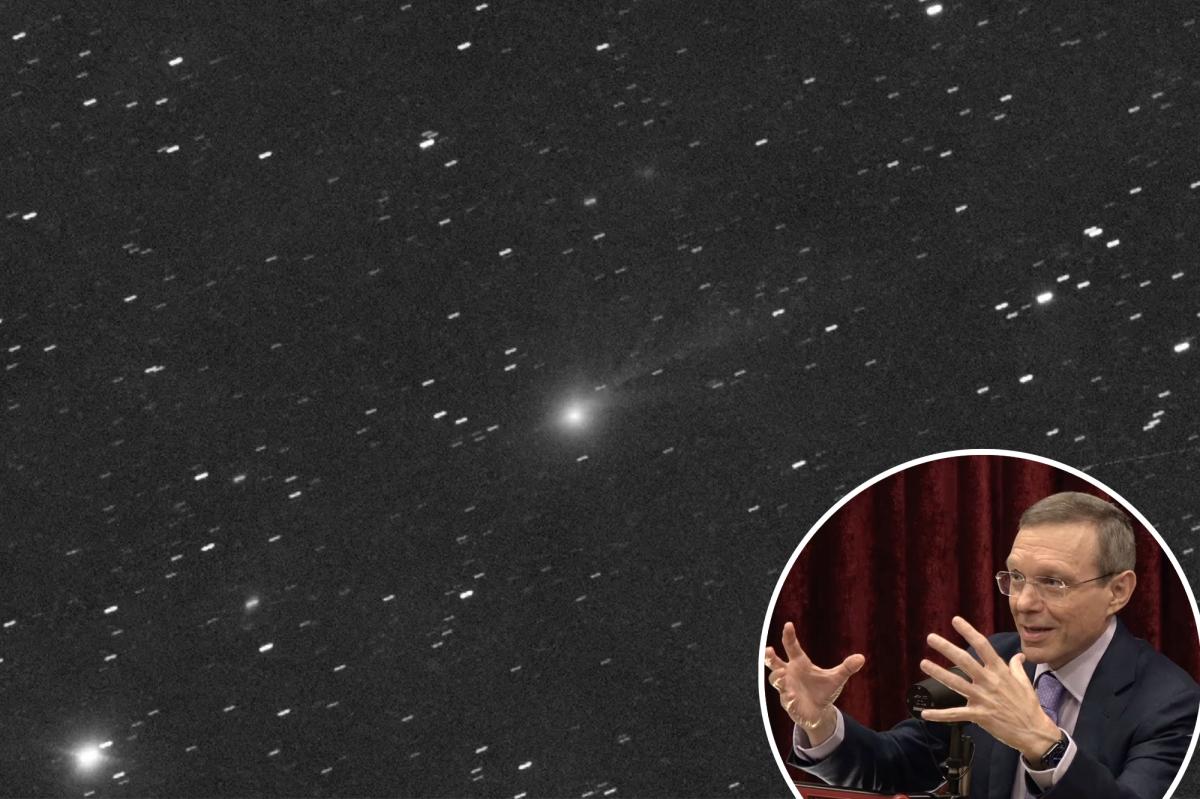

Theories about the interstellar object 3I/ATLAS are causing quite a stir in the scientific community.
As 3I/ATLAS prepares to make its closest approach to Earth tomorrow, speculation about its true nature has reached a peak. A recent study suggests that this celestial visitor behaves similarly to comets within our solar system, a claim that Harvard scientist Avi Loeb has dismissed, pointing out that it overlooks several “anomalies.”
The study, which appears in the Research Notes of the AAS, was led by Thomas Marshall Eubanks from Space Initiatives. According to a report by Spaceweather.com, Eubanks described the non-gravitational acceleration of 3I/ATLAS as “typical of normal comets.”
Previously, Loeb had characterized the movement of ATLAS as unusual, particularly noting its strange maneuver during a close pass by the sun last month. He suggested that this could indicate the use of technological thrusters.
Contrary to Loeb’s hypothesis, Eubanks and his team argue that the seeming rocket-like motions of ATLAS are actually due to the process of offgassing. This is a common behavior among active comets, where gas and dust expelled from the comet’s surface near the sun provide small thrusts that change its velocity, path, and rotation.
The research team arrived at this conclusion by measuring the “non-gravitational acceleration of 3I/ATLAS,” utilizing long-baseline astrometry—a method for determining the positions, distances, and movements of celestial bodies—via data from NASA’s Psyche spacecraft and the European Space Agency’s Mars Trace Gas Orbiter, Eubanks explained.
Their final conclusion: “3I/ATLAS is exotic and wonderful. It is also a comet.”
“It has obvious cometary outgassing with a non-gravitational acceleration to match,” the team wrote. “Claiming that it, too, is a spacecraft does not fit the data.”
However, Loeb dubbed their correlation tenuous — on par with seeing a dirt plume shoot up and assuming it’s caused by a living creature.
“When you see a cloud of dust in the desert you might argue that it’s an animal making this cloud because animals, when they run in the desert, they make a cloud of dust,” he told the Post. “But it could also be a car. So it’s really very superficial to say, ‘oh, just because we see dust, it must be a comet.’”
He added, “What they need to do, instead of explaining what are the commonalities with familiar comets, which they often do, is explain the anomalies.”
Loeb argued that they failed to address 3I/ATLAS’ 13 non-cometary traits, including the high levels of nickel (an industrial element) in its plume, its unusual trajectory around our planets, and a tail pointing toward the sun rather than away as is typical.
In a recent post to Medium, the astrophysicist floated a 14th anomaly — a rotation axis in the direction of the sun that he suspected could be evidence of a solar deflector shield.
Loeb referenced a new letter published in the journal Astronomy & Astrophysics, in which Spanish astronomers detected “a wobbling high-altitude jet” in ATLAS between early July and September.
They found that the Sunward “anti-tail” is angled within eight degrees of the poles associated with the object’s axis of rotation — an extremely specific orientation.
This means, per Loeb, that “3I/ATLAS has a steady dayside and a steady nightside, which switch roles” during its closest approach to the Sun, which occurred on October 29.
Loeb found it highly unlikely — a probability of just 0.5% — that an interstellar object would be oriented so constantly Sunwardly and provide such a seamless transition from dayside to nightside.
One theory, Loeb told the Post, is that ATLAS is “technological” and had deployed a Sun-facing jet-like shield to protect itself from the solar wind and radiation. “It would launch a jet that somehow deflects the solar wind particles in the direction of the sun always,” he theorized.
He said this could explain why the jet was so tightly “collimated” — ten times longer than it is wide — rather than going in all directions as is typical when an ice pocket evaporates.
This concentrated beam would, in theory, protect its technological or biological exterior from any hazards from the sun.