
The United States announced on Thursday an arms deal with Taiwan valued at $11.15 billion, marking its most significant support package amid escalating tensions with China. This transaction, seen as a potential flashpoint, also plays a role in the complex relations between Beijing and Tokyo.
China reacted strongly, with Guo Jiakun, a spokesperson for the foreign ministry, condemning the U.S. for breaching the “one-China principle.”
“The U.S.’s decision to back Taiwan’s independence through arms sales ultimately harms its own interests. Any strategy that uses Taiwan to counter China is destined to fail,” Guo declared, as translated by CNBC from Mandarin.
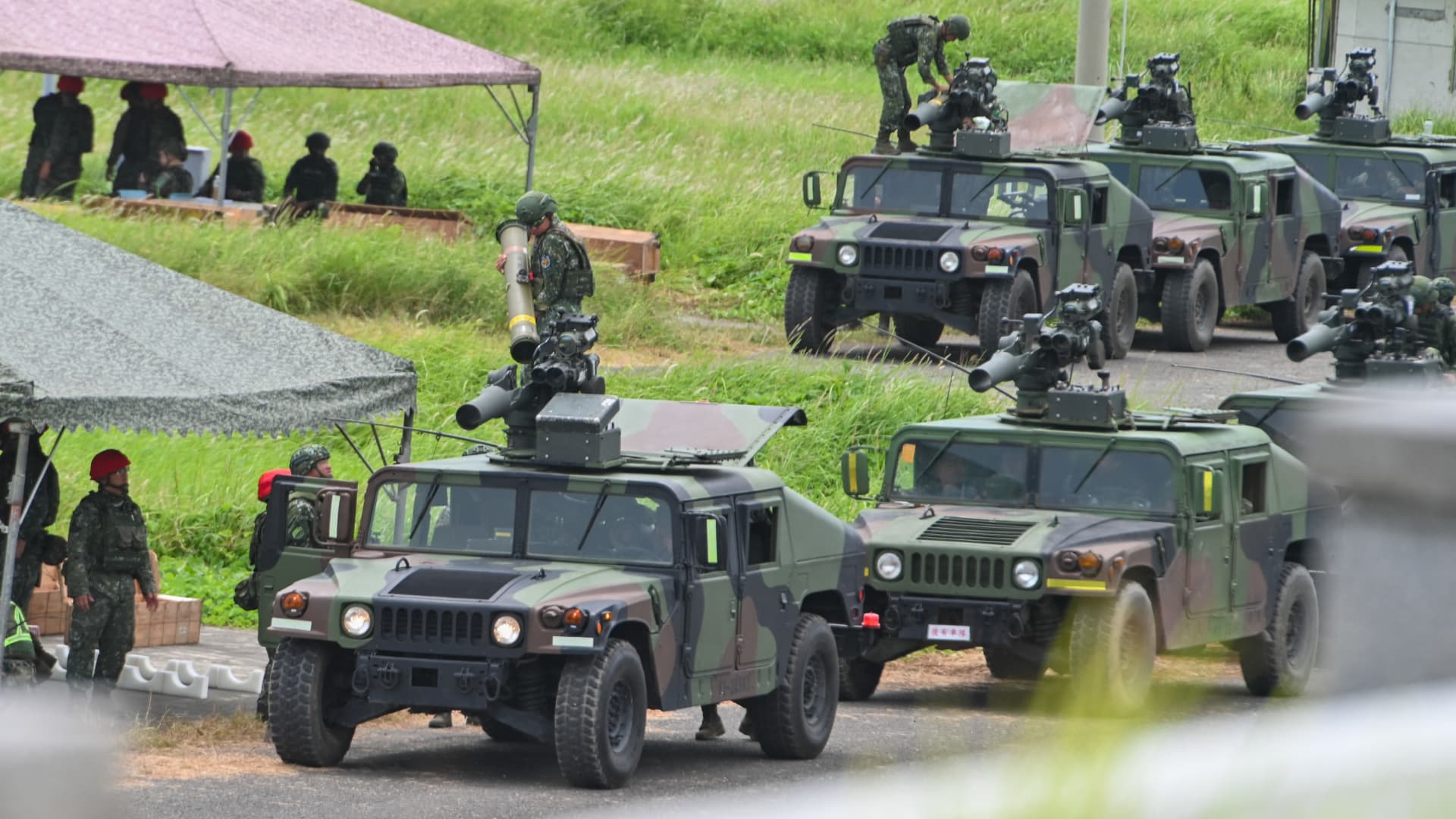
Taiwan’s defense ministry clarified that this arms package—which includes artillery systems, antitank missiles, and spare parts for helicopters and antiship missiles—is part of a $40 billion defense budget supplement announced by President Lai Ching-te last November.
In the previous month, President Lai reiterated his commitment to enhancing Taiwan’s defense capabilities in response to increasing threats from Beijing. He aims for heightened combat readiness by 2027 and has warned of China’s intentions to take control of the island by that year.
Lai highlighted an “unprecedented military buildup” by China, noting increased provocations in various strategic regions, including the Taiwan Strait, the East and South China Seas, and the broader Indo-Pacific area.
On Wednesday, Taiwan’s defense ministry said in a post on X that China’s Fujian aircraft carrier sailed through the Taiwan Strait, adding its armed forces had “monitored the situation and responded.”
In response to Taiwan’s supplementary budget, a spokesperson for Chinese foreign ministry said at a press briefing that “the Democratic Progressive Party’s plan of resisting reunification and seeking independence using armed forces is doomed to fail,” referring to Taiwan’s ruling party.
China has been piling pressure on Taipei and has conducted several military drills off the coast of the island over the past few years, issuing stern warnings over Taiwan’s “provocations for independence.”
Beijing considers democratically governed Taiwan as its own territory and Chinese President Xi Jinping regards its reunification with the mainland “a historical inevitability.” Taiwan rejects those claims.
Speaking to CNBC on Thursday, Matt Gertken, chief geopolitical strategist at BCA Research, said that the U.S. move was President Donald Trump’s way of “restoring some deterrence to Taiwan,” while continuing to negotiate on trade with China.
“So he’s saying to China, we’re willing to trade. We’re not going to cut off your semiconductors completely, but we’re not going to let you attack Taiwan,” Gertken added.
The U.S. package, the biggest on record as per Reuters, comprises 82 HIMARS rocket artillery systems and related equipment worth $4.05 billion, including 420 ATACMS missiles with a range of up to 300 kilometers, as well as unmanned surveillance systems and military software.
It also includes 60 M109A7 self-propelled howitzer systems and related equipment worth more than $4 billion, as well as Javelin and TOW antitank missiles worth more than $700 million.
“It [arms package] seriously infringes upon China’s sovereignty and territorial integrity. It gravely undermines peace and stability across the Taiwan Strait, and sends a seriously wrong signal to the separatist forces for Taiwan independence,” Guo said.
The U.S. does not have a mutual defense treaty with Taiwan and is not obligated to defend the island.
However, the 1979 Taiwan Relations Act states the U.S. “will make available to Taiwan such defense articles and defense services” as may be necessary to “enable Taiwan to maintain sufficient self-defense capabilities.”
In November, China unleashed fiery rhetoric against Japanese Prime Minister Sanae Takaichi, after she said that an attempt to seize Taiwan by force could trigger the intervention of Japan’s Self-Defense Forces.
Beijing, which has called on Takaichi to withdraw her statement and apologize, has advised its citizens not to visit Japan as it continues to be locked in a diplomatic spat with Tokyo.
— CNBC’s Anniek Bao and Yulia Jiang contributed to this report.