Archaeologists may have unearthed the remnants of a grand hall believed to have belonged to England’s last Anglo-Saxon monarch.
The death of King Harold Godwinson at the Battle of Hastings marked the end of four centuries of Anglo-Saxon rule, paving the way for a new dynasty as Norman forces ushered in sweeping changes across the British Isles.
The Bayeux Tapestry famously captures this significant battle, but the subsequent Norman campaign, led by William the Conqueror, sought to erase many remnants of the Anglo-Saxon era as they solidified their control over the realm.
Now, it seems that archaeologists have stumbled upon a rare glimpse into Godwinson’s considerable wealth. They’ve uncovered a substantial hall and a trove of jewelry on land that once belonged to the Anglo-Saxon king.
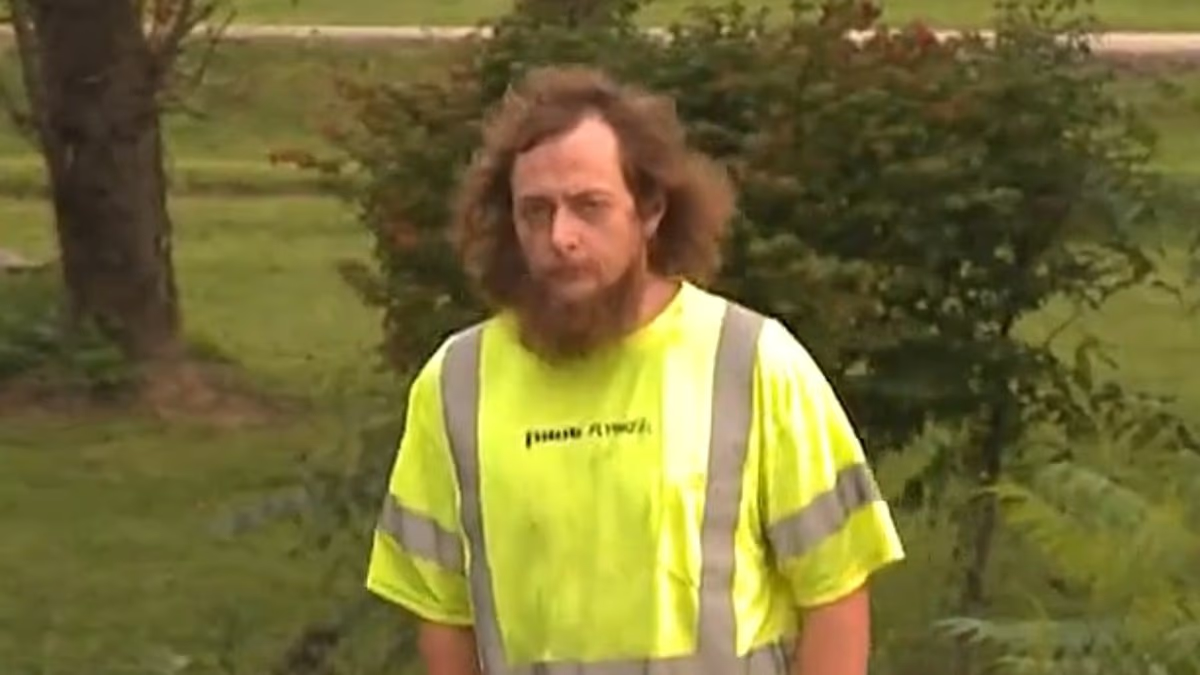
The excavation, directed by Dr. Jim Leary from the University of York, also revealed the presence of a malthouse and a sunken tower. These findings suggest the site may have been a significant center of wealth and influence, befitting royalty.
Conducted over the past two years, the dig near Skipsea Castle in East Riding of Yorkshire has unveiled these historical treasures. The site, featuring a motte-and-bailey castle, was established by the Normans around 1086 on an ancient lake.
The castle’s structure no longer exists, but the name has been given to the mound where it once stood.
Dr Leary and a team of excavators from the university are taking part in a six-year project to unearth the history of the site.

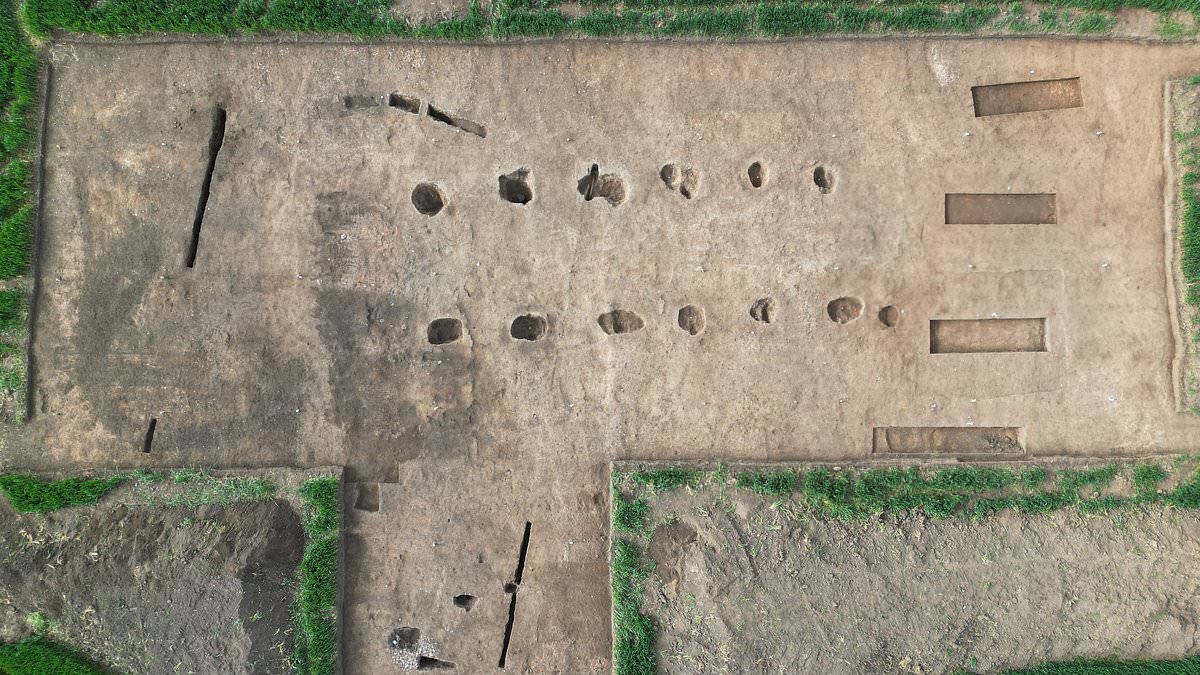
Excavators from the University of York have uncovered a large medieval timber hall

Students from the University of York pictured excavating a timber hall found near Skipsea Castle
The dig is featured in the new series of BBC show Digging for Britain, which is set to be released in January.
Excavators made their first discovery when they found a tandoori-style oven inside a long building, with red colouring in the earth surrounding it due to the heat.
Charred seeds were discovered which indicated that the oven was part of a malthouse, where beer would have been made.
Dr Leary said the original floor of the building had survived and they believe the malthouse dates back to the around the year 750 or 850.
The evidence continued when the team unearthed a square building with a cellar and postholes which they believe is from a sunken tower.
Mr Leary told The Mail: ‘The tower is an indicator of a high-status site, the Malthouse is also an indicator of high-status. It is not the sort of thing that is normally found. This tells us that it is probably a lordly centre.
‘We know that the land was owned by Harold Godwinson, but we don’t know that he ever visited it.
‘The tower may relate to Godwinson, as he did have a similar tower in Bosham in Sussex. We know he had it because it was depicted in the Bayeux Tapestry.’

Harold Godwinson was the last Anglo-Saxon King of England after being defeated by William the Conqueror in 1066

The Battle of Hastings, where Harold Godwinson was defeated by Norman Conquerors, is depicted on the Bayeux Tapestry (pictured)
The team also found evidence of a large timber hall which was built on top of the malthouse which came before it.
While the team has been unable to date the hall, Dr Leary said it was another indicator of an area of high status.
Excavators also found a piece of worked amber was being prepared for jewellery.
Dr Leary said this was the ‘standout find’ of the dig, as it confirmed their theory that the site was a place where luxuries were enjoyed by wealthy individuals.
‘It does indicate high-status sites, and the fact that he [Godwinson] owned it, you know, all of these things sort of link up
While the discovery has been identified to have existed in the right place and time to have been owned by the last Anglo-Saxon King, there is no concrete proof that Godwinson had visited or owned the site.
He also suggested that the site may be the lordly centre of the settlement of Cleeton which was mentioned in the Domesday Book records but was subsequently thought to have been lost.
The dig will continue next year, when Dr Leary alongside his co-director Elaine Jamieson will begin looking further into the area’s history and pre-history.

Students pictured excavating a Saxon oven which indicated the remains of a malthouse

A digger pictured beginning the excavations in front of Skipsea Castle, which is now just a mound
Ms Jamieson said they had been surprised by the discoveries made already.
She said: ‘We definitely were surprised in the sense that we thought there might be a hall there. The nature of archaeology is you don’t always find what you’re looking for, so it was surprising.
‘But the other two structures, the malthouse, we had no inclination that was there and the sunken tower structure is a very rare building. There are very, there’s only a few of them that have actually been excavated, so that was a real surprise. We had no idea that was there as well, so that’s a really exciting.
‘It has given us more and more every single year that we have been excavating.’
Dr Leary added: ‘We use this as the main undergraduate field school for students at the University of York, so this is where they get their first real taste of excavation and it has blown us away.
‘We will be digging for the next few years and it is tremendously exciting.’
The team said they have already discovered evidence of Iron Age ritual activity at the site as well as prehistoric activity.