
Pauline Hanson, the leader of One Nation, is experiencing a significant resurgence, with recent polling suggesting that 2026 could be a landmark year for the politician.
The latest Resolve Political Monitor reveals that both Hanson and her recent ally, Barnaby Joyce, have achieved remarkable increases in likeability among over 50 federal politicians observed over the past year.
Additionally, Hanson’s One Nation party is seeing its highest polling numbers to date.
At the close of 2024, Hanson had a likeability rating of -13, which, while still negative, marked a notable improvement from her -25 score in 2023.
By the end of 2025, she had moved into positive territory with a score of 3, reflecting a significant 16-point improvement.
Joyce’s recovery in popularity is equally impressive.
After quitting the Nationals earlier this month to join One Nation, Joyce’s popularity has jumped from -22 at the end of 2024 to -4.
Even with this lift, he remains one of only two MPs still in negative figures.

Barnaby Joyce (left) and Pauline Hanson (right) both saw their likeability ratings improve
The other is Lidia Thorpe, though the controversial senator has seen the biggest improvement of all, moving from a dismal -41 to -12.
Prime Minister Anthony Albanese has also staged one of the biggest comebacks, leaping from -17 last year to 9.
The analysis was completed before both the Bondi Beach terror attack and Barnaby Joyce’s shock defection to One Nation.
Tasmanian senator Jacqui Lambie, who topped the 2024 rankings, still holds the title of Australia’s most-liked politician with a score of 15.
She now shares top spot with ACT independent senator David Pocock, whose score jumped 10 points this year.
Labor’s most popular member is Small Business Minister Anne Aly, who joined cabinet after the election and now sits at 12.
She narrowly outpaces Foreign Minister Penny Wong and Infrastructure Minister Catherine King, who are both on 11.
Leading the Liberals is Tim Wilson with 11, after winning back Goldstein from teal independent Zoe Daniel.

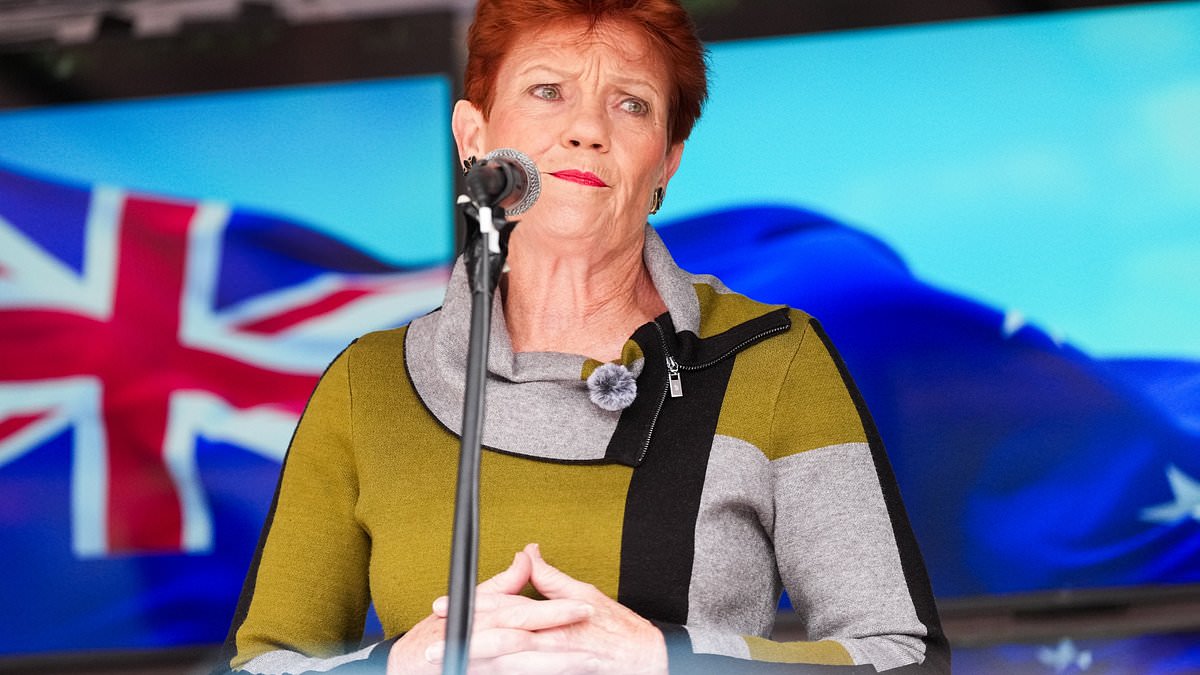
Hanson (pictured) is riding a wave of momentum as her party hits its highest polling in history

Barnaby Joyce (pictured) had his likeability increase by 18 per cent since the end of 2024
Independents remain well-liked: Zali Steggall, Helen Haines and Monique Ryan are all on 8; Kate Chaney and Sophie Scamps on 7; and Allegra Spender on 5.
Liberal leader Sussan Ley has also seen a notable boost, climbing from 0 to 8.
Jacinta Nampijinpa Price was the only politician to go backwards.
After quitting the National Party for the Liberals post-election, her rating fell five points, though she remains in positive territory.
While Hanson’s personal fortunes are soaring, the Coalition faces its biggest crisis in 40 years as its core support drops to record lows.
According to Newspoll’s quarterly analysis for The Australian, conducted from 29 September to 20 November, the Coalition’s primary vote slumped to just 24 per cent in October, the lowest figure since Newspoll started in 1985.
Senior Coalition support is falling fastest among older Australians and people without university qualifications, with many turning away from the two major conservative parties and backing Hanson’s resurgent party.

Albanese (pictured) had his likeability increase, but the poll was taken before the Bondi attack
Between the last two quarters of 2025, Coalition support among voters without tertiary education dropped six points to 26 per cent, while Labor’s slipped two points to 30 per cent.
Among Australians aged over 65, both Labor and the Coalition lost ground to One Nation, the data shows. Men and women alike are deserting the Coalition, with Hanson’s party clearly benefiting from the shift.
Queensland is at the heart of the Coalition’s decline. Formerly a Liberal and Nationals stronghold, the state is now a battleground, with One Nation encroaching further every month.
Joyce’s decision to leave the Nationals after two decades has rattled conservative MPs and is widely expected to fuel One Nation’s growth among rural voters disappointed with the Coalition.
Political analysts warn that the Coalition’s 24 per cent primary vote is not a momentary dip, but a genuine threat to its future.
The party hasn’t faced numbers this dire since the 1980s, and even then, its support never fell this low.
With Labor steady and independents strongly backed, the Coalition faces being squeezed from both sides of the political spectrum.