
In an interview with The Wall Street Journal, President Donald Trump addressed concerns about his health, clarifying details about a medical examination he underwent in October. Trump revealed that contrary to initial reports, he had a CT scan rather than an MRI during his visit to Walter Reed National Military Medical Center. This information comes after a period of speculation due to limited details being shared by the White House at the time.
The president expressed some regret over the decision to have the scan, acknowledging that it sparked public speculation about his health. However, Trump’s physician, Navy Capt. Sean Barbabella, had previously explained in a December memo that the “advanced imaging” was a routine preventative screening, common for men of Trump’s age.
Initially, Trump had mentioned the procedure as an MRI but admitted uncertainty about which part of his body was examined. It’s worth noting that a CT scan, while less detailed than an MRI, is a quicker diagnostic tool.
Navy Capt. Barbabella elaborated on the circumstances surrounding the examination, noting that Trump’s October visit to Walter Reed was primarily to meet with staff and soldiers. Given the president’s presence at the medical center, Barbabella recommended a routine physical evaluation to maximize the visit’s benefits.
“President Trump agreed to meet with the staff and soldiers at Walter Reed Medical Hospital in October. In order to make the most of the President’s time at the hospital, we recommended he undergo another routine physical evaluation to ensure continued optimal health,” Barbabella explained.
To ensure no cardiovascular concerns were present, Barbabella advised either a CT scan or MRI. The results, according to Barbabella, were “perfectly normal,” showing no abnormalities and affirming the president’s health status.
White House press secretary Karoline Leavitt said in a statement Thursday that the president’s doctors and the White House have “always maintained the President received advanced imaging” but said that “additional details on the imaging have been disclosed by the President himself” because he “has nothing to hide.”
“In retrospect, it’s too bad I took it because it gave them a little ammunition,” Trump said in the interview with The Wall Street Journal published Thursday. “I would have been a lot better off if they didn’t, because the fact that I took it said, ‘Oh gee, is something wrong?’ Well, nothing’s wrong.”
The 79-year-old became the oldest person to take the oath of office when he was sworn in as president last year and has been sensitive to questions about his health, particularly as he has repeatedly questioned his predecessor Joe Biden’s fitness for office.
Biden, who turned 82 in the last year of his presidency, was dogged the end of the his tenure and during his abandoned attempt to seek reelection over scrutiny of his age and mental acuity.
But questions have also swirled around Trump’s health this year as he’s been seen with bruising on the back of his right hand that has been conspicuous despite a slathering of makeup on top, along with noticeable swelling at his ankles.
The White House this summer said the president had been diagnosed with chronic venous insufficiency, a common condition among older adults. The condition happens when veins in the legs can’t properly carry blood back to the heart and it pools in the lower legs.
In the interview, Trump said he briefly tried wearing compression socks to address the swelling but stopped because he didn’t like them.
The bruising on Trump’s hand, according to Leavitt, is from “frequent handshaking and the use of aspirin,” which Trump takes regularly to reduce the risk of heart attack and stroke.
He said he takes more aspirin than his doctors recommend but said he has resisted taking less because he’s been taking it for 25 years and said he is “a little superstitious.” Trump takes 325 milligrams of aspirin daily, according to Barbabella.
“They say aspirin is good for thinning out the blood, and I don’t want thick blood pouring through my heart,” Trump said. “I want nice, thin blood pouring through my heart. Does that make sense?”
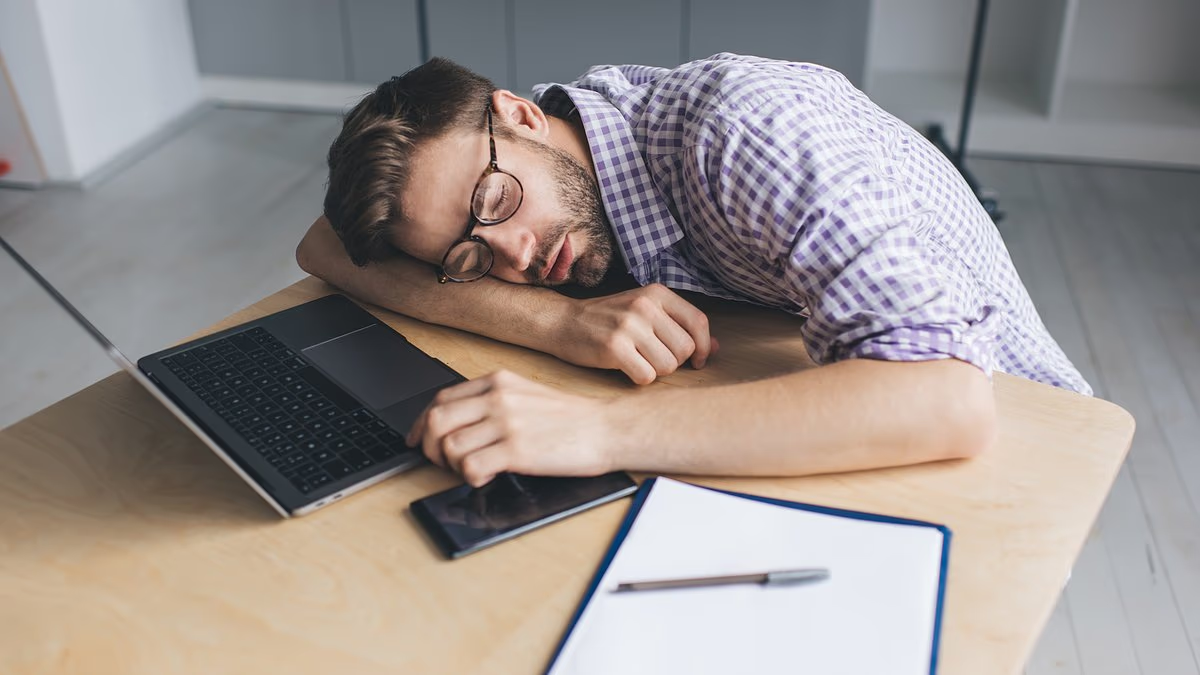
Trump, in the interview, denied he has fallen asleep during White House meetings when cameras have caught him with his eyes closed, instead insisting he was resting his eyes or blinking.
“I’ll just close. It’s very relaxing to me,” he said. “Sometimes they’ll take a picture of me blinking, blinking, and they’ll catch me with the blink.”
He said that he’s never slept much at night, a habit he also described during his first term, and said he starts his day early in the White House residence before moving to the Oval Office around 10 a.m. and working until 7 p.m. or 8 p.m.
The president dismissed questions about his hearing, saying he only struggled to hear “when there’s a lot of people talking,” and said he has plenty of energy, which he credited to his genes.
“Genetics are very important,” he said. “And I have very good genetics.”
Copyright © 2026 by The Associated Press. All Rights Reserved.