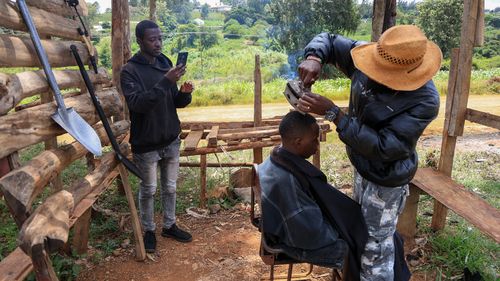

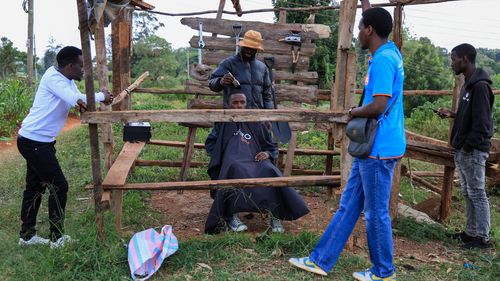
Barber and viral content creator Safari Martins, demonstrates one of his inventive shaving methods using an iron box while grooming Ian Njenga in Kiambu, Kenya, Wednesday, Nov. 26, 2025. (AP Photo/Andrew Kasuku)
Share this @internewscast.com

Safari Martins guides his customer, Ian Njenga, into a modest shack located by a rural road in Kiambu, just outside the bustling city of Nairobi.

The wooden walls of the shack are adorned with an assortment of tools—a shovel, a piece of iron, gardening shears, and a wrench. However, Njenga isn’t there to purchase any equipment.

He’s there for a haircut.
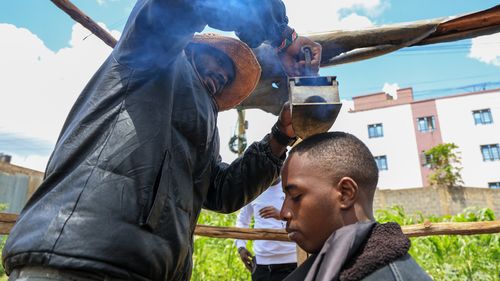
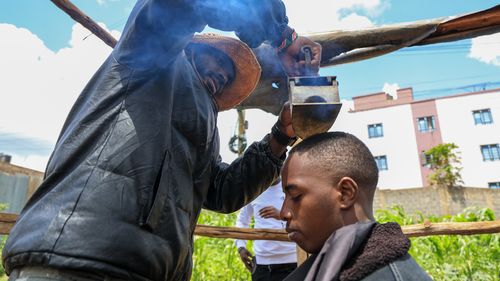
Barber and viral content creator Safari Martins, demonstrates one of his inventive shaving methods using an iron box while grooming Ian Njenga in Kiambu, Kenya, Wednesday, Nov. 26, 2025. (AP Photo/Andrew Kasuku)
Barber and viral content creator Safari Martins, demonstrates one of his inventive shaving methods using an iron box while grooming Ian Njenga in Kiambu, Kenya. (AP)

“I just use unconventional tools,” Martins remarks with a grin, moments before using the sharp edge of a shovel to skillfully remove a section of Njenga’s hair, initiating a series of cuts that result in a remarkably neat hairstyle.

Martins has made a name for himself with his unique approach, becoming one of Kenya’s most famous barbers. He boasts about one million followers each on Instagram and TikTok, where he is known as Chief Safro.

As Martins expertly works on Njenga’s hair, an assistant stands nearby, diligently capturing every moment from various angles on a smartphone camera.

Influencer barbers are a new trend in Kenya, where social media usage has exploded in recent years and platforms like TikTok are being used both for entertainment and as a lucrative side hustle.
Barber and content creator Safari Martins shaves Ian Njenga in Kiambu, Kenya on Wednesday, November 26.
Barber and content creator Safari Martins shaves Ian Njenga in Kiambu, Kenya on Wednesday, November 26. (AP)

Born in Rwanda and now based in Nairobi, Martins got his start barbering in high school in 2018.

Using borrowed clippers, he began offering trims outside classrooms and in cramped dormitories.

Five years later, he added a camera and dropped a conventional trimmer and never turned back.

Martins went viral for zany barbering methods, but he has increasingly incorporated traditional African folk tales into voiceovers on his videos.

“I’m motivated by African culture, by African stories,” he says, adding that one of his tools, a sharpened iron box, was blessed by village elders.

The barber’s staying power has come from the haircuts themselves, which his customers say they love and the chance to be featured on one of Kenya’s most magnetic social media accounts.

Barber and content creator Safari Martins uses a clothing iron as he shaves Ian Njenga in Kiambu, Kenya.
Barber and content creator Safari Martins uses a clothing iron as he shaves Ian Njenga in Kiambu, Kenya. (AP)

“If I compare him with other barbers his talent is next level,” says Njenga, who first visited Martins last year.

“When I get shaved here I get very comfortable … while walking in the streets I get very confident.”

The draw of a unique barbering experience and five minutes of social media fame is enough for customers to push past the price.

Martins charges up to 1500 Kenyan shillings, or about $17, for one of his cuts, a hefty premium in Nairobi, where men may pay a tenth of that for a trim.

The popularity of Martins and other content creator barbers has come amid the breakneck growth of social media in Kenya.

In January 2023, there were just 10.6 million social media users in the country, according to DataReportal, a market research group.

A man uses his phone to record barber and content creator Safari Martins as he shaves Ian Njenga in Kiambu, Kenya, Wednesday, Nov. 26, 2025. (AP Photo/Andrew Kasuku)
A man uses his phone to record barber and content creator Safari Martins as he shaves Ian Njenga in Kiambu, Kenya. (AP)

By January 2025, that number had increased almost 50 per cent, to 15.1 million.

With monetisation of social media content often benchmarked to Western digital advertising rates, finding success online can also bring a relative windfall to Kenyans.

Around 15 per cent of Kenyans engaged in online content creation rely on it as their primary source of income, the Kenya Institute for Public Policy Research and Analysis, a think tank, said in a June 2025 brief.

Nevertheless, Martins complains that barbers do not not reap the same rewards as other content creators, and he is right.

Some of the highest-paid creators are those who make gaming, education, or lifestyle content, according to Fundmates, a company that finances influencers, because of the wide applicability of brand deals in these niches.

“Barbers get viral on social media but I feel like they are not respected,” Martins said.

“You are not paid as a content creator, even though you have the views, even if you have the engagement.”

Share this @internewscast.com
You May Also Like

Trump Dismisses Australia’s Assistance Over Strait of Hormuz Tensions, Claims No Need or Desire for Support

President Donald Trump has sharply criticized Australia in a recent outburst targeting…
Legionnaires' disease

Critical Health Alert: Severe Respiratory Illness Spreads in Melbourne

Victoria’s Chief Health Officer (CHO) has issued an urgent health warning following…
Long queues for petrol at a Sydney service station.

Albo Faces Critical Decisions: Navigating Complex Challenges Today

The prime minister will talk to state premiers and chief ministers today…
The High Court held the visa refusal did not infringe on implied freedom of political communication. (Lukas Coch/AAP PHOTOS)

High Court Ruling Overturns Monitoring System for Convicted Killer

The nation’s top court has struck down curfew and ankle-monitoring restrictions imposed…

Record-High Incarceration Rates for Indigenous People: A Growing Crisis

Key Points Only 3 outcome areas are on track to achieve their…
Israel kills another top Iranian official as energy facilities targeted

Israeli Forces Strike Again: High-Ranking Iranian Official and Energy Sites Hit

Israel continues its strategic offensive against Iran’s leadership, recently resulting in the…

Iran Threatens Gulf Energy Sites Amid Escalating Tensions Over Israeli Strikes on Pars Gas Field

In Brief South Pars supplies around 80 per cent of Iran’s gas,…

Brace for Impact: Category 4 Cyclone Narelle Set to Hit Far North Queensland Coast

A region already reeling from floods is now preparing for the arrival…
'Fatal miscalculation': Iran's chilling vow over gas field strike

Iran’s Ominous Pledge: Unveiling the Consequences of the Gas Field Assault

Iran has vowed to retaliate following what its state media claims was…
The entrance to the Qantas lounge in London.

Jetstar Passengers Face New Restrictions: Qantas Lounge Access Revoked Under Updated Policy

Some Jetstar travellers will be booted from Qantas lounges under new rules…
Janet Taylor Easton, 67, was killed alongside her cousin Alison Taylor from New Zealand , also 67, in South Luangwa National Park on July 3 last year. Pictured: Alison Taylor

British Teacher and Kiwi Cousin, Both 67, Tragically Killed by Charging Elephant During Zambia Walking Safari, Inquest Reveals

In a tragic incident during a safari in Zambia, a retired British…
Over 10,000 adults aged between 60 and 89 were followed over time and asked how many times a week they would have disturbing dreams.

The Sleep Pattern Linked to an Increased Risk of Dementia

A new study spearheaded by researchers in Australia suggests that individuals experiencing…