
As is often the case with Donald Trump, the recent events unfolding in Caracas offer a mix of both positive and negative outcomes. This duality is particularly evident in the weekend’s significant and dramatic developments in Venezuela.
Many are cheering the ousting of Venezuelan leader Nicolas Maduro, whose oppressive regime left citizens in poverty and despair. His removal came via a bold U.S. military operation under Trump’s orders, marking the end of his tumultuous reign.
Now, Maduro faces serious charges of drug trafficking in a New York court, with a future likely spent in a U.S. federal prison.
However, Trump’s declaration, “We are going to run the country [Venezuela] now,” raises serious concerns about potential overreach and imperialistic intentions.
While Venezuelans celebrate Maduro’s departure, they are wary of substituting one form of domination for another, particularly by an external power thousands of miles away. The idea of being governed from afar by the U.S. is not something they are willing to accept.
For now, there is a collective sigh of relief as Maduro heads to face justice. He was a significant threat to his own people, deeply entwined with drug cartels and heavily involved in arms trafficking. Moreover, he had forged troubling alliances with Russia and Cuba, posing a challenge to U.S. interests in the region.
The Cubans provided him with the intelligence resources to maintain a brutal grip on his people – in return for enough Venezuelan oil to sustain the ailing communist gerontocracy in Havana.
The brutality got worse the longer he was in power. Arbitrary arrest, torture and even killing of political opponents became commonplace. Dissent was ruthlessly suppressed by the regime’s thuggish security forces.

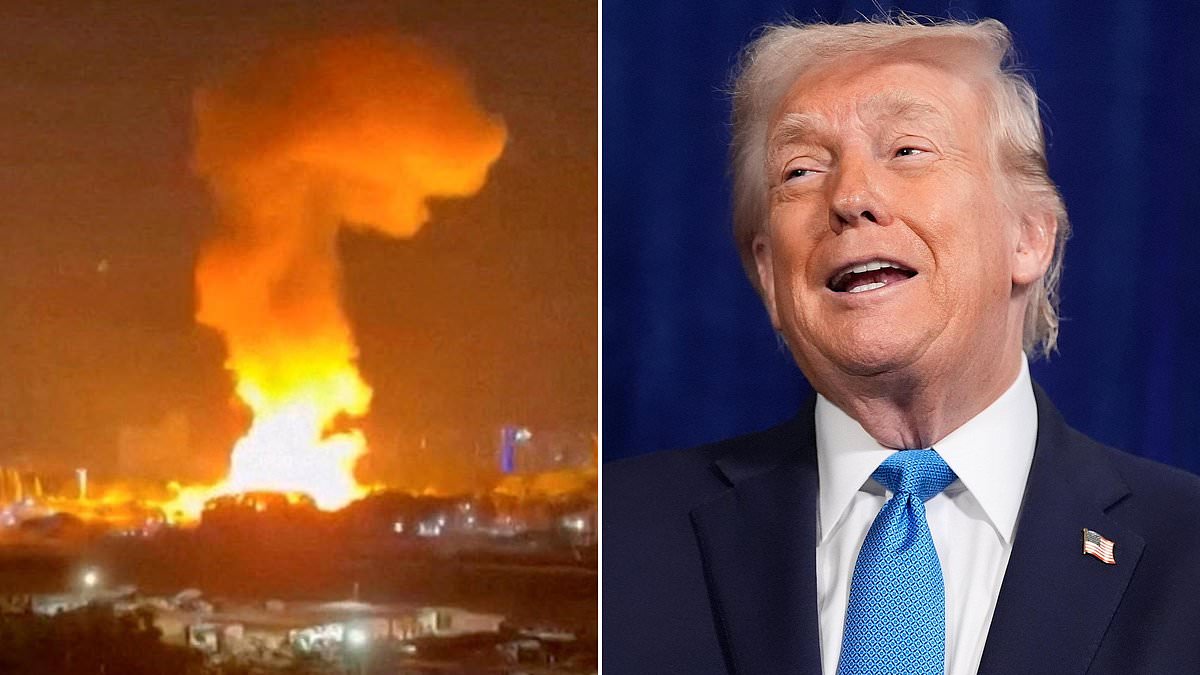
President Trump addresses the media from Mar-a-Lago after the military action in Venezuela

A destroyed anti-aircraft vehicle at La Carlota military air base in Caracas, Venezuela’s capital
The dead hand of state socialism turned what was once the richest country in Latin America, with the largest oil reserves in the world, into an economic basket case, impoverishing the population with soaring inflation and collapsing national output.
The Venezuelan economy was disappearing before our very eyes as its GDP slumped. So were its people. Nearby countries were flooded with 8million refugees, including the US, to which Maduro encouraged mass illegal migration to sow division among Americans.
It is a measure of its warped values that only elements of the British Left are mourning Maduro’s demise – unlike anybody in Venezuela, beyond those whose wealth and status depended on the regime’s survival and who now fear that they too will face justice.
But the little matter of what happens next is already at the fore. The omens are not encouraging thanks to Trump’s desire – described as ‘bizarre’ by a leader of the democratic opposition in Caracas – to run the show himself.
It’s one thing for America to hang around to help during a post-Maduro transition period to restore democratic government. It would be irresponsible of Trump to depose Maduro only to leave Venezuela to fend for itself and risk a return to dictatorship. But Trump is talking about much more than a transitional helping hand.
He has put no time limit on how long he plans to be Venezuela’s imperator. There is even talk of making his Secretary of State, Marco Rubio, the Spanish-speaking American of Cuban descent, his ‘Viceroy of Venezuela’ (a ‘stupefying concept’ one senior US State Department official tells me).
Venezuela faces the prospect of moving from being a domestic dictatorship to a US colony.
Fears are fanned by Trump talking much more about ‘the oil’ than the creation of a free and democratic Venezuela. It merely underlines that, for Trump, this is a mercenary project designed to feather America’s own nest rather than rebuild a prosperous, democratic Venezuela.

Smoke rises from the site of an explosion in Caracas during the US’s military action

‘Venezuela faces the prospect of moving from being a domestic dictatorship to a US colony’
Not once has Trump mentioned the need to restore the human rights of Venezuelans. He is far more obsessed with America making money out of a revived Venezuelan oil industry.
‘He keeps on talking about taking back Venezuelan land and oil that rightly belongs to America,’ one senior White House adviser confides in me. ‘But we have no right to any land or oil in Venezuela.’
Even worse, says this adviser: ‘If there is a blueprint for running Venezuela post-Maduro, nobody in the White House has seen it.
‘We assumed the President had drawn up a detailed plan before removing Maduro. But he hadn’t. He seems to be making things up as he goes along.’
Regime change, of course, is fraught with danger, as America has found out the hard way in places such as Iraq and Libya, where the removal of despots resulted in anarchy and civil war, often just as bad – if not worse – than what went before them.
But that need not happen in Venezuela, which has a respected and popular opposition which recently won a general election, only for the result to be nullified by Maduro.
So it was especially chilling to hear Trump so easily dismiss the hugely respected Maria Corina Machado, Venezuela’s main opposition leader, a centre-Right democratic heroine and last year’s winner of the Nobel Peace Prize.
He claimed that she lacked the ‘support’ or ‘respect’ of the people, which is palpable nonsense. She has both by the lorry-load. No other Venezuelan has more.

Venezuelan opposition leader and Nobel peace prize winner Maria Corina Machado

Activists in Florida hold a Venezuelan flag with a picture of Corina Machado on January 3
She risked her life to challenge Maduro in the 2024 general election by organising and rallying opposition to him. Maduro was so scared he barred her from running. So she threw her weight behind Edmundo Gonzalez, a 76-year-old former diplomat who went on to win by a landslide despite widespread intimidation.
Maduro ignored the result, declared himself the winner, drove Gonzalez into exile and Machado into hiding. She had to be smuggled out of Venezuela to collect her Nobel Prize in Norway.
Trump didn’t even mention Gonzalez in his weekend press conference, and referred to Machado only to disparage her.
It boils my blood that he thinks he has more of a right to run Venezuela than either of them. Clearly – and absurdly – it still rankles that she won the Nobel Peace Prize, not him. It is beyond pathetic.
There is much talk of regime change in Caracas. In fact, for all the US pyrotechnics at the weekend, Venezuela’s regime has not changed. Maduro has gone but the government is still in the hands of his vice president, Delcy Rodriguez, a hardline socialist surrounded by Maduro’s nastiest enforcers.
Trump claims that she’s ready to do his bidding. But she has denounced the US operation as ‘shameful’, evoked historic Venezuelan socialist icons in her cause – ‘We will never again be slaves or the colony of an empire’ – and demanded the release of Maduro.
Just how Trump thinks he can wrestle power from her without a massive deployment of US boots on the ground – for which he has no mandate, not even from his own MAGA base, which abhors foreign interventions – is just one of many mysteries now surrounding Trump’s approach to Venezuela, a country of 28million people that is twice the size of California.
I’ve explained on these pages before how Trump has made the Western Hemisphere his geopolitical priority, in a revamping of the Monroe Doctrine (named after an early 19th century president), which Trump has renamed the Donroe Doctrine.
Venezuela shows, however, that it is not enough for neighbouring nations to settle meekly within the US sphere of influence. He wants control over them, directly if need be. This should send a shiver down the spine of nearer neighbours, such as Greenland and Canada, whose land Trump has already made clear he covets.
Yesterday a former White House adviser married to one of the President’s most influential aides, deputy chief of staff Stephen Miller, posted a map of Greenland with the American flag over it and the caption, ‘SOON’.
A chilling ambition, for sure. But not so far-fetched now we face the prospect of Emperor Trump of Venezuela. The best chance of peaceful regime change in Latin America for a generation is being squandered on the altar of his own narcissistic, imperial ambitions.
A case study in how to grab defeat from the jaws of victory.