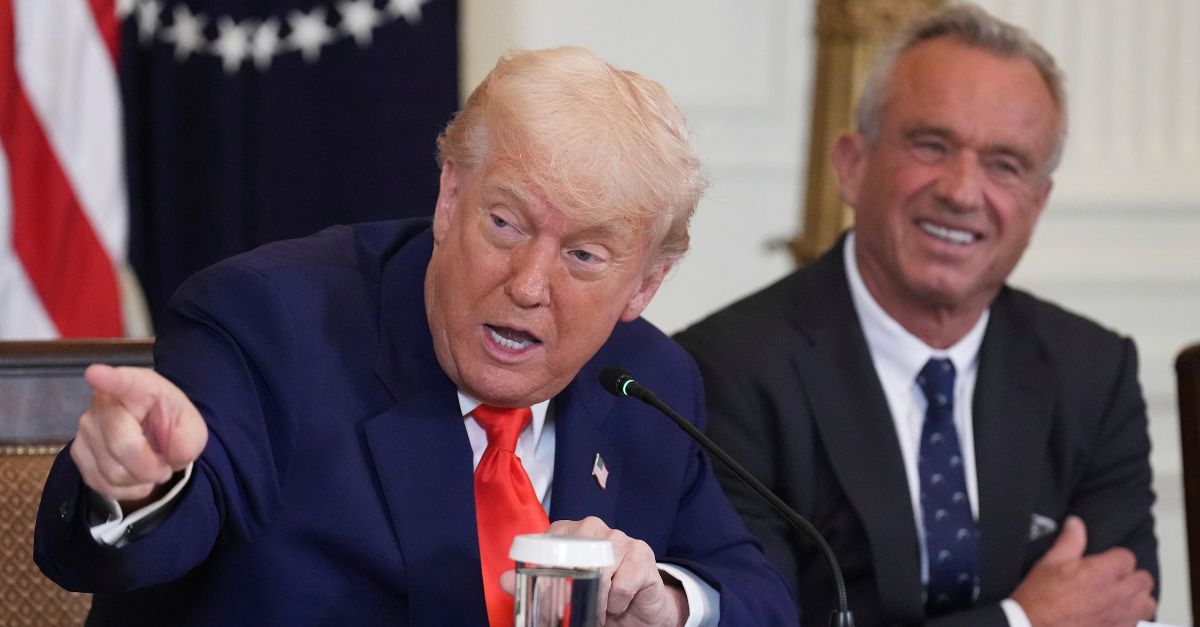

President Donald Trump, left, speaks as Health and Human Services Secretary Robert F. Kennedy Jr. listens during a Make America Healthy Again (MAHA) Commission Event in the East Room of the White House, Thursday, May 22, 2025, in Washington (AP Photo/Jacquelyn Martin).
A federal appeals court has blocked the Trump administration from implementing a new initiative perceived to favor drug manufacturers over low-income hospitals, as announced on Wednesday.
The 1st U.S. Circuit Court of Appeals, in a case initiated by the American Hospital Association and several regional hospitals against the Department of Health and Human Services (HHS), ruled unanimously that a proposed drug rebate program likely contravenes the Administrative Procedure Act (APA), which regulates federal agency procedures.
This seven-page decision from the appellate court supports a previous district court injunction that had already halted the pilot program’s implementation.
Last summer, HHS unveiled plans to alter the longstanding 340B program, known for providing upfront discounts to patients at rural and low-income hospitals.
In December 2025, the plaintiffs submitted a comprehensive 65-page lawsuit, contesting that the government was aligning with pharmaceutical industry interests by transitioning to a “rebate” model.
The lawsuit contends, “This shift would compel safety-net providers to initially pay drug companies at full market price and subsequently obtain reimbursement for the discounted difference after treating patients and submitting detailed claims data to drug companies.” The complaint further argues that such a change would impose hundreds of millions of dollars in annual costs on hospitals and other entities involved.
On Dec. 29, 2025, U.S. District Judge Lance E. Walker, who was appointed by Trump during his first term, sided with the plaintiffs.
“In a careful and thorough decision, the district court granted the preliminary injunction,” the appellate court summarized. “It determined that the federal government had failed to consider the hospitals’ reliance interests and other important aspects of the problem in enacting the new program and that the hospitals would face irreparable harm, including potential closure, without an injunction during the course of the litigation.”
After that, HHS moved for a stay pending appeal with Walker, who denied it. Then, HHS appealed directly to the 1st Circuit for a stay.
In rejecting the stay bid, the panel described the HHS pilot program as “upending a decades-long practice of providing safety-net hospitals — which serve rural and low-income communities — with upfront discounts to purchase prescription drugs.”
At the district court level, the government did not provide “any explanation or reasoning for the change in policy,” the panel explained. The appeals court went on to muse that the “apparent purpose” for the pilot program is to remedy occasional instances of drug manufacturers being “subjected to duplicative pricing concessions when selling drugs to safety-net hospitals.”
But the 1st Circuit was clearly not happy with the proposed solution.
“To avoid this duplication problem, the Rebate Program requires safety-net hospitals to pay to the drug manufacturers upfront prices far exceeding the amounts that they actually owe — essentially functioning as an interest-free loan from the hospitals to the manufacturers — and then wait for a rebate,” the ruling reads.
Endorsing the legal basis of the plaintiffs’ complaint, the appeals court went on to say that “the federal government had failed to consider important aspects of the problem, all in violation of the APA.”
Specifically, the panel means HHS “acted arbitrarily and capriciously,” an APA-based term of art referring to agency actions that go too far while simultaneously eschewing formal, mandatory processes.
“The federal government has not carried its burden to justify a stay,” the ruling goes on. “To begin, we agree with the district court that the administrative record previewed below is devoid of evidence that the federal government considered the hospitals’ significant reliance interests — a critical factor in the analysis of an arbitrary-and-capricious claim.”
In real terms, the government’s arbitrary and capricious actions included “failing to consider [the hospitals’] significant reliance interests” based on “more than thirty years of established practice” and “hundreds of millions of dollars’ worth of new costs that safety-net hospitals would incur under,” the 1st Circuit again summarized.
The appeals court goes on to dissect, at length, just how unprepared the government was when it tried to institute the payment change, calling the government’s own record of inquiry “threadbare.”
“It does not contain any evidence showing that the federal government considered the hospitals’ reliance interests, which all parties agree are significant,” the ruling continues. “Indeed, in its briefing to the lower court, the federal government conceded that it was ‘currently examining’ the hospitals’ increased administrative costs from the Rebate Program.”
The appeals court goes on to rubbish the Trump administration’s late-stage attempts to “elaborate” on its administrative plans — with a declaration by an HHS employee — as unavailing because “there is nothing upon which” the government can elaborate in the first place.
“As the district court pointed out, the preview of the administrative record contains almost no contemporaneous explanation for the Rebate Program,” the ruling goes on. “Instead, the declaration appears to present new information in an attempt to justify the Rebate Program retroactively.”
The plaintiffs welcomed the ruling.
“The AHA remains pleased that these courts have put on hold this harmful program that would have a devastating effect on America’s most vulnerable patients and communities, and the hospitals that serve them,” AHA President and CEO Rick Pollack said in a press release.