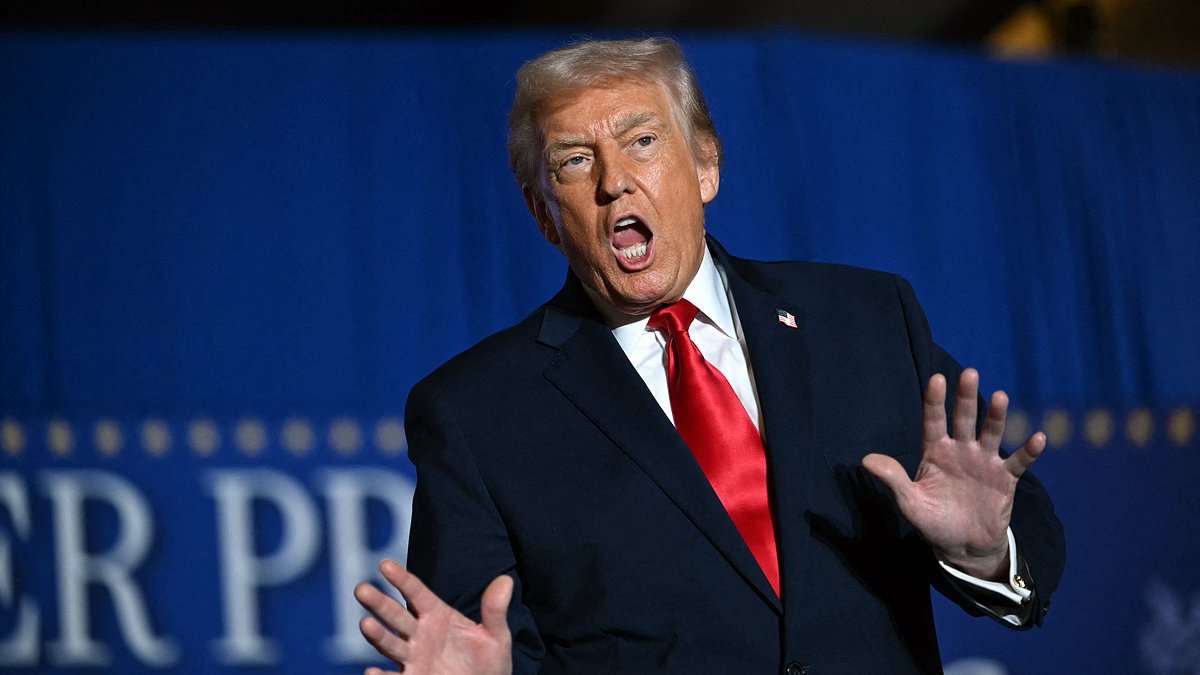
In a recent post on Truth Social, former President Donald Trump announced the cancellation of all scheduled meetings with Iranian officials, signaling a shift towards potential direct intervention. Addressing Iranian protestors, Trump declared, “help is on its way,” hinting at a more active stance in the ongoing unrest.
This development marks a new phase in Trump’s “maximum pressure” strategy, as he moves from imposing diplomatic sanctions to advocating for regime change from within Iran. He has called on Iranian citizens to “take over” their institutions, thereby encouraging grassroots movements to challenge the current regime.
“Save the names of the killers and abusers. They will pay a big price,” Trump stated in a provocative message this morning, further escalating tensions.
Amidst these developments, Trump is convening a critical meeting with Secretary of State Marco Rubio, Secretary of War Pete Hegseth, Joint Chiefs Chair General Dan Caine, and other senior officials. The agenda will focus on evaluating options for responding to the situation in Iran.

Trump Warns Military Action Could Come Before Talks As Death Toll Rises
While Trump has hinted at possible military action, he has also cautioned that such measures might precede any diplomatic engagement if the situation in Iran continues to worsen. “A meeting is being set up,” he mentioned to reporters, adding a warning, “We may have to act before a meeting.”
‘A meeting is being set up,’ Trump had told reporters, warning, ‘We may have to act before a meeting.’
Verified video evidence from Sunday shows citizens gathered at the Kahrizak Forensic Centre in Tehran. The footage depicts people standing over long rows of dark body bags.
Since the nationwide demonstrations began on December 28, the US–based human rights organization HRANA reports it has confirmed about 600 fatalities, but according to other reports that number is more likely in the thousands.
President Trump told a group of reporters on Air Force One that Iranian diplomats had reached out to the administration to negotiate.

Iran Warns of Response As Trump Threatens Intervention
‘The communication channel between our Foreign Minister Abbas Araqchi and the US special envoy (Steve Witkoff) is open and messages are exchanged whenever necessary,’ Foreign Ministry spokesperson Esmaeil Baghaei said on Monday.
Mohammad Ghalibaf, Iran’s speaker of Parliament, put out a statement Sunday saying that any US military action will result in a retaliatory response from Iran.
‘If the United States takes military action, both the occupied territories and US military and shipping lanes will be our legitimate targets,’ Ghalibaf said. ‘Both US and Israeli military bases could be targets,’ he added.
Speaking aboard Air Force One on Sunday night, Trump threatened to intervene, saying: ‘The military is looking at it, and we’re looking at some very strong options.’
Asked about Iran’s threats of retaliation, he said: ‘If they do that, we will hit them at levels that they’ve never been hit before.’
This wave of protests was ignited by an economic implosion that saw the Iranian Rial plunge to a historic low of 1.45 million per US dollar, essentially making their currency near worthless and driving inflation higher than 70%.
This all comes six months after the US–Israeli strikes on Iran’s nuclear facilities during operation ‘Midnight Hammer’ in June 2025.

Iran Declares Three-Day Mourning As Trump Ramps Up Pressure With Tariffs
The Trump administration claimed that this dismantled a significant amount of the regimes nuclear capabilities at their sites Fordow and Natanz.
In an effort to reshape the narrative surrounding the recent violence, the Iranian government has declared three days of state–mandated mourning.
According to the semiofficial Tasnim news agency, the tribute is dedicated to those purportedly slain by ‘urban terrorist criminals’—a designation likely used by the state to describe security personnel killed during the ongoing clashes with protesters.
US President Donald Trump announced a 25–percent tariff on any country doing business with Iran, ramping up pressure as a rights group estimated a crackdown on protests has killed at least 648 people.
Iranian authorities insisted they have regained control after successive nights of mass protests nationwide since Thursday that have posed one of the biggest challenges to the clerical leadership since the 1979 Islamic revolution ousted the shah.
But rights groups accuse the government of using live fire against protesters and masking the scale of the crackdown with an internet blackout that has now lasted more than four days.

International Calls Resume As Trump Targets Iran’s Trading Partners
International phone calls, however, have resumed in Iran after being blocked for days, an AFP correspondent in Tehran said on Tuesday, but only outgoing calls could be made.
Trump, who has repeatedly threatened Iran with military intervention, said in a social media post on Monday that the new levies would ‘immediately’ hit the Islamic republic’s trading partners who also do business with the United States.
‘This order is final and conclusive,’ he wrote, without specifying who it will affect.
Iran’s main trading partners are China, Turkey, the United Arab Emirates and Iraq, according to economic database Trading Economics.
In power since 1989 and now 86, Khamenei has faced significant challenges, most recently the 12–day war in June against Israel, which resulted in the killing of top security officials and forced him to go into hiding.
‘When a regime can only hold on to power through violence, then it is effectively finished,’ said German Chancellor Friedrich Merz during a trip to India. ‘I believe that we are now witnessing the last days and weeks of this regime.’

Analysts Warn Too Early to Predict Regime Collapse
Analysts however have cautioned that it is premature to predict the immediate demise of the theocratic system, pointing to the repressive levers the leadership has, including the Revolutionary Guards Corps (IRGC), which are charged with safeguarding the Islamic revolution.
‘These protests arguably represent the most serious challenge to the Islamic republic in years, both in scale and in their increasingly explicit political demands,’ Nicole Grajewski, professor at the Sciences Po Centre for International Studies in Paris, told AFP.
She said it was unclear if the protests would unseat the leadership, pointing to ‘the sheer depth and resilience of Iran’s repressive apparatus.’
Reza Pahlavi, the US–based son of Iran’s ousted shah who has been vocal in calling for protests, said Trump was a man who ‘means what he says and says what he means’ and who ‘knows what’s at stake’.
‘The red line that was drawn has been definitely surpassed by this regime.’
Opinion: Iran’s rulers are teetering on collapse. Trump must give them a shove
For years, policymakers and analysts have obsessed over how the Islamic Republic of Iran might fall. Far less attention has been paid to the more important question: whether it should. To many of the several million Iranians who have fled their homeland since the 1979 Islamic Revolution, the answer is obvious — and deeply personal.
Before the mullahs seized power, Iran was a modern, secular state. Women enjoyed far greater political and social freedom. Western culture was welcomed, not criminalised. Oil wealth fuelled economic growth instead of terror abroad. By any honest measure, what replaced that Iran has been an unmitigated failure.

For some, the case against the regime is moral. Iran’s Shia theocracy enforces a medieval interpretation of Islamic law, brutalises women, executes dissidents, and rules through fear. It seeks to export its extremist ideology far beyond its borders. That alone makes it a threat to all freedom-loving people.
But the most compelling argument is strategic — and it aligns squarely with the principles of America First. The Islamic Republic is not merely a repressive domestic dictatorship, now widely suspected of killing thousands of demonstrators during the largest popular uprisings since the regime’s founding. It is the world’s most aggressive state sponsor of terrorism — the central node of a proxy empire stretching from Yemen to Lebanon, and from Gaza to Venezuela.
Read the full story here
Trump holds urgent meeting with Rubio as Iran death toll rises
President Donald Trump was meeting with Secretary of State Marco Rubio on Monday to discuss options for intervention in Iran. More than 500 people have been killed in protests which have swept the country after an economic implosion. Trump last week threatened action if any protesters were hurt.
The Iranian regime initiated contact with the White House over the weekend for new nuclear negotiations, the president told reporters on Air Force One last night. Politico reports that Trump willhold another meeting tomorrow with Rubio, Hegseth and Joint Chiefs Chair Gen. Dan Caine along with other top leaders to weigh options.
Read the full story here