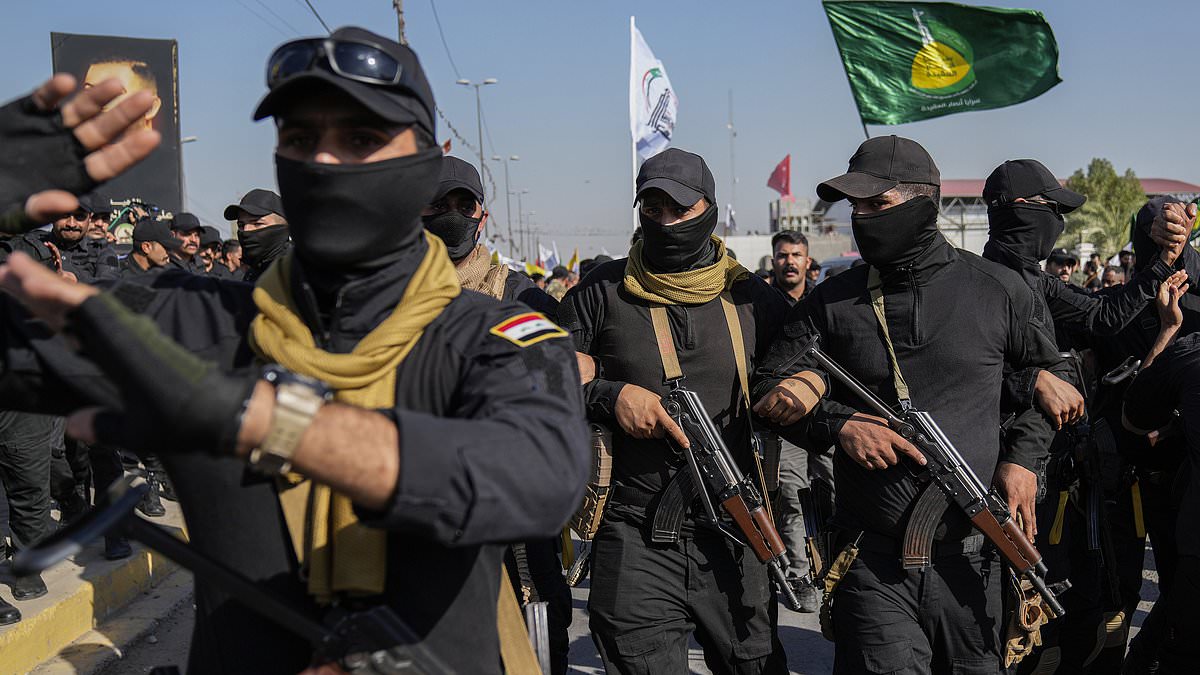

Hezbollah has issued a stark warning, declaring that any attack by Donald Trump on its ally, Iran, would result in their adversaries experiencing “the bitterest forms of death.”
Kataib Hezbollah, an Iraqi paramilitary faction connected to the more prominent Lebanese organization Hezbollah, delivered this vehement message on Sunday. The group urged its members to brace themselves for the possibility of an all-out conflict.
Abu Hussein al‑Hamidawi, the leader of Kataib Hezbollah, accused “forces of darkness” of conspiring to annihilate Iran. He asserted, “We assure our enemies that a war against the [Islamic] Republic will not be an easy endeavor.”
He further warned, “Instead, you will encounter the harshest forms of death, and your presence in our region will be obliterated.”
This ominous message from al‑Hamidawi coincides with American officials, as reported by CBS News, confirming that the USS Abraham Lincoln aircraft carrier strike group has entered the Central Command area, which encompasses the Middle East, including Iran.
The aircraft carrier is accompanied by three guided missile destroyers: the USS Frank E. Petersen, Jr., the USS Spruance, and the USS Michael Murphy.
Trump said late last week: ‘We have a big flotilla going in that direction. We’ll see what happens. We have a big force going toward Iran. I’d rather not see anything happen but we’re watching them very closely.’
Iranian officials said over the weekend that they are prepared to retaliate if attacked by the US.

Members from the Popular Mobilization Forces attend the funeral of fighters from Kataib Hezbollah, who were killed in a US airstrike in Babil province southwest of Baghdad, Iraq, Wednesday, July 31, 2024

American officials confirmed today to CBS News that the USS Abraham Lincoln (pictured) aircraft carrier strike group has crossed into Central Command

Iran’s supreme leader Ayatollah Ali Khamenei (pictured) is reportedly cowering in an underground bunker
Speaking to Reuters on condition of anonymity, an official said: ‘This military build-up – we hope it is not intended for real confrontation – but our military is ready for the worst-case scenario. This is why everything is on high alert in Iran.’
He then delivered a warning to Washington, adding: ‘This time we will treat any attack – limited, unlimited, surgical, kinetic, whatever they call it – as an all-out war against us, and we will respond in the hardest way possible to settle this.’
In preparation, Iran’s supreme leader Ayatollah Ali Khamenei is reportedly cowering in an underground bunk.
The autocrat is said to have fled to a heavily fortified shelter underneath Iran’s capital.
He has handed control of the nation to his youngest son, 53-year-old Masoud Khamenei.
Tension between the US and Iran has spiked in the wake of a brutal crackdown on nationwide protests that saw thousands of people killed and tens of thousands arrested.
Trump had threatened military action if Iran continued to kill peaceful protesters or carried out mass executions of those detained.
There have been no further protests for days, and Trump claimed recently that Tehran had halted the planned execution of about 800 arrested protesters — a claim Iran’s top prosecutor called ‘completely false’.

Iranians attend an anti-government protest in Tehran, Iran, on January 9, 2026

Families and residents gather at the Kahrizak Coroner’s Office on January 13 2026 confronting rows of body bags as they search for relatives killed during the regime’s violent crackdown on protests
But the President has indicated he is keeping his options open, saying on Thursday that any military action would make last June’s US strikes on Iranian nuclear sites ‘look like peanuts’.
The protests in Iran began on December 28, sparked by the fall of the Iranian currency, the rial, and quickly spread across the country. They were met by a violent crackdown by Iran’s theocracy, which does not tolerate dissent.
The death toll reported by activists has continued to rise since the end of the demonstrations, as information trickles out despite a more than two-week internet blackout — the most comprehensive in Iran’s history.
It comes after it was revealed last night that more than 33,000 protesters had been killed in Iran following the regime’s brutal crackdown on anti-government demonstrations, Time reports, quoting two senior officials working for the country’s Ministry of Health.
The death toll from the anti-government protests, which began on December 28, was previously estimated to be between 16,500 and 18,000.
Alongside the death toll, 97,645 have been wounded, with 30 per cent suffering eye injuries, according to research by Professor Amir-Mobarez Parasta.