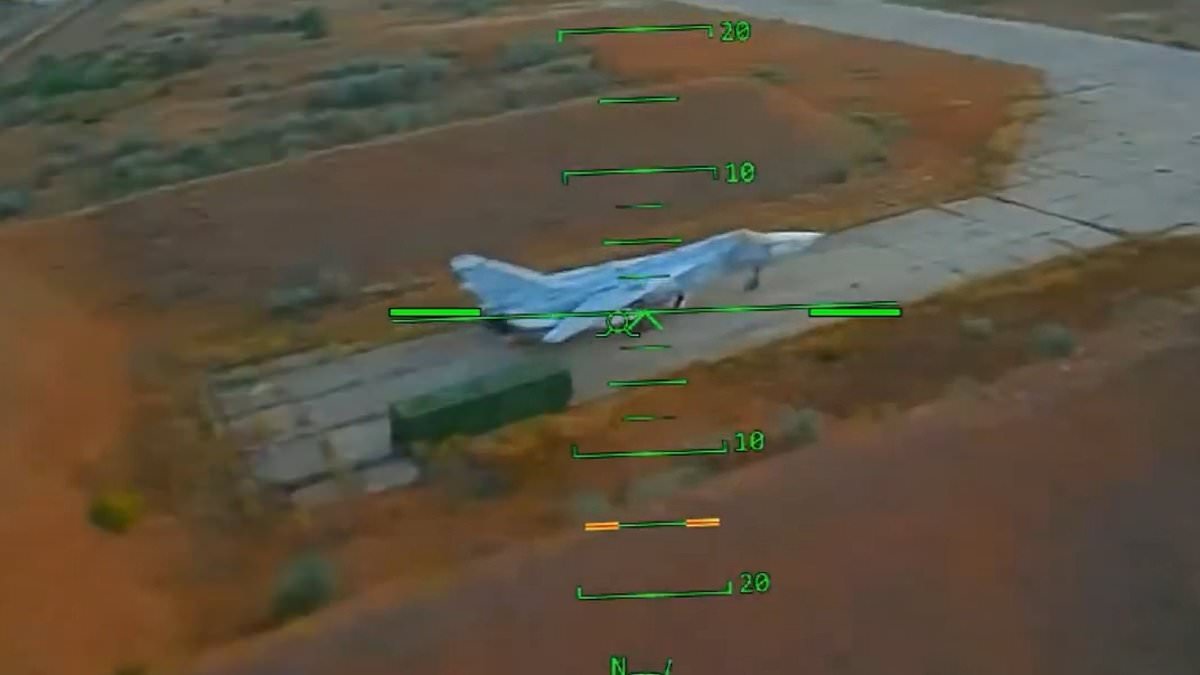

Ukrainian drones have successfully targeted and destroyed 15 military aircraft belonging to Russia at airfields located far from the front lines, as part of what has been dubbed Operation Spiderweb.
Dramatic videos reveal the drones hitting aircraft at five separate military bases. However, Ukrainian authorities have not disclosed the exact timing of these strikes.
The Security Service of Ukraine (SBU) reported that the attacks resulted in the destruction of 11 Sukhoi and MiG fighter jets, three helicopters, and an Antonov An-26 cargo plane.
According to the SBU, the collective value of these destroyed aircraft exceeds $1 billion.
The SBU credited its elite Alpha unit with executing the operation. The strikes took out Su-30SM and Su-34 jets, which are among Russia’s most crucial frontline aircraft, alongside older Su-27 and Su-24 models used in attacks against Ukraine.
Additionally, Ukraine managed to take down MiG-31 interceptors, which play a significant role in Russia’s air defense strategy and are frequently employed to launch hypersonic Kinzhal missiles.
The three choppers – a Mi-8, a Mi-26 and a Mi-28 – will have hurt Russia’s transport and logistics capabilities.
The SBU added that fuel and ammo depots were also destroyed in the operation.

Dramatic footage showed drones successfully striking the planes across five different military airfields

Ukraine’s spy service, the SBU, claimed to have taken out 11 Sukhoi and MiG fighter jets, three helicopters and an Antonov An-26 cargo plane
The strikes come just weeks after the same Alpha unit destroyed or disabled an estimated $4billion worth of Russian air defence systems.
Missile launchers including the S-300, S-350 and S-400, as well as advanced radar systems were hit.
Though the destruction of the aircraft gave the SBU much to celebrate over, a senior Ukrainian lawmaker today said that life will be particularly tough for Ukrainians over the next three weeks due to plunging temperatures and intense Russian attacks on the energy system that have already deprived millions of light and heat.
The attacks follow last year’s Operation Spiderweb – a mission overseen in secret by Volodymyr Zelensky himself – that used hundreds of first-person view (FPV) attack drones smuggled into Russia in wooden containers disguised as modular homes.
Driven by unsuspecting Russian lorry drivers, the vehicles were parked near strategic airbases before their roofs opened remotely, unleashing swarms of drones that targeted and destroyed bombers on the ground.
The strikes took place on June 1, with dramatic videos posted by pro-Kremlin military bloggers showing flames engulfing aircraft at multiple locations, including one deep inside Siberia, some 2,600 miles from the Ukrainian front lines.
At least four more Russian strategic airbases were struck: Olenya in the Arctic region of Murmansk; Dyagilevo in western Russia; Ivanovo, northeast of Moscow; and Podmoskovye in Moscow.
Sources inside Ukraine’s SBU security service claimed the operation crippled 34 per cent of Russia’s long-range strategic bombers, including the nuclear-capable Tu-95s and Tu-22M3s, often used to launch cruise missiles into Ukraine.
These planes, however, are no longer manufactured, and so could not be replaced.
In a statement, the SBU said at least 41 long-range bombers had been damaged or destroyed.
The deadly payloads were hidden in what drivers thought were modular homes – and delivered to Russian airfields in Murmansk, Irkutsk, Ryazan, and Ivanovo.
In images released by the Ukrainian secret services at the time, the wooden containers are seen packed with 117 FPV kamikaze drones – which allow pilots to control them remotely through a live feed.
Dozens of black drones were lined side-by-side in the mobile wooden cabins. The roofs had hidden compartments into which the small flying weapons were stashed.
These boxes were then loaded on to civilian trucks heading into enemy territory, their hired local drivers seemingly unaware of what they were carrying.
Then, on June 1, with all the lorries within range of five airfields stretching from northern Russia down to Siberia – they struck.
In a statement, President Zelensky hailed the ‘perfectly prepared’ operation, which he claimed was run out of a building located near an office of the Federal Security Service, Russia’s principal security service.
Despite progress in peace talks that has led to trilateral negotiations between Russia, Ukraine and the United States for the first time, Russia has stepped up bombardments beyond the front line that stretches across eastern and southern Ukraine.
Join the debate
How will Russia respond?

The SBU said that these aircraft were worth more than $1billion
Temperatures of below -20C are expected in the northern and eastern part of Ukraine next week, according to official forecasts, extremely low for the country.
‘The bad news is that there will indeed be frosts, and it will be difficult,’ Andriy Gerus, the head of the parliament’s energy committee, told the national TV channel, Marathon.
‘The good news is that we need to hold out for three weeks, and then it will get easier,’ he added, citing predicted warmer temperatures and increased solar power from longer days.
The last two Russian missile and drone attacks on the capital Kyiv in January left about a million people without electricity and 6,000 apartment buildings without heating. After weeks of repairs, about 700 buildings still lack heat.
That picture is replicated across the country, with northern and eastern Ukraine, home to major cities including Kyiv, Kharkiv, Chernihiv and Sumy, regularly targeted, resulting in power restrictions for industry and power cuts for consumers.
Attacks on power stations, the energy transmission system and the gas sector have long been key elements of the full-scale invasion of Ukraine launched by Russia in February 2022.
Moscow says it is seeking to undermine Ukraine’s ability to fight.
The head of Ukraine’s largest private power producer DTEK told Reuters last week that Ukraine is nearing a ‘humanitarian catastrophe’ due to the damage to its energy systems amidst the freezing temperatures, calling for a ceasefire on attacks on energy assets.
Kyiv has targeted Russian oil processing infrastructure to reduce state revenues funding the war.
Ukraine’s solar energy association said around 1.5 gigawatts of new solar capacity was commissioned by Ukraine in 2025 and the total installed solar capacity in Ukraine exceeded 8.5 gigawatts, including residential installations.
The volume is higher than the installed capacity of all three Ukrainian-controlled nuclear power plants of 7.7 gigawatts – and helped the country cope during repairs to those plants last summer – but output depends on the weather.
Zelensky said this month Ukraine’s damaged energy system was meeting only 60 per cent of the country’s electricity needs this winter, with electricity generation capacity of 11 gigawatts against a need of 18 gigawatts.
Maximum electricity imports from EU countries, combined with power cuts across entire regions, are allowing the system to remain balanced, nevertheless.