
Stay updated with complimentary news alerts.
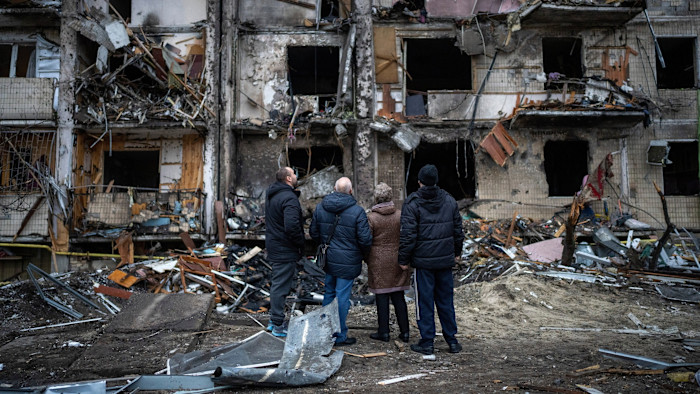
Volodymyr Zelenskyy has criticized European nations for leaving Ukraine vulnerable in the face of Russian ballistic missile strikes, which have severely damaged Ukraine’s energy infrastructure, edging the nation dangerously close to a complete blackout.
Speaking to journalists in Kyiv on Thursday night, the Ukrainian president revealed that Pac-3 interceptor missiles, essential for Ukraine’s Patriot air defense systems and promised by European allies, arrived a day late. This delay, caused by a missed financial transaction, left many Ukrainians without electricity, heating, and water during the harshest winter of the ongoing conflict.
“The payment for the PURL [Prioritised Ukraine Requirements List] initiative was not made, resulting in the absence of the missiles,” Zelenskyy stated, though he did not specify which country was at fault.
Zelenskyy seemed to allude to the Russian assault on January 20, during which 34 ballistic and cruise missiles were fired at Ukraine, as reported by the Ukrainian air force. The Pac-3 interceptor missiles are the only ones in Kyiv’s defense arsenal capable of intercepting ballistic missiles.
On January 16, Zelenskyy cautioned that Ukraine’s air defense missile supplies were alarmingly low, indicating that several systems had been without missiles since that morning.

Contributors to PURL include Germany, Norway, Poland, the Netherlands, Belgium, Canada, Luxembourg, Portugal, Slovenia and Spain.
Two western officials briefed on the operations of the PURL initiative said Zelenskyy’s allegation was not correct, but declined to provide details.
Nato did not immediately respond to a request for comment.
The initiative was launched by the US and Nato last year to purchase American air defence systems and other weaponry that are crucial for Ukraine to defend itself against Russian attacks, using funds pooled from European states.
Zelenskyy said that his fiery speech at the World Economic Forum in Davos earlier this month, where he railed against European allies, was him expressing his frustration over the missed payment. Russia succeeded in disrupting Kyiv’s power and water supply because “our air defence units against ballistic strikes are empty — simply empty”, Zelenskyy said.
“Imagine this: I know that ballistic missiles are incoming against our energy infrastructure, I know that Patriot systems are deployed, and I know that there will be no electricity, because there are no missiles to intercept them,” he said, describing the situation earlier this month.
He added: “That is the situation I am in. And I am negotiating for PAC-3 missiles that arrive a day after we are brought to the brink of a blackout.”
Ukrainian officials have accused Russia of “energy terror” by targeting its power plants and gas facilities in the middle of the harshest winter of the war. They said Moscow was trying to pound Kyiv into submission as the Trump administration pushed the warring sides into peace talks in an effort to end Russia’s full-scale war, which will enter a fifth year next month.
Zelenskyy said the interceptors “should have arrived a month earlier” when Kyiv received satellite intelligence from its western partners showing “that ballistic missiles are incoming”.
“I know the ballistic missiles have been launched, and partners know that my air defence units are empty. Empty NASAMS, an empty Patriot,” he said, recalling the moment he realised early this month that Ukraine’s stocks of interceptor munitions were running low.
Admittedly speaking “emotionally”, he said this was why it is important that Ukraine and Europe “need to be on the same page, so that everything else can be effective and timely”.
Kaja Kallas, the EU’s chief diplomat, said on Thursday — following a meeting of EU foreign ministers to discuss increasing support to Ukraine — that European capitals “must also dig deeper into their air defence stocks”, with Ukraine facing a “humanitarian catastrophe” this winter.
Zelenskyy’s remarks came a day after Donald Trump said that Russia’s Vladimir Putin had agreed to cease fire on Ukraine’s energy infrastructure “for a week during this . . . extraordinary cold”.
Overnight into Friday morning, the air raid sirens in Kyiv were silent and Russia appeared to hold up the deal. Ukraine’s air force reported no missile or drone strikes in much of the country, including the capital.
But 111 drones and one missile had been launched in areas around the eastern frontline regions. It was not immediately clear whether any critical infrastructure had been targeted.