
While managing in-law relationships can be challenging, Prince William seems to have navigated this with ease, especially with Carole and Michael Middleton.
Reportedly, the Prince of Wales embraced his wife Kate’s family from the outset of their relationship in the early 2000s. Today, Carole Middleton is considered an integral part of the close-knit family dynamic of the Waleses.
According to royal biographer Katie Nicholl, the Middletons have always viewed Kate’s marriage to William as an opportunity to welcome a new son into their family.
Although their relaxed rapport has been well-documented, it was during the Royal Ascot in 2024 that their genuine fondness for each other was visibly evident to onlookers.
At this event, William maintained a ‘stoic’ demeanor attending solo, following Kate’s announcement of her chemotherapy treatment.
Celebrating her 71st birthday, Carole made her first public appearance since her daughter’s diagnosis. Body language expert Judi James observed the silent yet profound communication between Carole and William, highlighting their mutual need for support during this unsettling time.
And the ‘telling’ sign was a deceptively light-hearted moment, Ms James told The Daily Mail.
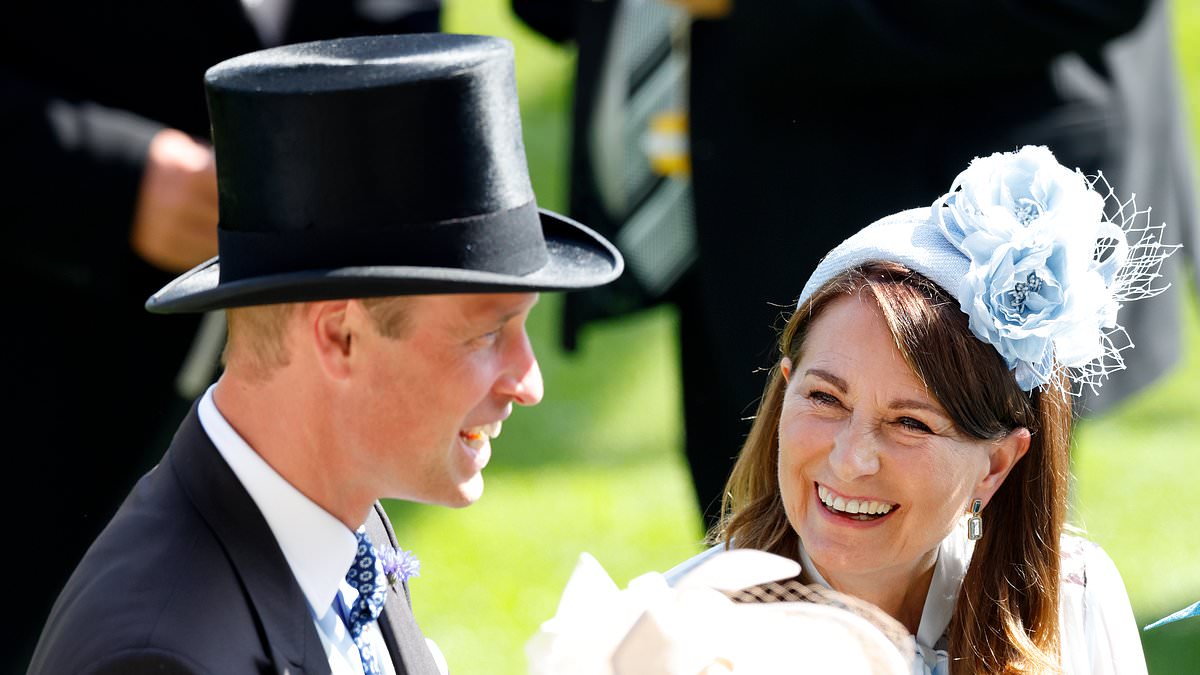
The pair erupted with laughter during the high-society event when Carole’s heel got stuck in the mud, and she made a ‘panicky grab’ for William’s arm, with Ms James suggesting: ‘It was a rare, insightful glimpse into their “mother-son relationship”.’

If navigating relationships with in-laws is tricky territory, Prince William is on solid ground when it comes to Carole (pictured) and Michael Middleton
Prince William showed he is a true gentleman when he rescued Carole after the heel of her right shoe got trapped in Ascot turf two years ago.
Photos showed William offering his mother-in-law a hand as Carole steadied herself before rewearing the shoe.
‘William and Carole’s body language bonding here was predominantly about the spontaneous haptics, or using touch to convey emotions,’ Ms James explained.
They would not have had an opportunity to speak freely or express their feelings during a ‘worrying’ time for the royal family.
‘Both William and Carole would have needed to present a stoic and upbeat mood here,’ the expert continued.
The pair avoided any overly sentimental gestures, like prolonged hugging or back-rubbing, and we witnessed a spontaneous ‘ritual of humour’ between the future King and his doting mother-in-law instead.
‘Carole’s slightly panicky “grab” at William was a telling hint to what is clearly a very close, fond and relaxed family unit in private,’ she said.
The Middleton matriarch appeared to make ‘dominant requests for physical and practical support’ from William while trying to take the edge off what must have been a ‘difficult’ outing for the prince.
‘William’s pose goes from solicitous, watching her carefully with his hand or arm ready to be offered, to clutching hands with her as his mouth is wide open in delight at the humour of the moment,’ Ms James added.

Prince William showed he is a true gentleman when he rescued Carole after the heel of her right shoe got trapped in Ascot turf two years ago

Photos showed William offering his mother-in-law a hand as Carole steadied herself before rewearing the shoe

The light-hearted moment was actually a ‘rare, insightful glimpse into their “mother-son relationship”, according to body language expert Judi James
‘Her need for support was clearly genuine, but the pair’s strong bonds showed in the way they were mutually amused by the slapstick potential of losing a shoe in the mud,’ she concluded.
Royal author Katie Nicholl has previously described how the Wales and Windsor families blended seamlessly after Kate and William officially announced their engagement on November 16, 2010.
In her incisive biography about the late Queen, Ms Nicholl remarked that Kate quickly became the sister Harry never had, while Carole and husband Michael’s fondness for their future son-in-law was made clear in their first statement about the union.
‘We all think he [William] is wonderful and we are extremely fond of him,’ they told members of the press gathered outside their Berkshire home as Michael was seen ‘clutching some handwritten notes’.
From the minute their engagement was announced, Kate was compared to William’s mother, the late Princess of Wales.
Like Diana, Kate was an instant hit with fans as royal commentators noted her natural affability and poise that drew people in. Even during her early years as a royal, the ‘Kate effect’ was so strong that outfits she wore routinely sold out within minutes.
As individuals, Kate and Diana were strikingly similar; as future Queens, they could not have been more different.
According to Ms Nicholl, the contrast was difficult to miss when Kate stepped out with Prince William as theirs was a ‘definite double-act’.

Kate’s parents, Carole and Michael Middleton have also always made it clear that Kate’s marriage to William meant ‘they were gaining a son’, according to royal biographer Katie Nicholl
‘Kate never eclipsed William; they were two halves of the same whole,’ Ms Nicholl wrote. ‘It was apparent she saw herself as William’s partner and equal, something which was crucial in her role as wife to the future King.’
‘It was so different to the tours on which an upset Charles was an also-ran to the worshipped Diana.’
Ms Nicholl chalked the dissimilarities down to Kate’s complete focus on learning the royal ropes from those who understood life in The Firm best, as well as having a ‘sensible, loving family’ like the Middletons to lean on.
In fact, their discretion in the run-up to William and Kate’s royal wedding made them ‘more popular than ever’ within the halls of Buckingham Palace.
By contrast, Prince Harry and Meghan Markle’s 2018 wedding was somewhat eclipsed by her father, Thomas Markle, who staged paparazzi photos in the run-up to their big day.
Ms Nicholl quoted Robert Lacey, who consulted with Netflix for their royal drama The Crown, as saying: ‘The Middletons have blended into the royal family as in-laws in a way that the Spencers never did.’
Mr Lacey also drew a comparison between Kate and Prince Harry’s wife, Meghan Markle.
‘People have commented on how Prince Harry’s rebellion against royal life was shaped by the determined personality of his older wife,’ he said.
‘Well, William’s way of life has also been shaped by his own older wife – along with the family that goes with her.’

Carole and Michael’s discretion in the run-up to William and Kate’s royal wedding made them ‘more popular than ever’ within the halls of Buckingham Palace

Carole (left) with the late Queen and Camilla after William and Kate’s wedding at Westminster Abbey on April 29, 2011
Determined to ‘repay’ Carole, Michael, and Kate’s siblings – Pippa and James – for their unwavering support, William has advised the Palace to keep them ‘more involved and better informed’ than previous royal in-laws.
According to one source, Kate and William formed an ‘insular unit’ with Carole and her husband Michael.
They added: ‘You could say that Kate and William, unlike most couples with a set of in-laws, feel most at their ease and happiest with her parents around. Tensions dissipate and there’s a party atmosphere.’
Carole was also said to help William decide what he should wear to engagements.
Another source said of William’s love for Carole: ‘He is in thrall to her capabilities, her tenacity, high-energy levels, her superb organisational skills and her networking.’
‘She above anyone else knows what makes Kate happy, what type of staff she will gel with, and understands her overriding need for loyalty and privacy. Carole leaves nothing to chance.’