
The Scottish National Party (SNP) administration received notifications of 14 significant infection outbreaks at Scotland’s £1 billion superhospital within its first three years of operation but did not take action on these urgent alerts.
Between 2015 and 2018, health board leaders issued a series of rare red and amber health warnings as both children and adults suffered from severe illnesses or succumbed to infections at the Queen Elizabeth University Hospital (QEUH) campus. This information comes to light through newly uncovered documents reported by The Mail on Sunday.
Despite these alerts, then Health Secretary Shona Robison, who would have legally been informed of these warnings, did not intervene or initiate an investigation into the outbreaks.
This disclosure adds to the pressure on First Minister John Swinney, who previously stated that his government only learned of the hospital’s infection issues in March 2018, nearly three years after the first official health warning was issued.
The revelation follows recent accusations against Mr. Swinney of misleading the Scottish Parliament and allegedly ‘fabricating’ details regarding the claim that ‘political pressure’ led to the premature opening of the QEUH.
Scottish Labour leader Anas Sarwar commented that the timing of the infection warnings, as disclosed by The Mail on Sunday, demonstrates that Mr. Swinney has once again misled patients and families.
He said: ‘If the Scottish Government received 14 red or amber Healthcare Infection Incident Assessment Tool (HIIAT) infection alerts between 2015 and 2018, many involving immunocompromised patients, then the claim that ministers only became aware of serious infection problems at the Queen Elizabeth University Hospital in March 2018 becomes another proven lie from the SNP.
‘These warnings exist precisely because lives are at risk.’

Former Health Secretary Shona Robison and Former First Minister Nicola Sturgeon are being urged to explain what they knew and when about infections at the QEUH

First Minister John Swinney has insisted there was no pressure applied to open the QEUH

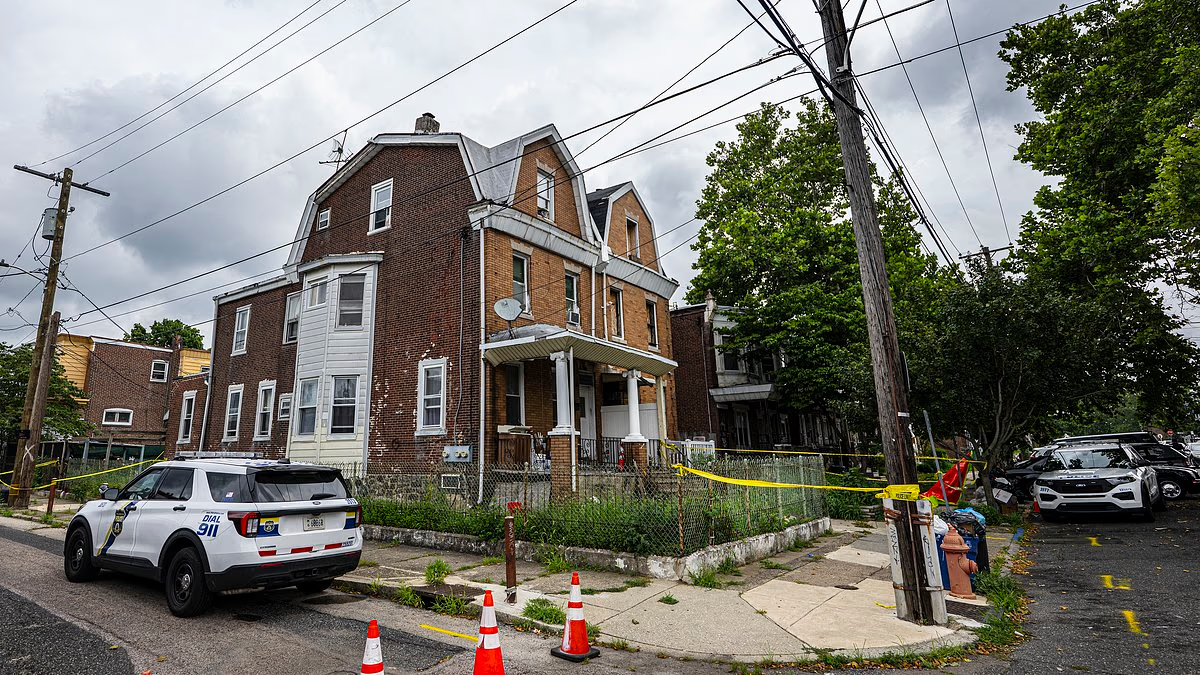
The £1billion Queen Elizabeth University Hospital in Glasgow opened in 2015
As revealed by the Scottish Mail on Sunday, last month NHS Greater Glasgow and Clyde (NHSGGC) finally accepted there was a probable link between infections in some child cancer patients and the facility’s contaminated water supply.
But health chiefs have failed to acknowledge a connection between the £842million hospital campus’s flawed ventilation system and any infections in patients, or any connection to infections outwith 2016-2018.
NHSGGC is currently a suspect in a corporate homicide probe into the deaths of four patients at the QEUH and RHC – Milly Main, 10, Gail Armstrong, 73, and two other children- while the deaths of Andrew Slorance, 49, Tony Dynes, 63, and Molly Cuddihy, 23, are being probed by police. In total 84 children’s infections have been reviewed by independent experts, with around a third of them possibly linked to the hospitals’ environment although this is not accepted by the health board.
The documents show government officials should have been informed on at least 14 occasions about infection outbreaks at both hospitals before March 2018 – including instances where experts were examining water and ventilation as a potential source.
Mr Sarwar said: ‘This revelation makes clear that the Scottish Government were made aware of concerns at the QEUH long before they claimed, despite that they failed to act and continued to lie to patients and families.
‘The pattern of denial, deception and cover-up at the very heart of government has moved beyond normal political scandal and become an inhumane disregard for these patients and their families and the memories of the victims.
According to infection control rules for NHS boards in Scotland, any incident or outbreak that happens in a healthcare setting must be recorded using the Healthcare Infection Incident Assessment Tool (HIIAT). Incidents are coded as either green, amber or red depending on severity.
The Scottish Government’s health and social care department are notified of all red and amber incidents, according to official documents, ‘to provide the government with assurance that all incidents are being effectively assessed’.

Milly Main, 10, who died in 2017 after contracting a rare infection, with her mum Kimberly Darroch
In October 2015 two ‘red’ reports were issued – one for an outbreak of bacteria Serratia marcescens which affected 13 babies in the paediatric intensive care unit, and another for a bloodborne virus at the QEUH.
Notes on the Serratia incident show NHSGGC were already examining the unit’s ventilators and sinks in connection with the outbreak, brought in extra cleaning regimes using chlorine and even considered closing the unit.
In 2016 there were three ‘amber’ reports for the Royal Hospital for Children (RHC), and one for the QEUH. They included an outbreak of aspergillus, a mould associated with soil and dust, in two children in the cancer ward. Notes relating to this outbreak show ventilation problems had been identified already and concerns were being raised by NHSGGC specialists.
Another outbreak of Serratia marcescens was recorded as ‘amber’ in November 2016, affecting three babies in intensive care.
In 2017, three ‘red’ reports were issued about incidents in the RHC, and one in the QEUH. There were two ‘amber’ alerts for that year – one for each hospital.
One report, made in March 2017, related to an increase in fungal infections on ward 2A of the RHC – the specialist ward for child cancer patients.
In July 2017, two patients contracted bacteria Stenotrophomonas maltophilia while in the child cancer unit at the RHC. One of them was Milly Main, a 10-year-old from Lanark, who died following the infection. She had been in remission from leukaemia at the time.
On March 3, 2018, a red report was issued after two children contracted Cupriavidus and pseudomonas bacterial infections. Notes from a meeting about this incident reveal that ‘routine water testing’ two years earlier ‘revealed the presence of’ Cupriavidus, but the same test was negative this time. Experts also tested sinks and showers on the ward, some of which ‘tested positive for pseudomonas’.
Nicola Sturgeon was First Minister and Shona Robison was the Health Secretary between 2014 and June 2018, covering the period when the hospital opened and until Mr Swinney claimed the government first learned about infection problems.
Ms Robison has never been questioned on her knowledge of the scandal, or why she failed to take any action.
It emerged last week that Ms Robison, now deputy First Minister, cancelled a pledge to have experts check infection controls just weeks before it opened.
The then-health secretary told MSPs in February 2015 that an independent audit would be carried out at the new facility in Glasgow before patients were allowed to move in, but u-turned on April 7.
Former Health secretary Alex Neil said he was informed about HIIAT reports depending on their severity, and ‘it would depend on how critical it is and if it was of a sufficient level of threat’
‘There’s a need for Lord Brodie to put the relevant ministers and special advisors from 2015 on the stand under oath to establish what they knew as well as the people within the health board who we’re putting on internal pressure to open the hospital.’
‘Either ministers were told and chose to do nothing, or they were not told and the system was deliberately allowed to fail.
‘At best it is negligence, at worst it is a criminal conspiracy – either one caused death and avoidable suffering.’
‘This sickness at the heart of this SNP government must end.’
The Scottish Government refused to answer direct questions about whether Ms Robison was informed of any HIIAT red or amber reports relating to the QEUH or RHC, who in government was told about these incidents and what action was taken.