In a series of “coordinated” assaults across Pakistan’s Balochistan province, separatists have claimed the lives of at least 15 security personnel and 18 civilians, according to military reports. This marks the latest incident in the ongoing violence that plagues the insurgency-stricken southwest region of the country.
Authorities confirmed that 92 militants were killed in the attacks, including three individuals identified as suicide bombers.
For decades, Pakistan has contended with a separatist movement in Balochistan, a province rich in minerals and sharing borders with Afghanistan and Iran. These ongoing tensions frequently result in attacks targeting security forces, foreign nationals, and non-locals.
The military’s media department released a statement detailing that the assaults occurred in various locations, including the provincial capital, Quetta, and the strategic port city of Gwadar.
The Inter-Services Public Relations (ISPR) also noted in their announcement that 18 civilians and 15 security personnel were among the casualties, bringing the militant death toll to 92.
Details surrounding the civilian casualties remain unclear at this time.
Baloch separatists have previously targeted civilians believed to have collaborated with state agencies.
A senior military official in Islamabad said the attacks were “coordinated but poorly executed”, adding that they had “failed due to poor planning and rapid collapse under effective security response”.
‘Explosions one after another’
Prime Minister Shehbaz Sharif praised security forces for “foiling” the attacks.
“We will continue the war against terrorism until its complete eradication,” he said in a statement, in which he accused India of backing the separatists.
Police officials in four districts earlier told AFP that the attacks were not yet completely under control.
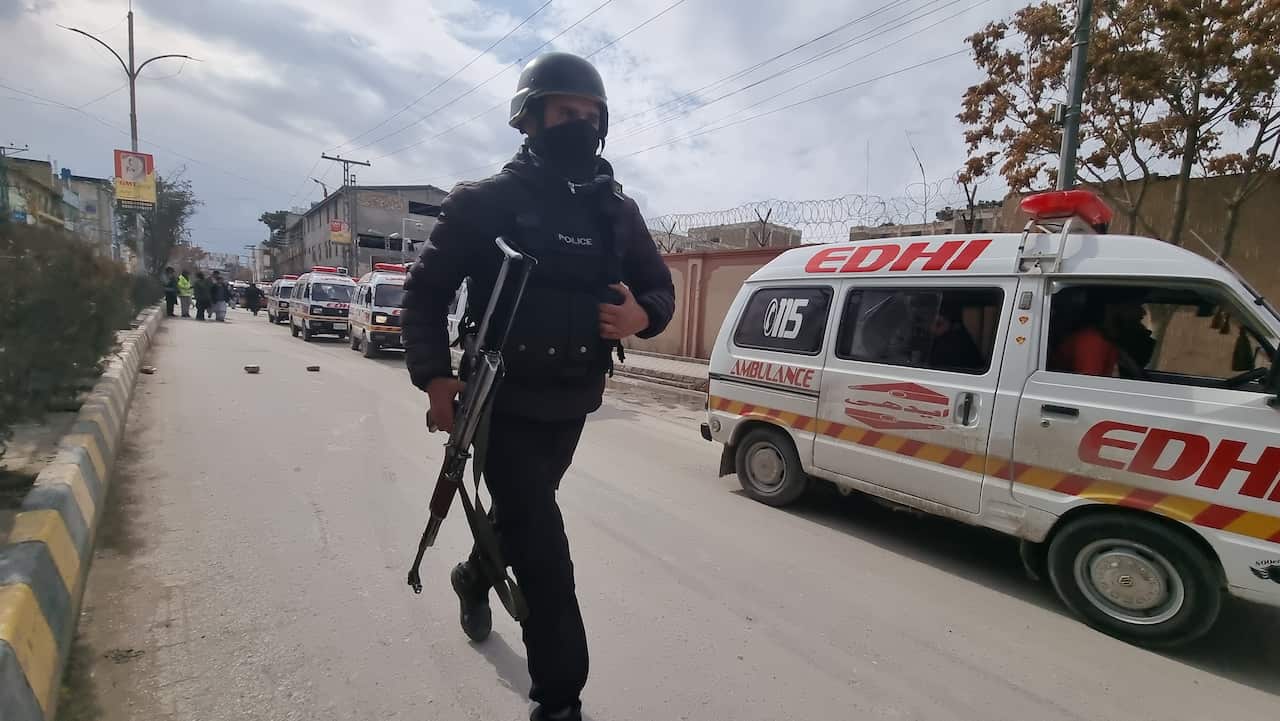
In Quetta, Balochistan’s provincial capital, an AFP journalist heard several explosions as heavy security was deployed across the city, with major roads deserted and businesses shut.
“Since morning, there have been explosions one after another,” Abdul Wali, 38, told AFP as he struggled to find blood for his hospitalised mother.
“The police point guns at us and say ‘go back’, otherwise they beat us. What should we do?”
A senior official in Quetta told AFP that militants had abducted a deputy district commissioner.
A senior government official in another district said militants had “freed at least 30 inmates from a district jail, seizing firearms and ammunition. They also attacked a police station and took ammunition with them”.
Mobile phone services have been jammed and traffic disrupted in the affected districts, while train services have been suspended across the province.
The Baloch Liberation Army (BLA), the most active militant separatist group in the province, claimed responsibility for the attacks in a statement sent to AFP.
Suicide bombings
The group said it had targeted military installations and police and civil administration officials in gun attacks and suicide bombings.
It said major highways were blocked to disrupt military operations.
Several women were involved in the attacks, according to statements and videos released by the BLA.
Saturday’s attacks came a day after the military said it had killed 41 insurgents in two separate operations in the province.
“Over the past 12 months, security forces in Balochistan have sent more than 700 terrorists to hell, with around 70 terrorists eliminated in just the last two days alone,” said Sarfraz Bugti, the chief minister of Balochistan province.
“These attacks cannot weaken our resolve against terrorism.”
Balochistan is Pakistan’s poorest province, despite an abundance of untapped natural resources, and lags behind the rest of the country in education, employment and economic development.
Baloch separatists have intensified attacks on Pakistanis from other provinces working in the region in recent years, as well as foreign energy firms that they believe are exploiting its riches.
The separatists attacked a train with 450 passengers on board last year, sparking a two-day siege during which dozens of people were killed.
In August 2024, militants blew up bridges, stormed hotels and targeted security installations in assaults across the province that killed dozens.
For the latest from SBS News, download our app and subscribe to our newsletter.


