
NASA has decided to delay the launch of its Artemis II mission to March after encountering fuel leaks during recent testing, the agency revealed on Tuesday.
The Artemis II mission, which will last 10 days, aims to send astronauts around the moon—a milestone not achieved in over half a century. The mission is set to launch from Launch Complex 39B at NASA’s Kennedy Space Center in Florida, utilizing the Space Launch System, the most powerful rocket ever developed by the agency.
“Early Tuesday, NASA completed a wet dress rehearsal for the Artemis II test flight,” the agency reported. “This involved successfully loading cryogenic propellant into the Space Launch System’s tanks, allowing a team to proceed to the launch pad to finalize the Orion spacecraft, and safely draining the rocket. This prelaunch test was designed to fuel the rocket and pinpoint any potential issues for resolution before the actual launch,” NASA explained.
Despite facing several hurdles throughout the two-day test, engineers managed to accomplish many of the planned objectives. “To give teams time to analyze the data and conduct another wet dress rehearsal, NASA has shifted its target launch date to March at the earliest,” the agency added.

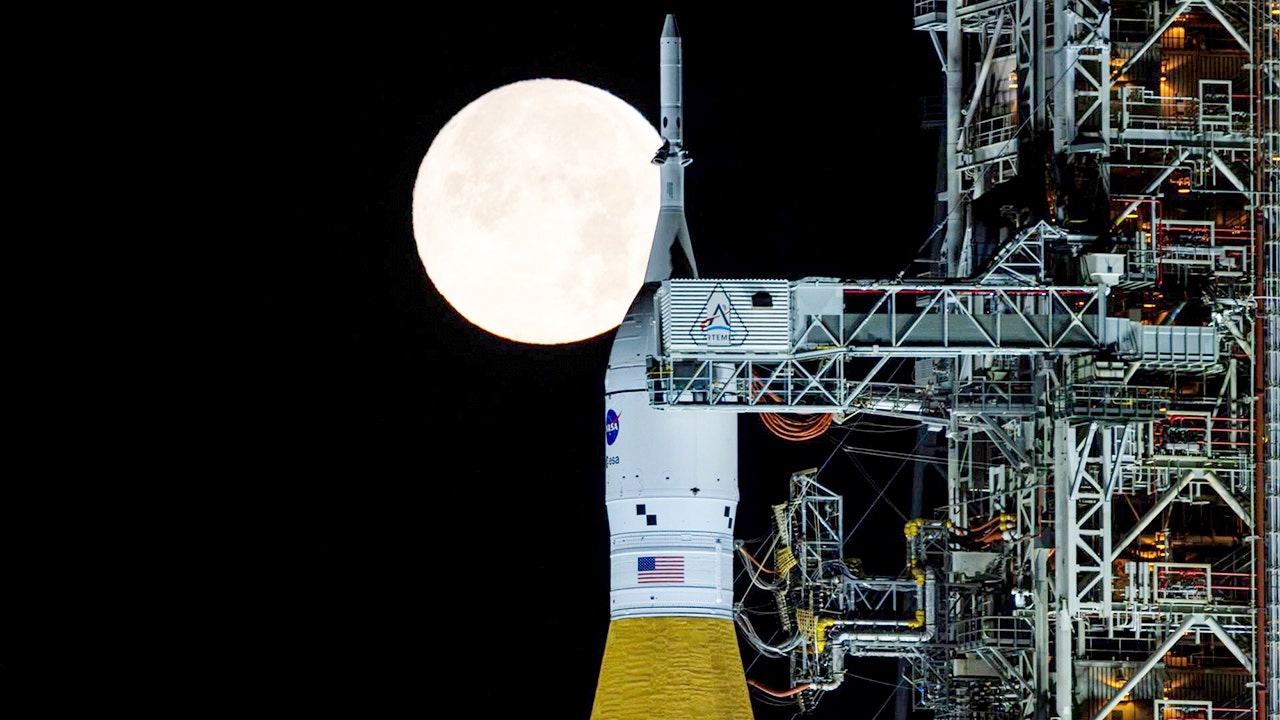
In the early hours of February 1, 2026, a full moon illuminated NASA’s Space Launch System (SLS) and Orion spacecraft, perched atop the mobile launcher at Kennedy Space Center in Florida. (Photo by Sam Lott/NASA via AP)
Earlier today, NASA stated that “the Artemis II wet dress rehearsal countdown was halted at the T-5:15 minute mark due to a liquid hydrogen leak at the tail service mast umbilical interface, which had previously shown high concentrations of liquid hydrogen during the countdown.”
“Moving off a February launch window also means the Artemis II astronauts will be released from quarantine, which they entered in Houston on Jan. 21,” according to NASA. “As a result, they will not travel to NASA’s Kennedy Space Center in Florida Tuesday as tentatively planned. Crew will enter quarantine again about two weeks out from the next targeted launch opportunity.”
The agency gave no indication of an official launch target in March, saying teams need to first “fully review data from the test, mitigate each issue, and return to testing.” Before Tuesday’s postponement, the earliest NASA could have launched commander Reid Wiseman and his crew to the moon was no sooner than Sunday.
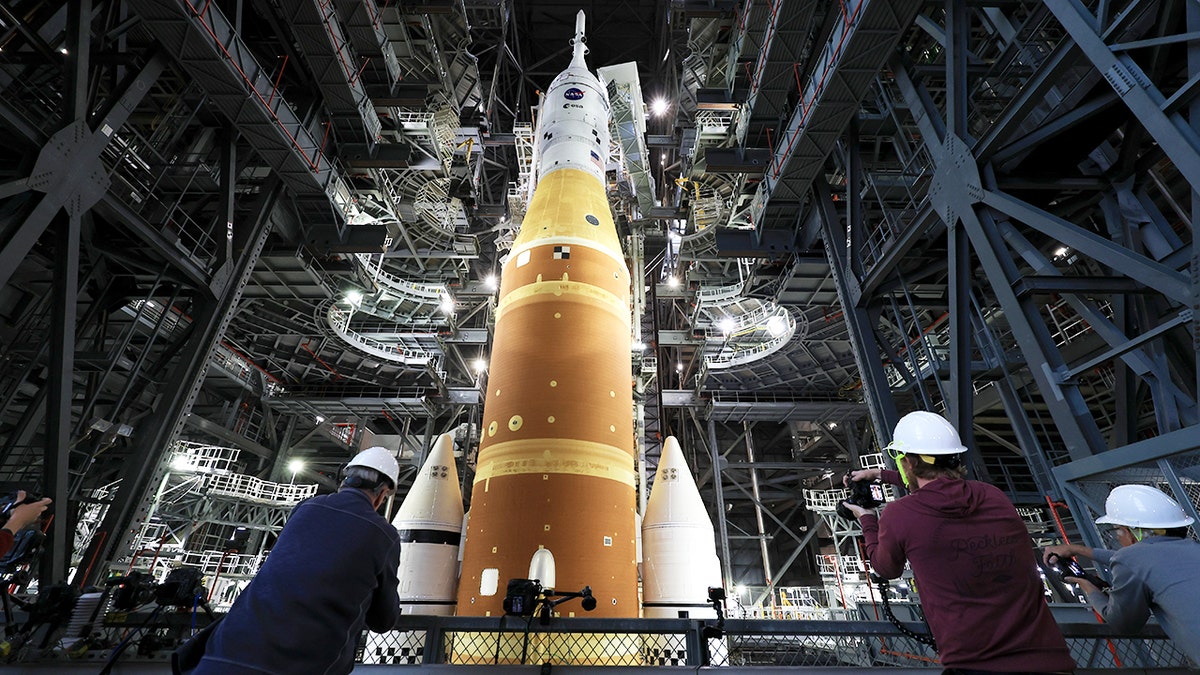
NASA’s Artemis II sits in the Vehicle Assembly Building at NASA’s Kennedy Space Center on Jan. 16, 2026 in Cape Canaveral, Fla. (Joe Raedle/Getty Images)
Launch controllers Monday began loading the 322-foot rocket with super-cold hydrogen and oxygen at midday. More than 700,000 gallons had to flow into the tanks and remain on board for several hours, mimicking the final stages of an actual countdown.
But excessive hydrogen quickly built up near the bottom of the rocket. Hydrogen loading was halted at least twice as the launch team scrambled to work around the problem using techniques developed during the previous Space Launch System countdown in 2022. That first test flight was plagued by hydrogen leaks before finally soaring without a crew.
Artemis II follows the uncrewed Artemis I mission and will serve as a critical test of NASA’s deep-space systems before astronauts attempt a lunar landing on a future flight.
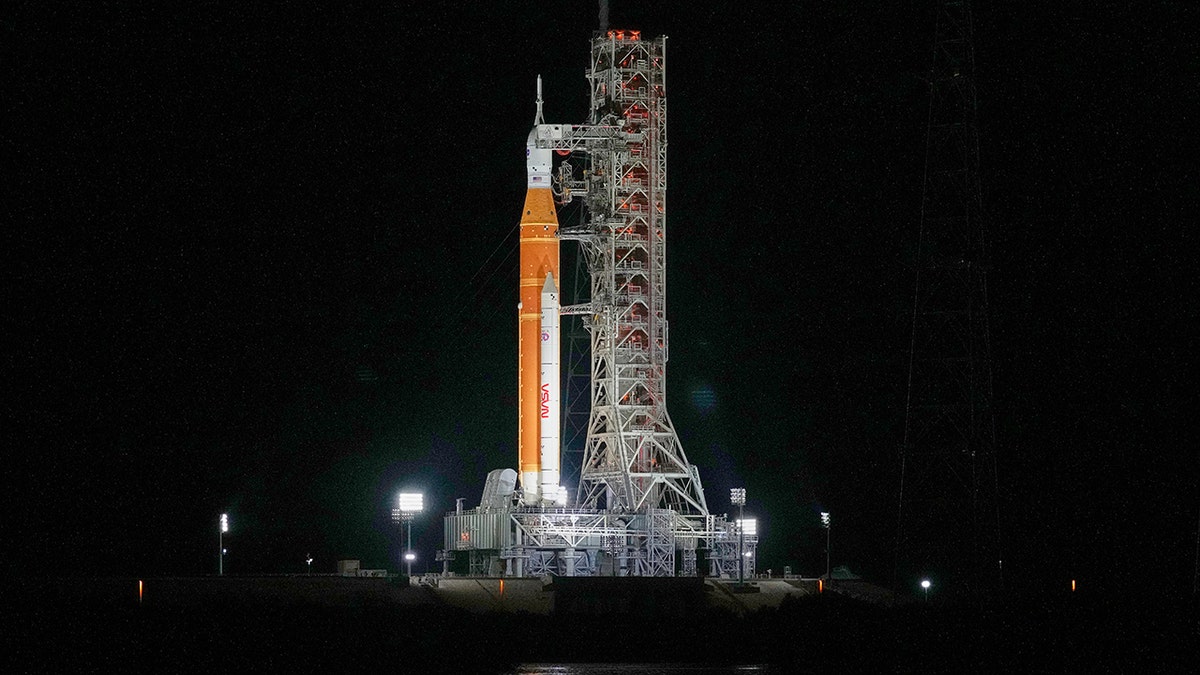
The NASA Artemis II SLS rocket with the Orion spacecraft is seen at Launch Complex 39B at the Kennedy Space Center, on Sunday, Feb. 1, 2026, in Cape Canaveral, Fla. (AP/John Raoux)
NASA says the mission is a key step toward long-term lunar exploration and eventual crewed missions to Mars.