
On a seemingly ordinary Sunday evening in the heart of Marseille, two masked individuals emerged from a vehicle, assault rifles slung casually at their sides. The usually bustling streets around the picturesque Old Port were thrown into chaos as tourists scattered in panic. The gunmen calmly crossed the street, raised their weapons, and opened fire on a group of men, tragically ending one life.
A mere four days prior, as the dawn of 2026 had just broken, a grim discovery was made in the city’s northern quarter. The charred body of a 17-year-old boy was found in the trunk of a burned-out car, adding to a string of violent incidents, including a similar horror found on Christmas Day.
While such brutal acts might incite widespread alarm elsewhere, in Marseille, they are viewed with unsettling nonchalance. All three murders were swiftly linked to the city’s vicious cocaine wars, where fatalities occur with such alarming regularity that they scarcely draw attention. Mention these events to locals, and you’re likely to receive nothing more than a characteristic Gallic shrug.
Historically, this ancient port city served as a critical node in the notorious French Connection heroin trade, channeling narcotics from Asia to the United States. Today, Marseille has assumed a new role as a crucial gateway for cocaine flowing into Europe. Much of this illicit cargo finds its way to the United Kingdom, where demand is exceptionally high. London, in particular, consumes more cocaine annually than cities like Amsterdam, Berlin, and Barcelona combined.
Despite a more than 50% increase in cocaine seizures in the UK, the fight against this pervasive drug is far from over. Experts warn that cocaine availability continues to rise across Europe. Meanwhile, in Marseille, warring gangs battle relentlessly for control of this lucrative trade, seemingly unchecked by law enforcement.
For Britain’s estimated 700,000 to one million cocaine users, Marseille might only register as a trendy getaway spot. This reflects the city’s paradoxical nature: while it holds the dubious title of Europe’s most dangerous city, it simultaneously boasts an undeniable cool factor.
On social media, British influencers trip over themselves to semaphore their sojourns, rhapsodising over the city’s arts scene, restaurants and edgy nightlife, with one noting that ‘trendy visitors from the UK capital’ are so ubiquitous they ‘bump into each other’ on its beaches.
Time Out magazine gushed: ‘Everyone is hot and the vibe is just sexy.’ Even street artist Banksy has been plying his trade here.

Three recent murders in the French city of Marseille have all been attributed to its ultra-violent cocaine wars – and such is the video game-frequency with which bodies pile up here that they barely register. Pictured: File photo

Half a century ago, this ancient Mediterranean port (pictured, file photo) was a major hub in the infamous French Connection heroin route from Asia to the US

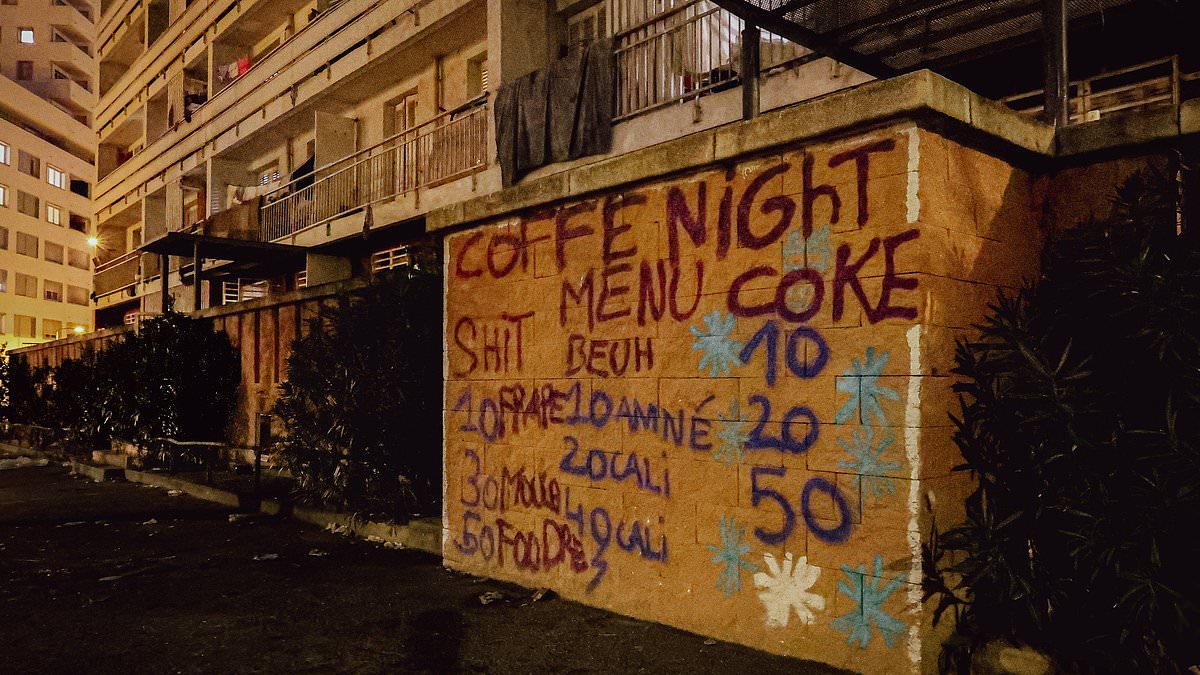
These days it is a key entry point for cocaine into Europe, with much of the white powder heading to Britain where demand is high. Pictured: Graffiti listing drug prices on a housing estate in Marseille
And London-based ‘fashion sisters’ Olivia and Alice Minns reported to their 325,000 Instagram followers that they enjoyed a ‘beautiful’ three days in France’s second city, and highlighted the ‘sunsets’ and ‘coffee spots’, adding: ‘What a place Marseille is.’
Last week, neither the cold nor the steady drizzle prevented hipsters from lounging outside the bars of Notre-Dame-du-Mont. In the heart of the city, this vibrant, graffiti-covered bohemian enclave was in 2024 ranked not just the coolest neighbourhood in Europe, but the world. The crowd was mainly French, but drifting above the hubbub came an occasional English voice.
Head a few miles north of here with the Mediterranean on your left and you hit the labyrinthine council estates of the ‘Quartiers Nord’, the northern districts, where an altogether different atmosphere prevails.
Some estates are so violent that police will only contemplate visiting in full body armour – and in large numbers.
Marseille’s link to drugs was established in the world’s conscience more than half a century ago via the gritty 1971 film The French Connection, which follows hard-boiled detective Jimmy ‘Popeye’ Doyle, played by Gene Hackman, as he tries to foil a Marseille-New York heroin smuggling operation.
But Popeye wouldn’t recognise the sun-drenched city’s drugs trade these days. French President Emmanuel Macron has accused urban middle-class users of stoking the violence.
He wonders whether it would give those in Britain and his own country pause for thought were they to know that children as young as 14 are hired as assassins in Marseille’s turf wars.
A recent book concluded that the teenagers are not so much inured to extreme violence as ‘galvanised’ by it and somehow forget they are shooting live ammunition because they ‘think they’re living in a video game’.
Far from operating in the shadows like the hitmen of popular imagination, they can double their £18,000 fee if they post footage of their kills on social media along with their gang’s signature.
Such is the seemingly unchecked power and spreading influence of the crime bosses they serve – some of whom order ‘hits’ from jail by mobile phone – that some politicians fear France risks becoming a narco state like Colombia and Mexico.
Hyperbole, maybe, but with more than 90 drug-related murders in the last three years, 18 of them in one month alone, their concerns are understandable.
Community workers in the Quartiers Nord talk of a ‘psychose’ – a collective trauma or panic – gripping parts of Marseille, with many believing the only way to halt the violence is through tackling entrenched poverty. In the past eight years the number of children involved in the drugs trade has quadrupled.
For now, Mr Macron seems to favour tougher police action. Visiting the city before Christmas, he opened a new police station and announced plans to draft in 300 extra officers and triple fines for drug users.
Little more than a week after the president returned to Paris, however, the killings resumed.
The man found in the boot of a blazing car on Christmas Day was the victim of a ‘barbecue’ murder to use the obscene local gangland parlance. It refers to victims being shot in the head, doused in petrol and set alight to destroy evidence. Sometimes they are burned alive.
In November a woman walking her dog in a park stumbled upon another charred body.

If Britain’s estimated 700,000 to one million cocaine users consider Marseille (pictured, file photo) at all, though, the chances are it’s as a hip mini-break destination

On social media, British influencers, like London-based ‘fashion sisters’ Olivia and Alice Minns (pictured, in snaps of Marseille shared online), trip over themselves to semaphore their sojourns, rhapsodising over the city’s arts scene, restaurants and edgy nightlife

The pair (pictured, in snaps of Marseille shared online) reported to their 325,000 Instagram followers that they enjoyed a ‘beautiful’ three days in France’s second city

The Notre-Dame-du-Mont area, a vibrant, graffiti-covered bohemian enclave in the heart of the city (pictured, file photo), was in 2024 ranked not just the coolest neighbourhood in Europe, but the world

Head a few miles north of here and you hit the labyrinthine council estates of the ‘Quartiers Nord’, the northern districts, where an altogether different atmosphere prevails. Pictured: Buildings in the Malpasse neighbourhood, in the northern districts of Marseille

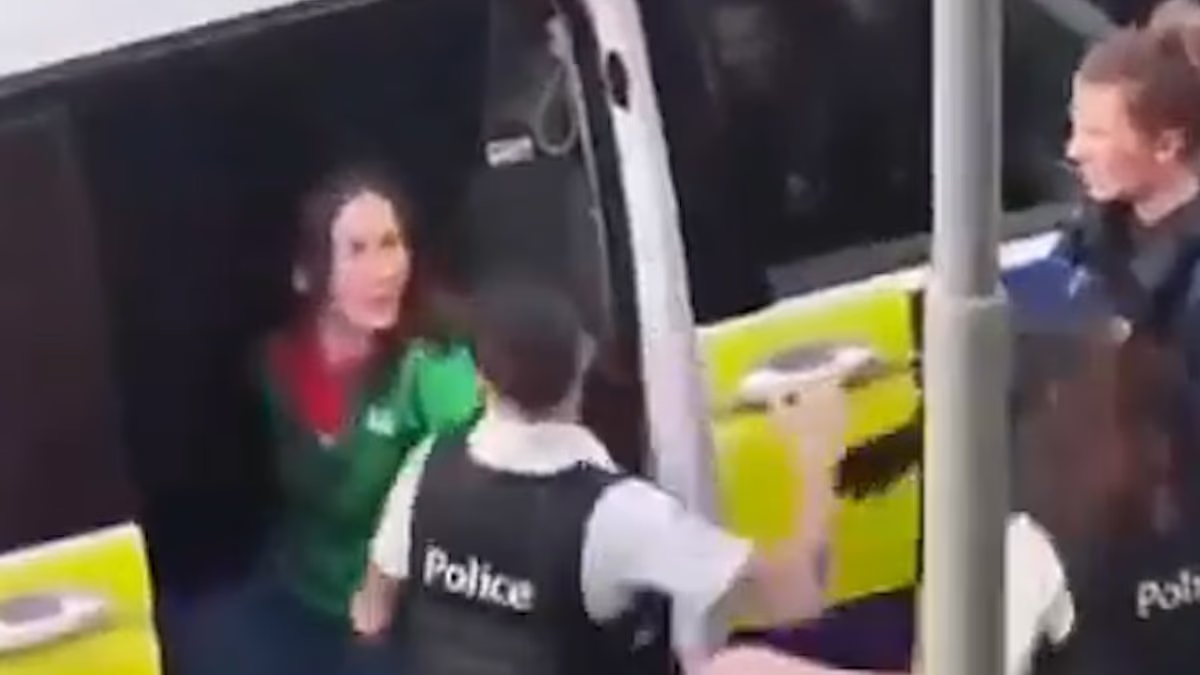
Some estates are so violent that police will only contemplate visiting in full body armour – and in large numbers. Pictured: Police search a man in the Cite des Oliviers neighbourhood, in the northern districts of Marseille, in December last year

Such is the seemingly unchecked power and spreading influence of French crime bosses – some of whom order ‘hits’ from jail by mobile phone – that some politicians fear France risks becoming a narco state like Colombia and Mexico. Pictured: Graffiti listing drug prices in the Cite des Oliviers area of Marseille

Hyperbole, maybe, but with more than 90 drug-related murders in the last three years, 18 of them in one month alone, their concerns are understandable. Pictured: Police during an anti-drugs operation in the Cite des Oliviers neighbourhood of Marseille in December last year

Community workers in the Quartiers Nord talk of a ‘psychose’ – a collective trauma or panic – gripping parts of Marseille, with many believing the only way to halt the violence is through tackling entrenched poverty. Pictured: The Cite des Rosiers residential complex, in the Sainte Marthe neighbourhood, in the northern districts of Marseille

In the past eight years the number of children involved in the drugs trade has quadrupled. Pictured: Police search a man during an anti-drug operation in the Cite des Rosiers residential complex in December last year

For now, Mr Macron (pictured, in December) seems to favour tougher police action. Visiting the city before Christmas, he opened a new police station and announced plans to draft in 300 extra officers and triple fines for drug users
On that occasion the victim was a 15-year-old boy. His death followed that of an 18-year-old who was shot in the back two days earlier near Saint-Charles train station, a short walk from the Old Port. Both murders were drugs related. And so it goes on.
While the police were scooping up bodies, influencers were busy lauding the other side of Marseille, highlighting its infectious energy.
Johnny Depp and Vanessa Paradis’s actress daughter Lily-Rose has spoken of Marseille in a similar vein, praising its ‘very special energy’ and noting how being ‘close to the ocean is so magical’.
None of which is wrong, of course. It is easy to enjoy Marseille’s charms without experiencing the slightest danger.
Indeed, the closest most visitors get to Quartiers Nord, whose tower blocks stretch from the Provence hills down towards the docks and the sea, is sitting in the seat of a high-speed train.
The state has invested heavily in La Busserine, one of the estates blighted by the drugs trade. Sports facilities abound. A renovated community centre now houses a theatre club and a new park fills the space left by demolished towers. Many of the apartments have balconies with views over the Mediterranean.
Yet when The Mail on Sunday visited, we found hooded teenagers lurking listlessly on street corners. They are the ‘choufs’, a French slang word with its origins in Arabic that means ‘look-out’.
All carry walkie talkies and quickly signal to their accomplices if any police or rival gangs are approaching. What becomes quickly apparent is how self-contained the Quartiers Nord estates have become. Some drugs gangs organise activities for children and go shopping for the elderly. And they clamp down on petty crime to limit police attention.
Wary of incursions from rival clans, some gang members operate a kind of customs check, searching cars entering the estates.
One gang, the DZ Mafia, dominates the cocaine trade, having transformed from a Marseille gang to a national criminal organisation. It is led by three men – one of whom is nicknamed La Brute – from behind bars.
Their incarceration, though, has done little to diminish their influence. Still, they are able to bribe or intimidate police and officials.
Eclipsing their nearest rivals, the Yoda organisation, the DZ has expanded its operations and ultra-violent methods to cities across France.
Back in La Busserine, a group of boys on their way to football training squeeze past the choufs selling drugs in an underpass. How their parents must pray they stick to sport and don’t get sucked into the deadly trade.
One incident that stunned France in late 2024 was the murder of a cab driver by a 14-year-old boy. The driver refused to wait for him when he went into a building to seek out his target. So the teen shot him dead.
Another boy in his late teens murdered six people in the space of a month before being caught.
He filmed his first victim’s bloodied body in the back of a car which he set alight. Then he posted the video on social media along with the DZ Mafia signature to acknowledge the gang that had hired him.

While the police were scooping up bodies, influencers and celebrities, like Johnny Depp and Vanessa Paradis’s actress daughter Lily-Rose (pictured at a Chanel fashion show in Marseille in 2024), were busy lauding the other side of Marseille, highlighting its infectious energy

They are not wrong, of course. It is easy to enjoy the charms of Marseille (pictured, file photo) without experiencing the slightest danger

Indeed, the closest most visitors get to Quartiers Nord, whose tower blocks (pictured, one called the Bel Horizon) stretch from the Provence hills down towards the docks and the sea, is sitting in the seat of a high-speed train

When The Mail on Sunday visited, what became quickly apparent was how self-contained the Quartiers Nord estates have become. Pictured: Parc Kaliste, a well-known drug trafficking area in the northern districts of Marseille

Some drugs gangs organise activities for children and go shopping for the elderly. And they clamp down on petty crime to limit police attention. Pictured: Protesters clash with riot police in Marseille in June 2023, after the shooting of a teen driver by officers revived long-running grievances in France over racial profiling

How the parents of boys living in these neighbourhoods must pray they don’t get sucked into the deadly trade. Pictured: Police offices patrol during a major anti-drug operation in the Cite des Oliviers neighbourhood of Marseille in December last year

Inevitably the drugs war in Marseille claims innocent victims, like 20-year-old Mehdi Kessaci, who was killed in a daytime shooting in November. Pictured: Graffiti listing drugs prices on the side of a residential tower block in the northern districts of Marseille
![President Macron (pictured, in December) made a discreet visit in December to pay his respects at the cemetery in Marseille where Mehdi was laid to rest. 'There is no chance that they [the drugs gangs] will win,' he said at the time](https://i.dailymail.co.uk/1s/2026/02/07/19/106191251-15538457-image-a-40_1770493181792.jpg)
President Macron (pictured, in December) made a discreet visit in December to pay his respects at the cemetery in Marseille where Mehdi was laid to rest. ‘There is no chance that they [the drugs gangs] will win,’ he said at the time

But locals told the Mail on Sunday they were not so sure things were going to change. Pictured: Police patrol during a major anti-drug operation in the Cite des Oliviers neighbourhood of Marseille in December last year
Probably the worst of the Quartiers Nord estates is La Castellane where France’s most famous footballer, Zinedine Zidane, was raised by his Algerian parents.
One of its tower blocks at the centre of the drugs trade was demolished in 2020. But business continued unabated, even after President Macron turned up with a TV news crew to launch a nationwide anti-drugs crusade in 2024.
Riot police were a visible presence in the months after his visit but none were around when The Mail on Sunday ventured into La Castellane as night fell last week. The drug dealers and their scouts were everywhere.
Hooded young men drove around on scooters or congregated at corners that serve as ‘fours’ (ovens) – the slang word for dealing points – and supermarket trolleys and mattresses were strewn across an entrance road.
Inevitably the drugs war in Marseille claims innocent victims.
A mile down the hill from La Castellane lies the Saint-Henri cemetery, the final resting place of 20-year-old Mehdi Kessaci. He was killed in a daytime shooting in November.
Two men pulled up on a motorbike and the passenger opened fire as Mehdi sat in his car in a central neighbourhood. Mehdi, a trainee policeman, was not involved in the drug trade.
Rather, he was murdered as a warning to his brother Amine Kessaci, who became a prominent anti-drugs campaigner when another of his brothers was killed in a turf war in 2020. His body was found in the boot of a burnt-out car with a bullet in his head.
Amine, 22, wore a flak jacket as he attended Mehdi’s funeral and was escorted by a unit of the elite Raid police force. He now lives in a secret location under permanent police protection but still continues his campaigns.
President Macron made a discreet visit to the Saint-Henri cemetery in December to pay homage to Mehdi.
‘There is no chance that they [the drugs gangs] will win,’ he said at the time. If only the residents of the Quartiers Nord shared his conviction.
‘I’m not sure things will change much,’ said one elderly man standing outside the new police station where Macron met with local officials.
‘The drug dealing will go on as usual just down the road from here.’
He was right. Minutes after Macron was whisked away in a 20-vehicle convoy, it was business as usual at the nearby Les Oliviers estate. Hooded young men guarded its entrances, walkie talkies crackling in their pockets, occasionally talking briefly to dealers. Trade was brisk.
‘See, what did I tell you?’ said the old man.
Additional reporting by Rory Mulholland