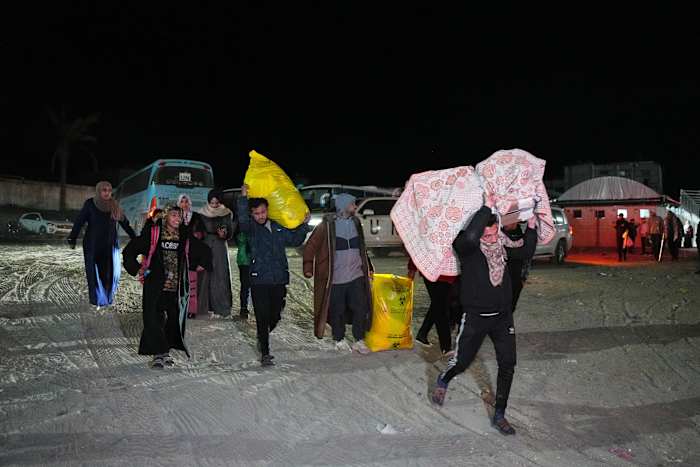

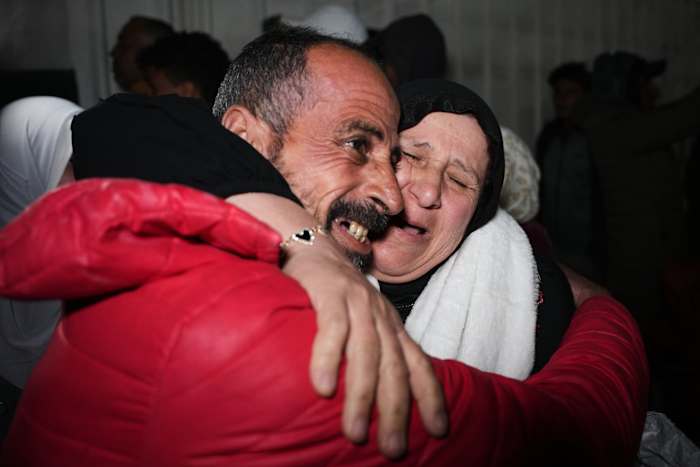
CAIRO – Palestinians gathered at the Gaza-Egypt border crossing on Sunday, eager to cross into Egypt following its reopening last week for the first time since 2024. This development is a key element of the U.S.-backed ceasefire. Meanwhile, Israeli Prime Minister Benjamin Netanyahu is set to visit Washington, where discussions are expected to focus primarily on Iran, according to his office.
The Rafah Crossing saw limited movement last week, allowing a small number of Palestinians to travel in each direction. This reopening followed the retrieval of the last Israeli hostage from Gaza and visits from several American officials who urged for the crossing to be opened. In the initial four days, United Nations data indicates that only 36 Palestinians in need of medical treatment, along with 62 companions, were permitted to exit to Egypt.
Palestinian representatives report that nearly 20,000 individuals in Gaza are seeking to leave for medical services not available in the conflict-ravaged area. Those few who managed to cross have described facing significant delays and accusations of mistreatment by Israeli forces, as well as by other groups involved in the crossing, including the Israeli-backed Palestinian armed group, Abu Shabab.
On Sunday morning, a group of Palestinian patients and injured individuals gathered at a Red Crescent hospital in the southern city of Khan Younis, Gaza. They prepared to head to the Rafah crossing for treatment abroad, as shared by family members with the Associated Press.
Among them was Amjad Abu Jedian, who was injured during the conflict and was supposed to leave Gaza for medical attention on the reopening day of the crossing. However, only five patients were allowed to cross that day, as recounted by his mother, Raja Abu Jedian. She explained that her son was shot by an Israeli sniper in July 2024 while constructing traditional bathrooms in the Bureij refugee camp.
On Saturday, the family received a call from the World Health Organization confirming that Amjad is included in the group scheduled to travel on Sunday, according to his mother.
“We want them to take care of the patients (during their evacuation),” she said. “We want the Israeli military not to burden them.”
The Israeli defense branch that oversees the operation of the crossing did not immediately confirm the opening.
A group of Palestinians also arrived Sunday morning at the Egyptian side of the Rafah crossing border to return to the Gaza Strip, Egypt’s state-run Al-Qahera News satellite television reported.
Palestinians who returned to Gaza in the first few days of the crossing’s operation described hours of delays and invasive searches by Israeli authorities and an Israeli-backed Palestinian armed group, Abu Shabab. A European Union mission and Palestinian officials run the border crossing, and Israel has its screening facility some distance away.
The crossing was reopened on Feb. 2 as part of a fragile ceasefire deal that stopped the war between Israel and Hamas. Amid confusion around the reopening, the Rafah crossing was closed Friday and Saturday.
The Rafah crossing, an essential lifeline for Palestinians in Gaza, was the only crossing not controlled by Israel prior to the war. Israel seized the Palestinian side of Rafah in May 2024, though traffic through the crossing was heavily restricted even before that.
Restrictions negotiated by Israeli, Egyptian, Palestinian and international officials meant that only 50 people would be allowed to return to Gaza each day and 50 medical patients — along with two companions for each — would be allowed to leave, but far fewer people than expected have crossed in both directions.
___
Lidman reported from Tel Aviv, Israel.
Copyright 2026 The Associated Press. All rights reserved. This material may not be published, broadcast, rewritten or redistributed without permission.