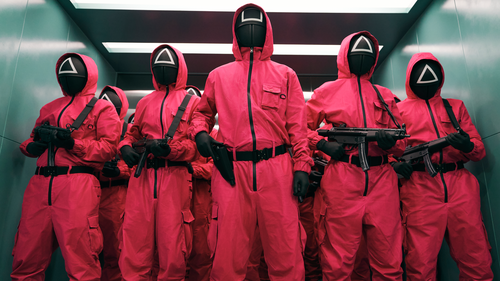

This image released by Netflix shows a scene from the popular Korean series "Squid Game." (Netflix via AP)
Share this @internewscast.com
North Korea is executing people in public for watching South Korean TV shows and listening to K-Pop, according to a leading international human rights organisation.
People who have fled North Korea between 2012 and 2020 have detailed the punishments under the ban on foreign media during a series of in-depth interviews with Amnesty International.

In recent years, South Korean television series, such as Netflix’s acclaimed Squid Game, have captivated audiences worldwide.
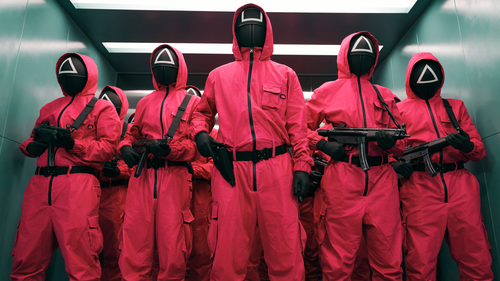
This image released by Netflix shows a scene from the popular Korean series "Squid Game." (Netflix via AP)
This image released by Netflix shows a scene from the popular Korean series Squid Game. (Netflix via AP)

Defectors have painted a picture of a capricious and corrupt system where secretly consuming South Korean TV shows is common, yet punishments for breaching vaguely defined cultural laws heavily depend on one’s wealth and connections.

According to Amnesty International, the 2020 Anti-Reactionary Thought and Culture Act has facilitated the continuation of these harsh penalties.

This legislation brands South Korean media as “rotten ideology that paralyzes the people’s revolutionary spirit.”

FILE - BTS arrives at the 64th Annual Grammy Awards on April 3, 2022, in Las Vegas. The group says they are taking time to focus on solo projects. The seven-member group with hits like Butter and Dynamite talked about their future in a video posted June 14, celebrating the nine year anniversary of their debut release.  (Photo by Jordan Strauss/Invision/AP, File)
BTS is a South Korean boy band formed in 2010. (Jordan Strauss/Invision/AP)

Under the new law, individuals caught watching or possessing South Korean dramas, films, or music face five to 15 years of forced labor.

Severe penalties, including the death sentence, are imposed for distributing large volumes of content or organizing group viewings.

Interviewees described a society in which dramas and films are commonly smuggled in on USB drives from China, which young North Koreans watch on notebook computers with built-in televisions.

However, privilege plays a role in the application of the law.

Interviewees said people commonly watched South Korean TV knowing that they risked extreme punishment, but also that it was possible to escape the worst penalties if you were able to pay.
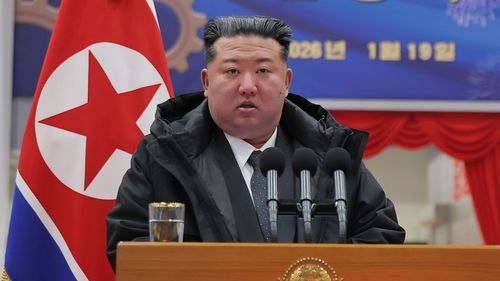
In this photo provided by the North Korean government, North Korean leader Kim Jong Un delivers a speech during a ceremony marking the completion of a first-stage modernization project at the Ryongsong Machine Complex in North Korea Monday, Jan. 19, 2026. Independent journalists were not given access to cover the event depicted in this image distributed by the North Korean government. The content of this image is as provided and cannot be independently verified. (Korean Central News Agency/Korea
North Korean leader Kim Jong Un. (AP)

Kim Joonsik*, 28, said he was caught watching South Korean dramas three times before he left the country in 2019.

However, he avoided punishment because his family had connections to officials.

“Usually when high school students are caught, if their family has money, they just get warnings,” he told Amnesty International.

“I didn’t receive legal punishment because we had connections.”

Amnesty International said North Korea’s government has reportedly deployed a specialised law enforcement unit known as 109 Group to crack down on foreign media consumption for decades.

The organisation said the unit conducts warrantless home and street searches of bags and mobile phones.

Interviewees said workers watch it openly, party officials watch it proudly, security agents watch it secretly and police watch it safely.
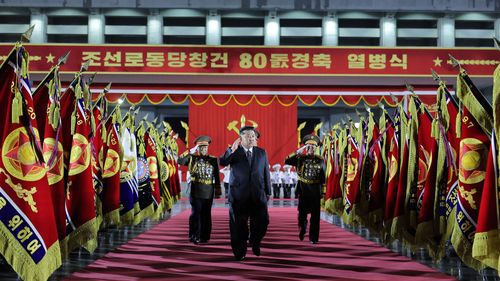
In this photo provided by North Korean government, North Korean leader Kim Jong Un, center, inspects an honor guard during the military parade marking the 80th anniversary of the founding of the ruling Worker's Party, in Pyongyang, North Korea, Friday, Oct. 10, 2025. Independent journalists were not given access to cover the event depicted in this image distributed by the North Korean government. The content of this image is as provided and cannot be independently verified. Korean language water
North Korean leader Kim Jong Un inspects an honor guard during the military parade marking the 80th anniversary of the founding of the ruling Worker’s Party in Pyongyang, North Korea on Friday, October 10 in 2025. (AP)

Interviewees described how North Korea uses public executions to terrorise entire communities into compliance. 

Choi Suvin* witnessed a public execution in Sinuiju in the North Pyongan Province “in 2017 or 2018” of someone accused of distributing foreign media.

“Authorities told everyone to go, and tens of thousands of people from Sinuiju city gathered to watch,” she said. 

“They execute people to brainwash and educate us.”

Some interviewees described schools systematically forcing students to attend public executions as part of “ideological education”. 

In one case, a squad of 10 people fired about 30 rounds at the condemned person. 

Amnesty International was also told in some cases a substance is placed in victims’ mouths to prevent them from speaking before execution. 

“When we were 16, 17, in middle school, they took us to executions and showed us everything,” said Kim Eunju*, 40, who fled in 2019. 

“People were executed for watching or distributing South Korean media.

“It’s ideological education: if you watch, this happens to you too.”

Amnesty International’s deputy regional director Sarah Brooks called on the law to be abolished.

“People who strive to learn more about the world outside North Korea, or seek simple entertainment from overseas, face the harshest of punishments,” Sarah Brooks said.

“This completely arbitrary system, built on fear and corruption, violates fundamental principles of justice and internationally recognised human rights. 

“It must be dismantled so that North Koreans can dare to enjoy the freedoms to which they are entitled.”

*All names are pseudonyms

NEVER MISS A STORY: Get your breaking news and exclusive stories first by following us across all platforms.

Share this @internewscast.com
You May Also Like

Tragic Porepunkah Shooting: Unraveling the Events Leading to Cop-Killer’s Demise

The elusive manhunt for a fugitive, believed to be Freeman, has concluded…

Netanyahu Directs Israeli Forces to Intensify Operations in Southern Lebanon

IN BRIEF Last week, Israel said it would seize southern Lebanon as…

Unmasking the Beneficiaries: How Your Outrage Fuels Profit in the Digital Age

SBS respectfully recognizes the traditional custodians of the lands across Australia. I…
Finder has revealed 12 per cent of Australians felt the regret when faced with a minor health matter such as a dental visit.

One-in-Five Australians Regret This Common Financial Blunder: Survey Insights

One-in-five Australians regret not taking out private health insurance after being stung…
An aerial image of the Walwa property where Dezi Freeman was reportedly located this morning.

Son of Convicted Cop Killer Condemns ‘Disgusting’ Remarks About His Father

A man identifying himself as Dezi’s oldest son, Koah, expressed anger on…

Nationwide ‘No Kings’ Rallies: Thousands Unite Against Trump in Powerful Protest Movement

In Brief The protesters called for action against the bombardment of Iran…
Apple almost went broke – now it's celebrating 50 years

Apple Overcomes Financial Struggles to Celebrate 50 Years of Innovation

Apple’s journey from the brink of collapse to becoming one of the…

Prime Minister Announces Fuel Excise Cuts in New National Energy Strategy

In Brief The fuel excise will be halved for three months. The…
FILE - A KitKat chocolate bar in Rugby, England, on July 25, 2018. (AP Photo/Martin Cleaver, File)

Twelve Tonnes of KitKat Bars Stolen in Major Chocolate Heist

Swiss food giant Nestlé says about 12 tonnes, or 413,793 candy bars,…
Millions of Aussies to suffer further after major bank's fresh rates warning

Major Bank’s New Rate Warning Signals Potential Challenges for Millions of Australians

Interest rates could peak at an 18-year high in a matter of…

Unveiling Iran’s Power Shift: Meet the New Leaders Steering the Nation

The recent US-Israeli strikes have significantly impacted Iran, claiming the lives of…
Marie (left) and Steph Browitt (right) lost two family members in the eruption at White Island in 2019. Steph suffered extensive burns in the tragedy and spent months in hospital

Australian Woman Forms Heartfelt Connection with Heroic Cab Driver After White Island Tragedy, Shares Inspiring Plans to Move to New Zealand

In the aftermath of a catastrophic natural disaster that struck a popular…