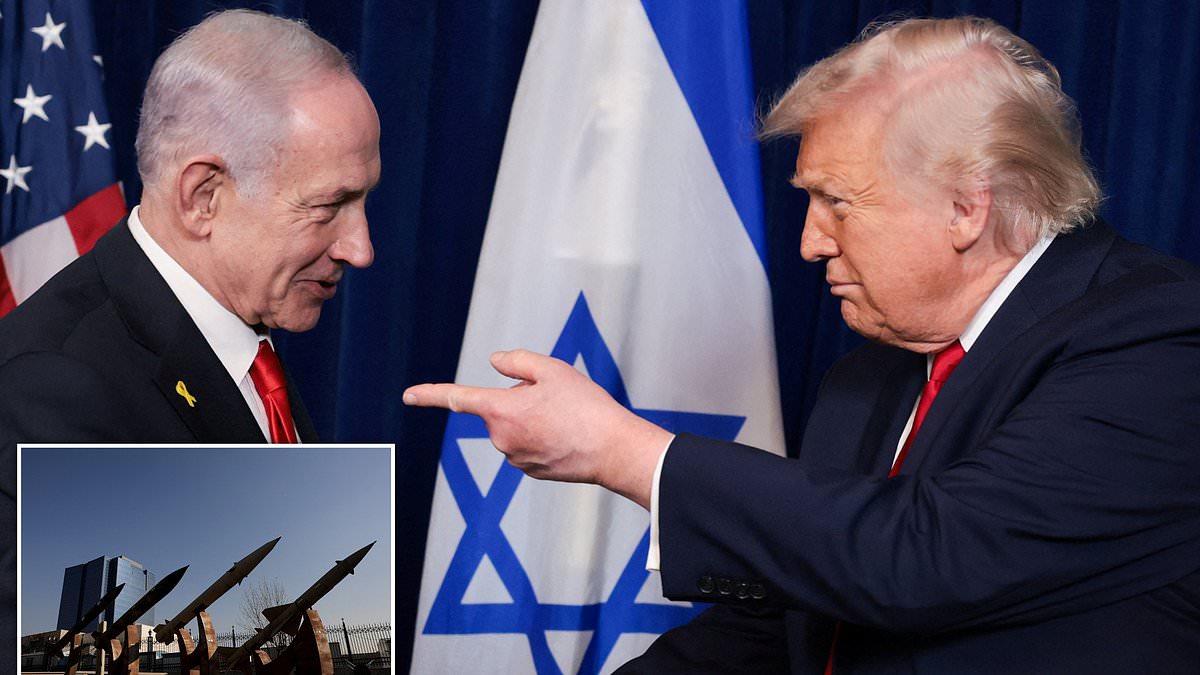

Israel’s Prime Minister, Benjamin Netanyahu, is set to visit Washington for crucial discussions with President Donald Trump, with the primary focus being the missile threat posed by Iran.
Prior to his departure from Israel, Netanyahu highlighted the growing danger of Tehran’s missile stockpile, setting the stage for what promises to be intense talks aimed at tackling the regime’s escalating missile capabilities.
“We’ll discuss Gaza and the region, but Iran will be at the forefront,” Netanyahu shared with an Israeli media outlet. “I intend to present President Trump with key negotiation principles regarding Iran—essential for those seeking peace and stability in the Middle East.”
Netanyahu is expected to detail what he describes as the “restoration” of Iran’s ballistic missile program, an initiative experts in the Middle East view as part of a broader campaign to justify potential military actions against Iran.
Meanwhile, reports indicate a deployment of 112 C-17 aircraft to the Middle East, underscoring the region’s heightened military preparedness.
The C-17 is a robust, adaptable military transport aircraft utilized by the U.S. Air Force and its allies, capable of delivering troops, cargo, and humanitarian assistance worldwide.
A NATO airbase in Germany has also been requisitioned for 24/7 flights as operational ‘tempo’ increases.
Before Netanyahu’s visit was announced, Iranian Foreign Ministry spokesman Esmail Baqaie explained in a news conference in Tehran that the US has should act alone in their decision making for Iran, and not rely on Israel.
‘Israel has proven to be a destructive party and is trying to undermine every channel of negotiation to resolve the crises in the region through diplomatic means,’ he said.
He followed up by saying that Iran is squarely focused on coming to an agreement with the U.S. with the goal of lifting their sanctions.

Israel’s Prime Minister Benjamin Netanyahu is in route to Washington D.C. today –– planning to meet with President Donald Trump tomorrow

High-resolution imagery captured on 22 June 2025 shows clear evidence of entry holes consistent with the use of Massive Ordnance Penetrators (MOPs) targeting Iran’s Fordow nuclear facility

Iranian missiles are displayed in a park in Tehran, Iran, January 31, 2026
Right now, the Trump–Netanyahu meeting is expected to take place Wednesday –– the only agenda item on the Prime Ministers schedule.
US ambassador to Israel Mike Huckabee is reportedly joining Netanyahu’s flight for the second time.
Trump said the US had ‘very good’ talks with Tehran on Friday and that discussions would continue, but noted that the consequences for Iran would be ‘very steep’ if a deal was not reached.
The US had threatened military action against Iran during the peak of the protest movement that swept the nation earlier this year, which saw authorities launch a deadly crackdown to quell dissent.
There was no immediate indication that the two sides discussed the protests during Friday’s Omani–mediated talks.
Iran has branded the protests as riots fueled by its arch–foes Israel and the US, and on Monday, supreme leader Khamenei called on the nation to show ‘resolve’ against foreign pressure.
‘National power is less about missiles and aircraft and more about the will and resolve of the people,’ Khamenei said, adding: ‘Show it again and frustrate the enemy.’

A billboard displaying a map of potential targets in Tel Aviv, Israel, along with a warning message reading, ‘You start, we finish!’ is seen at Palestine Square, Tehran, February 9

Families gather at the Kahrizak Coroner’s Office confronting rows of body bags as they search for relatives killed during the regime’s violent crackdown on nationwide protests
At the talks in Oman, the US and Iran had agreed to discuss Tehran’s nuclear program, though Washington and Israel also want to put the Islamic republic’s ballistic missiles and its support for regional militant groups on the agenda.
Iran insists its nuclear program is for civilian purposes but Western powers and Israel believe it is seeking a nuclear weapon.
On Sunday, Foreign Minister Abbas Araghchi said Iran could envision ‘a series of confidence–building measures concerning the nuclear program’ in exchange for the United States lifting sanctions on the country.
But Araghchi insisted on Iran’s right to continue enriching uranium.
Meanwhile, the secretary of Iran’s top security body, Ali Larijani, said he will visit Oman on Tuesday for meetings with Omani authorities.
With the US giving no indication that the protest crackdown is still a potential issue in the negotiations, Iranian authorities appear to be tightening their grip.