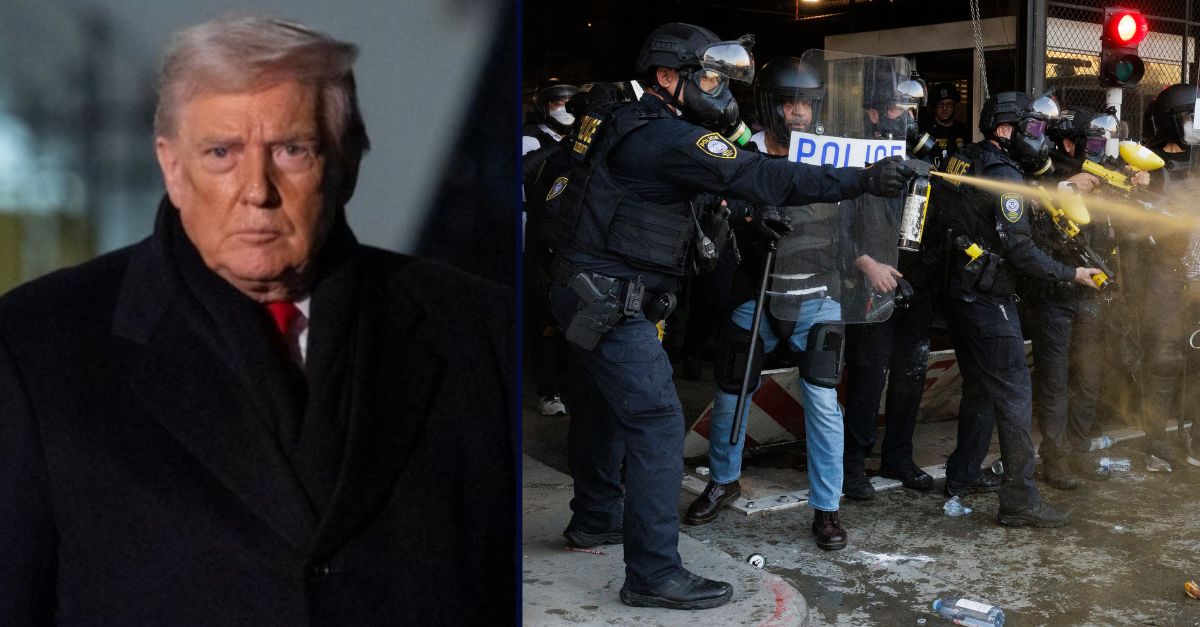

Left: President Donald Trump speaks with reporters before departing on Marine One from the South Lawn of the White House, Tuesday, Jan. 20, 2026, in Washington (AP Photo/Alex Brandon). Right: Department of Homeland Security officers use pepper spray as they clash with protesters outside the Metropolitan Detention Center in Los Angeles, Calif., on Jan. 30, 2026. This protest was a part of a national demonstration in opposition to ICE activities across the country (Caylo Seals/Sipa USA).
A federal judge recently granted California the right to oversee Immigration and Customs Enforcement (ICE) agents, delivering a nuanced decision that offers both victories and setbacks to the Trump administration and California officials alike.
The legal tussle stems from a challenge by the U.S. Department of Justice against two California statutes enacted last year, which were signed into law by Governor Gavin Newsom. The first, known as the “No Secret Police Act,” prohibits federal and local law enforcement agents from concealing their identities with masks. The second, the “No Vigilantes Act,” mandates that law enforcement officers, whether local, state, or federal, must display their name and badge number while on duty.
California introduced these laws in reaction to public outrage over the behavior of ICE agents and other immigration enforcement personnel, which intensified under the Trump administration’s aggressive deportation policies. This period also saw the deployment of National Guard troops to suppress protests against such measures.
In a recent decision, U.S. District Judge Christina A. Snyder, who was appointed by Bill Clinton, issued a 30-page ruling on a motion for a preliminary injunction. The judge struck down the key provisions of the “No Secret Police Act” but allowed the “No Vigilantes Act” to stand.
The court’s decision hinges significantly on the issue of discrimination against federal agents, albeit indirectly. Judge Snyder noted that although the act was a direct response to recent federal law enforcement practices, its language broadly addresses the issues caused by law enforcement officers using facial coverings during enforcement activities. The opinion highlights that the Act does not specifically target federal functions but rather applies generally to all law enforcement officers within California. However, it differentiates between federal officers and their state counterparts, which was a central concern in the ruling.
“While the Act may be a direct response to recent federal law enforcement practices, the Act’s text plainly addresses the harms caused by the use of facial coverings by ‘law enforcement’ generally during enforcement activities,” the opinion reads. “The Act, therefore, does not directly regulate federal functions or target federal practices but rather generally applies to law enforcement officers in California. However, the Act treats federal law enforcement officers differently than similarly situated state law enforcement officers.”
At heart, Snyder found, the problem is the explicit discrimination in favor of state law enforcement officials — at the expense of both federal and local law enforcement. So, the judge hints that this is a problem with how the law is “presently enacted.” Snyder goes on to suggest the state could simply universalize the prohibition to include state law enforcement officials “such as California Highway Patrol officers.”
Snyder, however, repeatedly emphasizes that the basic thrust of each law is on fairly solid ground despite her ruling.
“Although the challenged provisions dictate how a federal officer may carry out his law enforcement duties—prohibiting a facial covering and requiring the display of visible identification that includes their agency and either a name or badge number in non-exempted circumstances—the Court finds them analogous to traffic laws that, in a similar sense, dictate how a federal officer may operate a vehicle on state roads but are nonetheless enforceable against federal officers, subject to immunities,” the judge writes.
Notably, the DOJ did not challenge the name and badge number requirement as discriminatory. Snyder suspects this is because the law applies to state, local, and federal law enforcement equally.
“The Court finds that these Acts serve the public interest by promoting transparency which is essential for accountability and public trust,” the opinion goes on. “Moreover, the Court finds no cognizable justification for law enforcement officers to conceal their identities during their performance of routine, non-exempted law enforcement functions and interactions with the general public.”
After the court’s ruling, California legislators quickly signaled their intent to reconfigure the mask law to include state officials.
Snyder, in a lengthy section of the order, makes clear that the Trump administration’s broader concerns about the law’s impact on law enforcement are not likely to hold the day.
“The United States has not shown that its current practices with respect to masking and identification are essential to federal law enforcement operations such that state regulations in those areas seek to interfere with or control federal law enforcement functions,” the order continues. “A rule that prohibits law enforcement officers from wearing masks or requires them to have visible identification does not facilitate or enable criminals to harm law enforcement officers.”
The judge rejects a more specific argument, at length:
[T]he Court is not persuaded by the United States’ arguments that enforcement of the challenged provisions against federal officers would interfere with federal duties by facilitating evasion of arrest. The United States argues that federal law enforcement officers have encountered situations where people blow whistles to alert those nearby of the presence of enforcement operations, and that there are websites dedicated to tracking federal immigration officers. [B]lowing whistles, recording officers, posting those recordings online, or otherwise communicating about the public presence of a law enforcement officer is generally protected by the First Amendment.
Snyder also rubbishes the notion that masking “is necessary for federal law enforcement” because, at present, the masks worn by ICE — and other immigration agents — are not mandatory or required, but, rather, simply personal wardrobe choices.
“If masking or concealing identification were as critical to federal operations as the United States asserts, the Court would expect that federal agencies would not leave such decisions to the discretion of individual officers,” the order goes on.
The court stayed its ruling until Feb. 19, which will give the DOJ a chance to file several appeals before the law takes effect.