

BORMIO, Italy — Franjo von Allmen shrugged and gestured with his gloves, hinting that he doubted his run would secure a gold medal. He even playfully stuck out his tongue, perhaps suggesting he wasn’t confident about winning any medal at all.
Nevertheless, it was more than enough. It was a run that made history.
The 24-year-old Swiss skier clinched victory in the men’s super-G on Wednesday, marking his third Olympic gold at the Milan Cortina Games.
With this win, von Allmen entered an elite club of ski racers, becoming only the third male skier to win three events in a single Winter Olympics. He joins the ranks of iconic figures such as France’s Jean-Claude Killy, who triumphed in three events at the 1968 Grenoble Games, and Austria’s Anton “Toni” Sailer, who achieved the same feat at the 1956 Winter Games in Cortina d’Ampezzo, Italy.
“It might sound strange, but the records don’t really matter to me right now,” von Allmen remarked on matching these historic achievements. “I’m focused on enjoying the Olympics at the moment. Maybe these accomplishments will hold more significance for me in a few years, but right now, they don’t.”
Racing as the seventh competitor, von Allmen discovered a swift path on a snow surface that was softening under the warming sun, clocking in at 1 minute, 25.32 seconds. He narrowly edged out American Ryan Cochran-Siegle by 0.13 seconds, while his Swiss teammate, Marco Odermatt, secured the bronze medal.
“I maybe had a little bit of luck with the bib (number) and the snow,” said von Allmen, who became the first men’s racer from ski-crazed Switzerland to win the Olympic super-G.
Regardless of conditions, he’s racing at a different level in Bormio. He won the downhill on Saturday and paired with Tanguy Nef to win the inaugural team combined event Monday.
“When you’re on, you’re on,” Cochran-Siegle said. “He did an awesome job.”
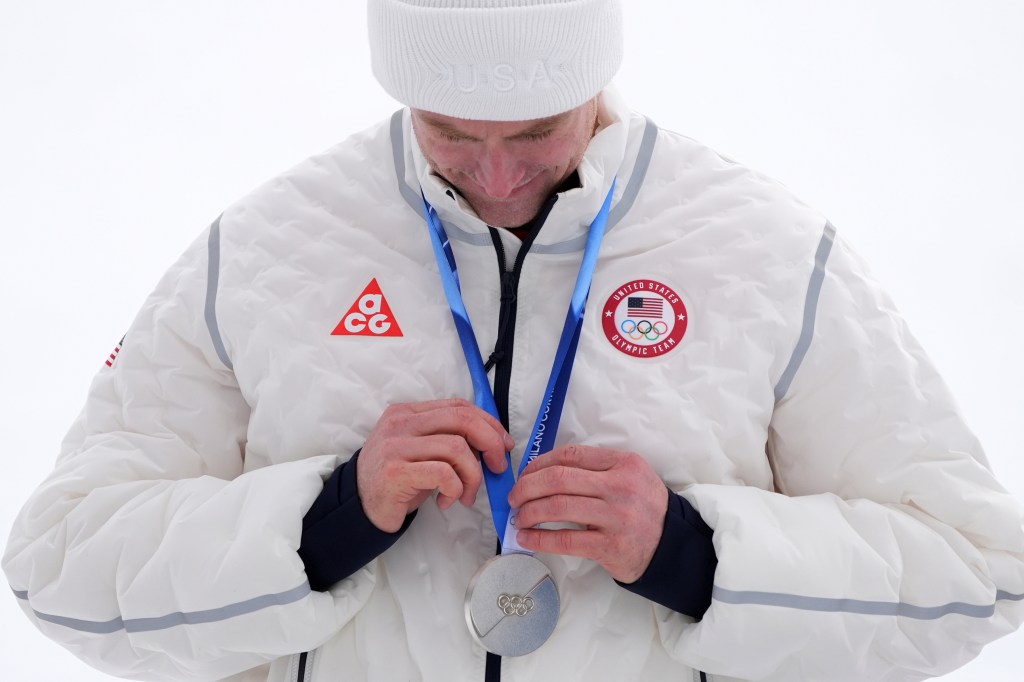
It’s another Olympic medal for the 33-year-old Cochran-Siegle, who also earned silver in the super-G at the 2022 Beijing Games. It’s also another medal for his family as his mom, Barbara, captured gold in the slalom at the 1972 Sapporo Games. She happened to be in the crowd on Wednesday, too.
“Must be something in the water back home in Vermont,” Cochran-Siegle cracked. “It’s crazy that we’re sitting here with another successful Olympics.”
Cochran-Siegle overcame a stomach bug on his way to silver, one that hit him hard before the downhill race when he finished 18th. He said he threw up in the gondola and again two hours before Saturday’s start.
He felt back to health for the super-G.
“Today was about really trying to trust my skiing,” Cochran-Siegle said. “It’s nice to put down a run top-to-bottom where I felt like I was really pushing in the right way.”
Odermatt, a four-time overall World Cup champion, added bronze to his silver in the team event. He was fourth in the downhill over the weekend.
After finishing as the 10th racer on the super-G course, Odermatt bent down and began shaking his head. He wasn’t confident his time would hold up. Little did he realize the snow conditions would make it tough for anyone to take his bronze.
“The slope got slower and slower, so the guys behind didn’t really have the chance to ski much faster,” Odermatt said. “So that was on my side.”
The Italian duo of Giovanni Franzoni and Dominik Paris — the silver and bronze downhill medalists — couldn’t knock Odermatt off the podium. Franzoni took sixth while Paris was a “did not finish” after equipment issues. He was in the middle of a fast run when his right ski popped off its binding. He fell to the snow and slid to a stop before hiking back up to retrieve his ski.
“It’s a bit heavy for me to accept that, but what do you do?” Paris said.
Odermatt is the reigning Olympic champion in the next event on the men’s program, the giant slalom. Any chance von Allmen lobbies to compete in the GS, to go for a fourth Olympic gold in Bormio?
“No,” said von Allmen, who has only raced one World Cup GS race and didn’t finish. “I will let the guys do (the GS) which can ski in GS.”