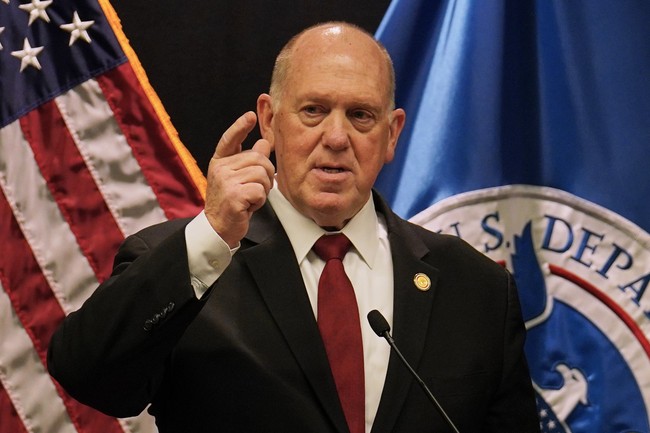

President Donald Trump’s Border Czar, Tom Homan, has emphatically stated that the recent decrease in ICE operations in Minneapolis, Minnesota is far from a permanent withdrawal. He emphasized that federal agents could be redeployed on a large scale if the situation demands it.
While ICE operations in Minneapolis are scaling back from their intensified state, this does not signal a halt in enforcement activities.
During a television interview on Thursday evening, Homan clarified the situation, countering claims that federal authorities were pulling back and dispelling the notion that this shift marked a triumph for Minnesota’s anti-ICE Resistance movement:
In the interview, Homan remarked:
“This is not a withdrawal. Hundreds of agents remain actively engaged in tackling fraud and other criminal investigations. Ongoing cases continue unabated, with personnel still firmly stationed on the ground.”
The change reflects the conclusion of the surge strategy, which involved a temporary increase in manpower to bolster cooperation and expedite enforcement efforts.
— Rapid Response 47 (@RapidResponse47) February 13, 2026
From the interview:
“Even though we’re drawing down resources, we still want to have hundreds of special agents here drawn down on the fraud here from the Somali community and others. During those fraud investigations, until they’re done, we’re going to hold people responsible.”
That is not a withdrawal. Hundreds of agents remain focused on fraud and related criminal investigations. Ongoing cases are continuing. Personnel are still on the ground.
What is ending is the surge configuration, the intensified manpower spike designed to force cooperation and accelerate enforcement.
‘We Are Not Surrendering the President’s Mission on Immigration Enforcement’: Homan Lays It on the Line
Independent journalist Julio Rosas reported that the Minneapolis effort brought a heavier federal footprint to the area, with a clear purpose: to get local officials to cooperate on criminal enforcement cases and ongoing fraud probes. The added manpower was a tool, not a long-term deployment.
As Rosas noted, once Minnesota authorities began working more closely with federal investigators and key investigative goals were achieved, there was no longer a need to maintain surge-level staffing.
The surge was structured to force compliance on specific criminal enforcement priorities and accelerate ongoing fraud investigations. Once cooperation was secured and operational goals were met, federal authorities transitioned away from surge-level staffing while maintaining investigative personnel.
That transition is what is happening now.
But the larger message from Homan was not about the past. It was about the future.
“This is like any other surge operation. Los Angeles, it ended. Charlotte, it ended. New Orleans, it ended. This is ending the surge, but we’re not going away.”
Surges end. Enforcement authority does not.
ICE maintains personnel in Minneapolis. The Department of Homeland Security retains full authority to increase its footprint again if conditions warrant. The federal government has not relinquished control.
Homan drove that point home with a line that sounded less like commentary and more like a warning.
“Over 800 flights a day land in St. Paul, Minnesota. If we need to come back, we’ll come back.”
That is the deterrent message.
Minneapolis is not off the radar. Minnesota is not insulated from federal enforcement. The surge phase has concluded, but the federal presence remains, and the capacity to scale back up is intact.
The manpower spike may have ended.
But the signal from Washington is clear: if cooperation falters, ICE will be back.
Editor’s Note: Democrat politicians and their radical supporters will do everything they can to interfere with and threaten ICE agents enforcing our immigration laws.
Help us hold these leftists accountable and expose their obstruction. Join RedState and use promo code FIGHT to get 60% off your membership.


