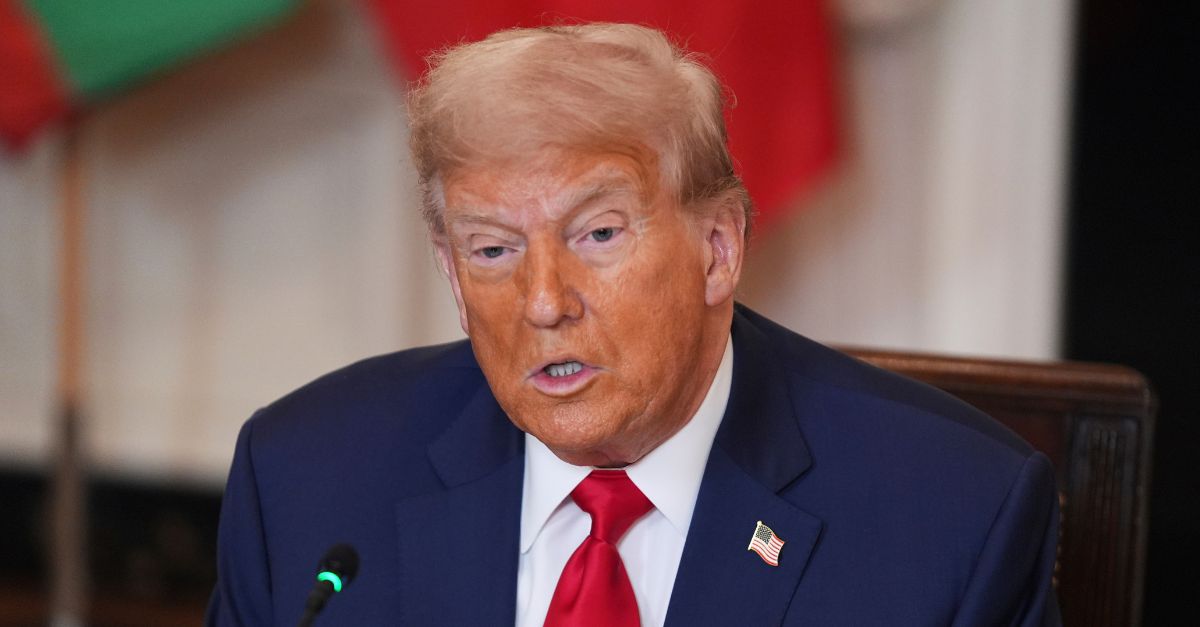

President Donald Trump speaks during a lunch with African leaders in the State Dining Room of the White House, Wednesday, July 9, 2025, in Washington (AP Photo/Evan Vucci).
A legal complaint filed in federal court this week accuses the Trump administration of unlawfully excluding four states—California, Colorado, Illinois, and Minnesota—from accessing approximately $600 million in grants provided by the Centers for Disease Control and Prevention (CDC).
The lawsuit claims that the decision to withhold these funds was officially made at the start of the month, although President Donald Trump and the Office of Management and Budget (OMB) had previously suggested such actions in public statements earlier in the year. This move is seen as a novel and timely threat, aligning with broader attempts to defund states that have policies the administration opposes, according to the lawsuit.
On February 9, the Department of Health and Human Services (HHS) informed Congress of its plans to terminate numerous CDC grants, as detailed in the 26-page legal document.
The lawsuit argues that this directive to reduce funding is driven by political bias, calling the action unlawful. It contends that such a decision breaches the Administrative Procedure Act’s requirement for rational decision-making and surpasses the agencies’ legal authority. Furthermore, it challenges the action on constitutional grounds, citing violations of the Tenth Amendment, the Separation of Powers doctrine, and the Spending Clause.
Central to the lawsuit’s argument is the claim that disputes over unrelated issues such as federal immigration laws, political demonstrations, and clean energy policies are fueling these funding cuts. The executive branch is accused of overstepping its bounds by trying to manipulate federal funds to penalize these states, effectively bypassing Congress’s authority, as per the lawsuit.
The plaintiffs argue this is a continuation of a pattern, noting that conflicts over federal funding for so-called “sanctuary” jurisdictions have been ongoing since the second Trump administration began.
“The Targeting Directive is part of a long-running pattern of defendants’ targeting disfavored jurisdictions for funding terminations and other retaliatory actions,” the filing reads. “The Targeting Directive forms a part of the same campaign to punish Plaintiff States because of political animus.”
The federal government’s desire to punish the plaintiff states has only increased in recent months as they have “successfully challenged” what the states term “aggressive federal immigration operations” and National Guard deployments in federal court, according to the lawsuit.
And, the plaintiffs add, more proposed cuts are in the offing.
From the filing, at length:
Indeed, upon information and belief, the CDC grant terminations announced thus far are merely the first shot fired under the Targeting Directive, with further retaliatory actions to follow. As an OMB spokesperson told the New York Post, “more cancellations” due to the Targeting Directive “are expected.” Indeed, as this complaint was being drafted, Plaintiff States learned that HHS today notified Congress of its intent to cut 42 more grants in the four Plaintiff States[.]
The proposed cuts would have a disastrous effect on public health, the plaintiffs say, particularly in the realm of infectious diseases.
“The result will be preventable deaths, injuries, and needless suffering due to HIV and other disease outbreaks the States can no longer track, lead exposure that the States can no longer mitigate, public health emergencies to which the States are less prepared and equipped to respond, and other core public health dangers that any developed public health system should easily quell,” the filing goes on.
In a press release, California Attorney General Rob Bonta excoriated the Trump administration in detailed terms about the cuts.
“The largest grant program targeted for termination is the Public Health Infrastructure Block Grant (PHIG),” the AG said. “California and its local public health departments, including the Counties of Santa Clara and Los Angeles, use PHIG funds to strengthen their workforce and ensure that the workforce can perform core functions necessary to protect public health, including disease surveillance and infectious disease control, emergency preparedness and response, laboratory and pharmacy capacity, food security, and support for communities to respond to health risks and emergencies.”
The lawsuit was filed on Tuesday. On Wednesday, the plaintiffs filed a motion for a temporary restraining order to stop the proposed cuts from going into effect. On Thursday, U.S. District Judge Manish S. Shah issued a series of findings in the plaintiffs’ favor.
“The allegations of the complaint that identify a political or policy objective behind the decision to identify grants awarded to plaintiffs (and not similar grants awarded other states) suffices to establish that the defendants are using funding to execute a policy objective unrelated to the public-health grants,” the order reads. “This is likely unlawful.”
The judge’s relatively terse and largely conclusory explanatory order and temporary restraining order (TRO) bar implementation of the cuts and are set to expire 14 days from the date of issuance. In the orders, the judge stresses that the record in the case is particularly threadbare but errs on the side of caution for now.
“More factual development is necessary and it may be that the only government action at issue is termination of grants for which I have no jurisdiction to review,” Shah writes. “But as discussed, plaintiffs have made a sufficient showing that defendants issued internal guidance to terminate public-health grants for unlawful reasons; that guidance is enjoined as the parties develop a record.”