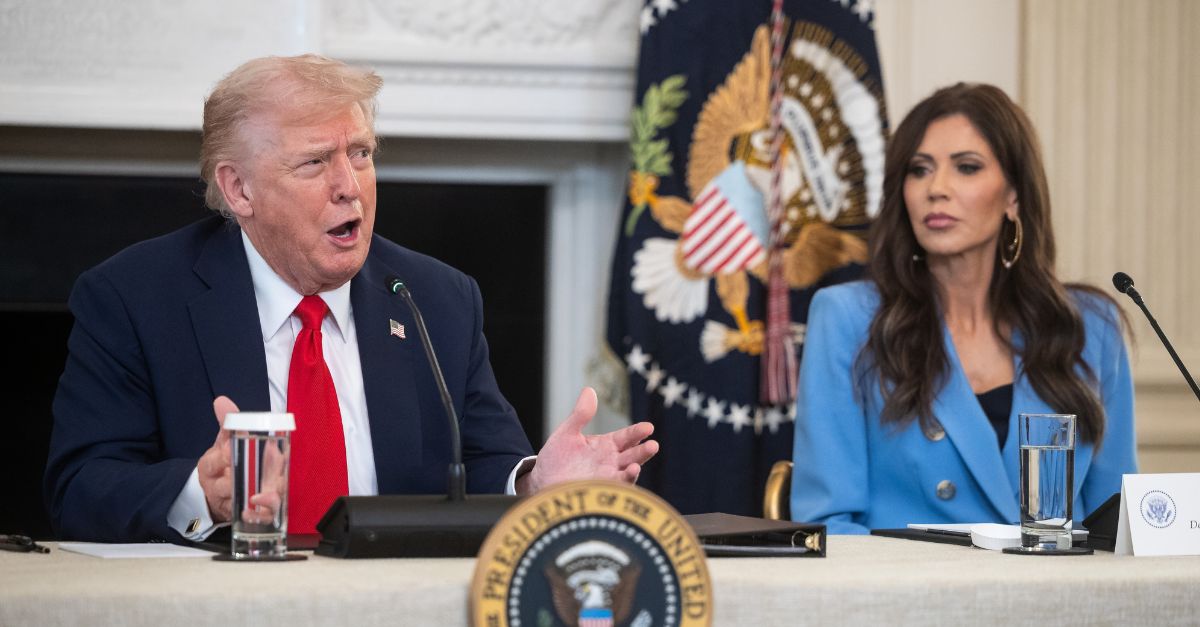

President Donald Trump speaks alongside Homeland Security Secretary Kristi Noem during a roundtable about antifa in the State Dining Room at the White House Oct. 8, 2025 (Francis Chung/POLITICO via AP Images).
A federal judge has sharply criticized the Trump administration for its handling of immigrants detained under “unconstitutional” conditions in a Minnesota facility.
In a comprehensive 41-page ruling, U.S. District Judge Nancy E. Brasel, appointed by former President Donald Trump, delivers a blunt assessment of the violations.
“Immigration and Customs Enforcement (ICE) acknowledges that noncitizen detainees have a constitutional right to legal counsel,” the order states. “Yet, in recent weeks, ICE has isolated thousands at the Bishop Henry Whipple Federal Building, restricting access to their attorneys.”
The lawsuit, initiated by The Advocates for Human Rights, a Minneapolis nonprofit, was filed in late January. The complaint highlights numerous violations, including breaches of the First and Fifth Amendments, the Immigration and Nationality Act (INA), and the Administrative Procedure Act (APA).
In granting a temporary restraining order, the court finds the evidence overwhelmingly supports the detainees’ claims against the government in Minnesota.
“Defendants provide scant declarations claiming, without concrete evidence, that ICE facilitates phone access to legal counsel for detainees,” the order continues. “Conversely, Plaintiffs offer detailed declarations proving the contrary. The disparity in evidence is too significant for the Defendants to refute.”
Brasel says the record shows ICE’s “policies and practices prevent” the plaintiffs’ attorneys from “effectively representing their clients” by prohibiting them “from visiting or speaking confidentially with clients.”
The state of affairs, the judge notes, has become dire since increased immigration enforcement activity began in December 2025.
“Plaintiffs’ evidence suggests that since Operation Metro Surge began, Defendants’ policies and practices at Whipple all but extinguish a detainee’s access to counsel,” the judge opines.
The court goes on to cite several specific examples of problems identified by the plaintiffs regarding detainees’ access to counsel.
First, immigrants are often quickly shipped out of state.
“Detainees are moved frequently, quickly, without notice, and often with no way for attorneys to know where or how long they will be at a given facility,” the order explains. “Once a person has been transferred out of Minnesota, ‘representation becomes substantially more difficult’—attorneys must secure local counsel to sponsor a pro hac vice application and navigate additional barriers. And, even when an attorney is eventually able to contact a client who has been transferred outside Minnesota, Plaintiffs allege there are still grave restrictions on the client’s access to counsel.”
Brasel notes that ICE’s own internal detainee locator system does not actually work as it is supposed to most of the time because the government does not “accurately or timely input information,” which prevents “attorneys from locating and speaking with their clients.”
“Often, Defendants do not update the locator until after detainees are out of state,” the judge notes. “Attorneys frequently learn of their client’s location for the first time when the government responds to a habeas petition.”
Other forms of access are similarly unavailing, the judge says.
When detainees are allowed phone calls, they are allowed one phone call only, the judge notes. But the court says this arrangement frequently precludes speaking with counsel because many people “do not know the name, much less the number, of their attorney” if they even have one at the time they are detained. And, when detainees are allowed to access the phones, more problems arise.
“The phones are located in open, non-private areas where ICE personnel and other detainees can overhear the conversation,” the order goes on. “But the phones are not easy to operate. And incoming calls from attorneys are met with a busy signal or never-ending ringing.”
The judge describes how emails fare no better, at length:
ICE does not monitor emails from attorneys, even if the attorney’s email attaches a release order. When an attorney told an agent that she sent a copy of a release order to the specified email address, the agent laughed and said “something to the effect of ‘yeah we really need to get someone to check that email.’”
The court says in-person visits are strictly off-limits.
“When attorneys are permitted to enter Whipple, Defendants refuse to let them see their clients,” the order continues. “Defendants tell attorneys that they do not allow any attorney visitation because if they gave one person an attorney visit, they would have to give everyone an attorney visit.”
In the order, the judge finds more than enough evidence the plaintiffs are likely to succeed on their Fifth Amendment claim — and, under the auspices of the request for temporary relief, did not find it necessary to consider the other constitutional and statutory claims at present.
“It appears that in planning for Operation Metro Surge, the government failed to plan for the constitutional rights of its civil detainees,” Brasel muses. “The government suggests—with minimal explanation and even less evidence—that doing so would result in ‘chaos.’ The Constitution does not permit the government to arrest thousands of individuals and then disregard their constitutional rights because it would be too challenging to honor those rights.”
Still, the court hints at its position on the First Amendment claim in a footnote: “Defendants cannot pick and choose which of the nation’s laws to follow; it must follow all of the nation’s immigration laws, including constitutional protections provided to citizens and noncitizens alike.”
The order offers a wide suite of protections to current and would-be immigration detainees in Minnesota, including all but immediate access to attorneys, and mandatory disclosure of transfers. The TRO will be in effect until 5 p.m. on Feb. 26; a hearing is slated for that same day.